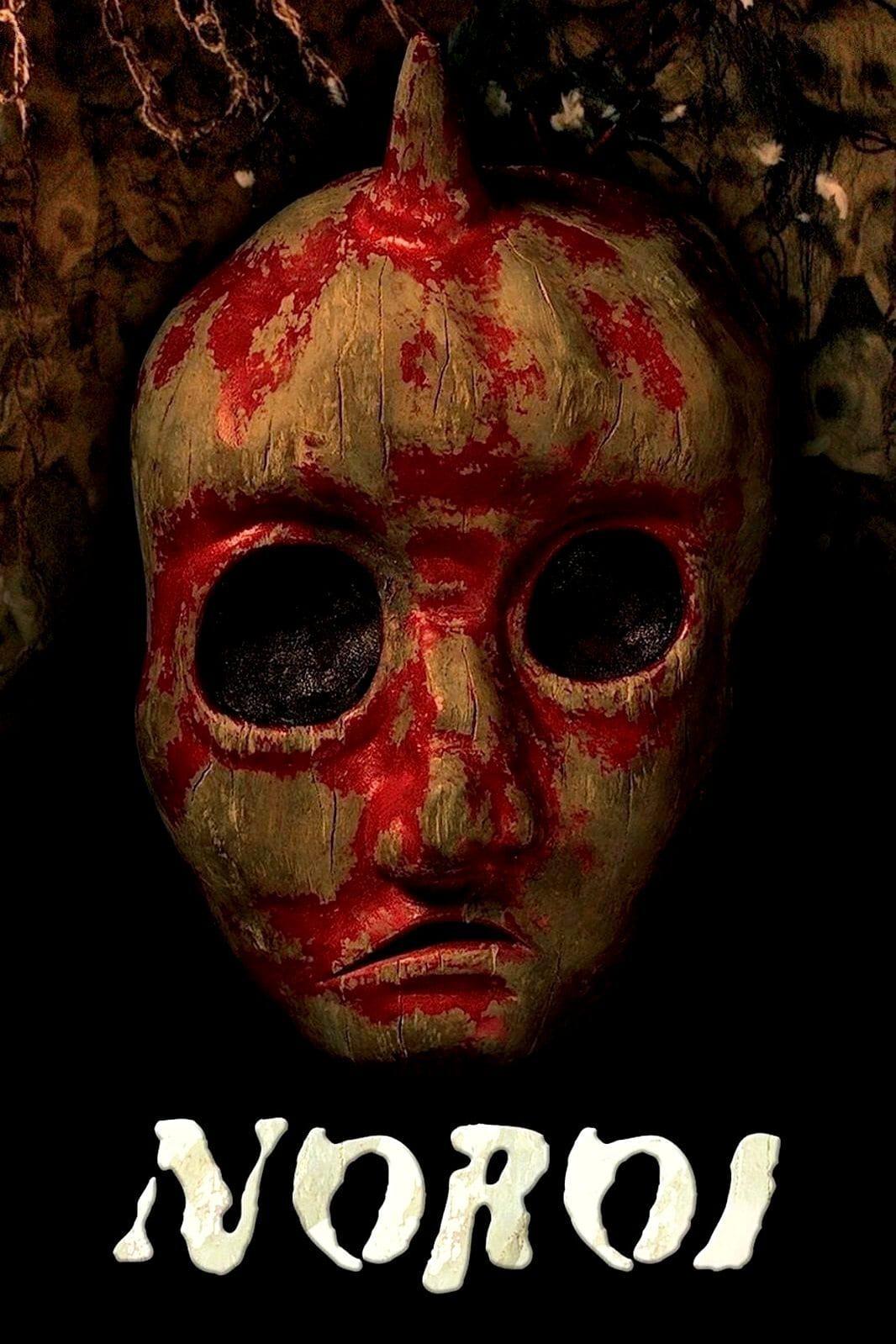
Review of Noroi: The Curse
By: Jenna Sparks

Horror films, for me, are one life's greatest pleasures. While there are many studies correlating our relationship to fictional horror genres, it's pretty clear cut: it's the matter of the fear being permitted in a safe environment. There's also a chance I've managed to de-sensitize myself regarding horror films. Long gone are the days where I'd find myself clutching my chest after a rather loud, startling jump-scare. While there are many crucial subgenres to the genre itself, taking part in viewing a horror flick feels like a gamble anymore. Today, we see many cerebral horror movies make it to major releases alongside slasher or otherwise mainstream horror films. Personally, I think it's easy to disturb an audience. It's even easy to gross out an audience. But to legitimately scare? Gimmicks, while fun, can only take you so far.
The more horror I've consumed, the more I've been able to pinpoint what I enjoy and what stands a chance of lingering in my mind to make me shiver; and somehow, I always fall back to the one film that introduced me the art of horror: The Blair Witch Project. While it certainly wasn't the first of its kind, the publicity surrounding it as well as the lore and the mystery that comes along with a found-footage style film make it a prime candidate for being something that eats away at its viewer in all the right ways. It's the steady, slow-burn of the pacing. The unseen threat. The subtleties of every waking moment we watch this film crew beginning to end. Much like falling in love, we all desire to rekindle those fledgling feelings the first time we ever felt them. I yearn to feel the same way I felt the first time I saw The Blair Witch Project when I was nine. Dangit, YEARN!
Enter Noroi: The Curse. Released sixteen years ago in the ancient ages of Von Dutch trucker caps, jeans with such low rise they could send a postcard to your bellybutton, and side-swept, chunky highlighted bangs; the year was 2005. Noroi has maintained its niche popularity and with good reason. The plot is relatively simple: a paranormal journalist/documentarian begins exploring specific occurrences that lead us through a maze of slow comprehension and understanding. Typical paranormal horror. But for reasons I hope to explore in this review, it's anything but.
Upon the start of the film, we realize trouble has brewed during the course of production. We see the filmmaker is missing, his house having been set aflame in the aftermath, and his wife's body found in the charred remains. What we embark on are the bits of film pieced together that Masafumi Kobayashi (portrayed by Jin Muraki) and his cameraman had filmed in the past year and a half.
Kobayashi begins his investigation by reaching out to the neighbor of woman who's accrued her fair share of complaints. Things like messes in her yard as well as the absolutely unsuspicious sound of babies crying even though the woman only lives with her adolescent son. When Kobayashi seeks to interview the woman, named Junko Ishii, she ferociously denies him the pleasure, screaming at him and demanding how he feels he has any right to address her.
Eventually, Junko movies away and the neighbor who'd helped Kobayashi with his research regarding her dies in a car accident alongside her small daughter some days later. Junko's house, now abandoned, is still surrounded by trash and, alarmingly, a slew of dead pigeons.
We shift gears and turn our attention to a young girl called Kana who is revealed to have psychic abilities as disclosed in a television expose regarding children tapping into their clairvoyant potential. Kobayashi interviews the girl and her family, learning that Kana has a broad vocabulary of existential one-liners that leave everyone flabbergasted. After suffering from a fever and feeling ill, Kana disappears. It's then Kobayashi learns a man called Hori has been visiting Kana prior to her disappearance.
Woven into the story so far is also the introduction of actress Marika Matsmato (a real actress playing a fictionalized version of herself), who also has a knack for being in touch with her psychic side. For her own TV program, Marika films a segment wherein she and two other hosts explore an ancient shrine with a history of being haunted. Initially, Marika comments she feels tingly and is clearly unnerved. Later, in an interview, Marika and Hori meet face-to-face, only for Hori to attack her on stage. Kobayashi, clueing into an interesting parallel proceeds to investigate both the footage of Marika at the shrine and Hori. During his inquiry of the footage, Kobayashi learns that Marika had heard a voice. An audio engineer presents both the raw and amplified audio for Kobayashi, who then can make out the word "Kagubata".
As his investigation progresses, Kobayashi meets with Hori, the man who'd visited Kana and attacked Marika. The man is eccentric, to say the least, living in a house with walls adorned with both aluminum foil and messages in red ink. He is also dressed head-to-toe in a flattering coat made of duct tape and foil and a matching bucket hat. Hori, in a sort of psychosis upon being interviewed, discloses that he can hear Kana, suggesting she's been taken by the "ectoplasmic worms", and is able to draw up a rough vision of the place in which Kana is being held. Kobayashi seeks out the building, and after some time, actually finds it. It's there he and his cameraman discover a mysterious man with his own army of pigeons and a mild reputation with his neighbors.
If this is all getting confusing, just sit tight.
Up to this point, we're beginning to see how everything is intertwining. Kobayashi then connects with Marika, who is open to expressing the peculiar instances she's been experiencing. In particular, waking up to discover a spool of yarn tied in intricate hoops. A random mass suicide later involving a colleague of Marika and the mysterious pigeon man, Kobayashi seeks to discover more about the link to the word "Kagubata", ultimately learning it's the believed name of a demon that has strong ties to a small village that routinely performed rituals to satiate the demon before 1978, before a dam was built on the ritual site.
So that's where I leave you regarding the plot so to avoid major spoiler territory. As far as paranormal, demonic entities go in fiction, there's not much that seems super unique about the story. But like I said, it's not the plot that drives this film, but rather, everything else.
There is something brutally intimate about watching international films with subtitles. You're entrenched in it; you literally can't look away because you may miss an integral part of the story. If there were any jump scares, your reaction would be unavoidable. The intimacy of the relationship with its audience and the film's content is deep and consuming because you are forced to be involved. And with Noroi, there are more than just a few notches on the belt of intimacy within the film. Even watching it on Shudder with a good internet connection, the film is poor quality. It's grainy and pixelated and the audio is so unreliable you're forced to get up and close and personal with what you're watching and hearing. Pricking your ears and squinting your eyes to catch what he said or see that odd shape in the background, while still reading the subtitles puts you in such close proximity mentally, you can't help but feel enveloped by the atmosphere. You might as well be in a Youtube rabbit hole at 4 a.m. watching CC footage of ghosts trying to discern if they're altered or not (they probably are).
Reading about others' experiences with Noroi all prove similar. It's a film that's hard to explain. Not the plot, but the way it settles into your bones. Falling into the category of found footage, the movie is also presented very much like a documentary. We, the audience, are allowed the information as it becomes available. Paired with pacing, you never feel out of the loop. You might as well be by Kobayashi's side as he winds through the puzzles of Kagubata's lore. He's just as confused as you when someone does or says something confounding. It feels as if you could lean over and ask him, "What do you think that means"?
While I don't know if the graininess of the footage was intentional or not, it feels deliberate. It's easy to tell, and get distracted by, poor CGI effects manipulating modern camera footage to look older or grainier (something I hate). Watching the natural glitches of an older, handheld camera enriches the experience tenfold and makes the viewing so much more enjoyable and believable.
On the note of ambiance, we can't talk about this film without really commending not just the use of the handheld camera, but the way in which it's shot. While shooting in small spaces, we're unavoidably close to the subjects. Referring to the intimacy, there's something so unnerving about feeling so close with the scenes. There's always a warmth that feels disrupted by the vagueness of a chill, though to identify it directly and in specific scenes is not a simple task. Unlike western films, too, there's a facet to the natural lighting that invites you into each setting. When a scene ends with the abrupt black screen and transitions to the next scene, you feel the jolt of completion. You are imbued with information to proceed further into the web.
While there are a few moments of incredulity and odd special effects, they're outshined by not just the performances in the film, but also the practical effects utilized. There are just a few blink-and-you'll-miss-it gimmicks, and that's fine because as I said, the film relies so heavily on the strong performers who fulfill the ambience of the film masterfully. Everything feels organic, including the pacing. From start to end, it feels like we're on a continuous, even trajectory. While there are aspects of the story that feel unanswered or still hanging in the air, you, as a participating audience member, know the answers are there, in front of your face, but to nail them down feels very similar to reality. No story is ever perfect; you can only surmise the facts that we've been offered.
To say the film left me without words is fair. I don't have the vocabulary to more eloquently express just what the movie had managed to do in two hours. It's a fascinating, beautiful experience to witness that leaves you thumbing your chin. I enjoyed it very much, but also feel fulfilled more by how the overall movie made me feel. I never felt scared. But watching it in the wee hours of the morning while it's 80 degrees (F) outside, I felt the chills crawl over my arms periodically. I nibbled my lip and picked at my nails in mild anxiety. I couldn't take my eyes off the screen. I even put down my usual movie snacks and forgot about their existence. While I couldn't help but think back to other films like it, both in the Japanese horror genre and found footage and documentary style, it's certainly a one-of-a-kind experience.
Potential trigger warnings: the film does approach subjects of suicide, abortion, adolescent child death, and animal death (dogs and pigeons).
That being said, I think I'd give it a solid 4 out of 5 stars! Noroi can be streamed on Shudder and on Youtube.