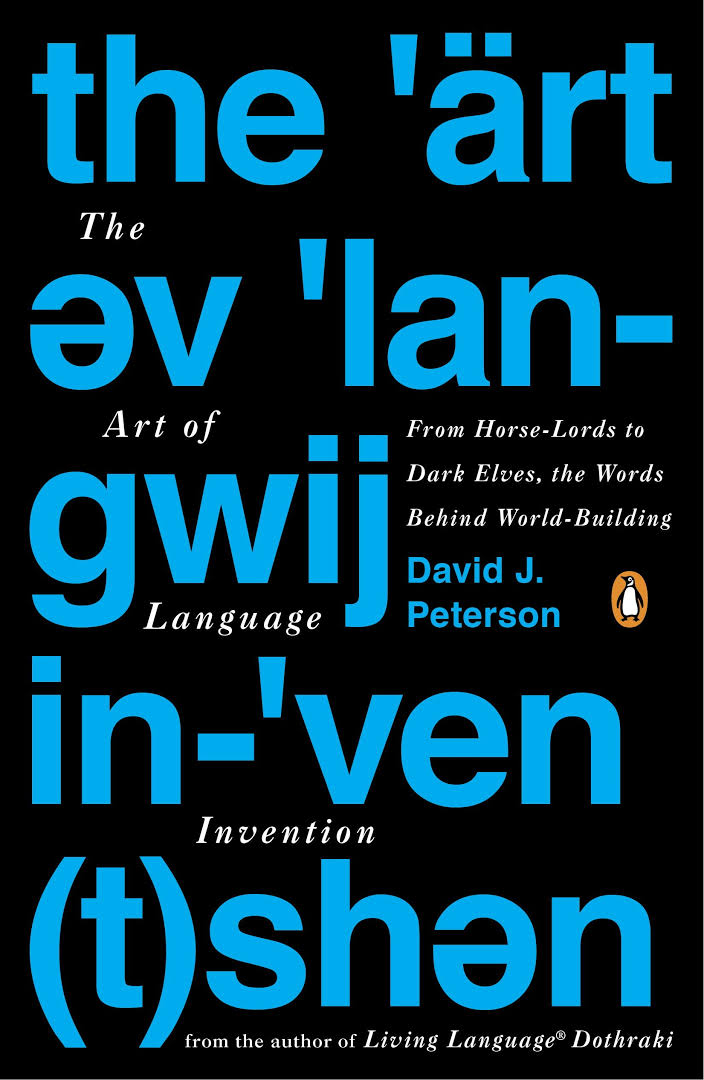
Review of The Art of Language Invention by David J. Peterson
By: Michael A. Arnold

Have you ever wanted to create a fictional language?
Ever since J.R.R. Tolkien's Lord of the Rings., and especially since the films came out, there has been an interest in his fictional elvish languages. And by extension, fictional languages more generally. These days the 'art of language creation', or 'conlanging' has become a popular online subculture with many forums and Facebook groups dedicated to it – and if this subculture has a rock star, David J. Peterson is it. He has created a number of languages for TV and video games, most notably Dothraki and High Valerian, both from Game of Thrones. If there is anyone to take advice from for this crazy-seeming and incredibly nerdy hobby then, really, who could be better?
But why would anyone want to create an entire language? Perhaps it is because they have a fictional world that they want to add more depth and colour to. People can create their own languages so they have a secret code, to think about things in different ways, or (which was the case with Tolkien) just to create beautiful words and put them together. There have even been attempts to create an easy to learn language for international use. This has been seriously attempted a number of times, even before Tolkien and his invented Elvish languages. In 1880, Johann Schleyer tried this with his language 'Volapuk', but the most famous example is Esperanto created by L. Zamenhof in 1887. Esperanto has since became so popular and widespread it even has native speakers.
When inventing a language, the only major difficulty most people might face is that they do not know a lot about how languages work. That is what The Art of Language Invention by David J. Peterson attempts to describe. Obviously, this book at 280 pages will not and cannot be a full explanation of all the different aspects of languages or language creation. Such a book would need to be thousands of pages long, and in several thick volumes explaining the technicalities of different grammar features from around the world. Peterson even says this himself in the Post Script: 'This isn't everything, though – not by a long shot'. And it never could be. What this book does is describes, gives a taste, of the 'art of language invention' - explaining the basics of the basics in very easily digestible language. For what can be quite a complex (perhaps even esoteric) subject, Peterson has a way of writing it that feels very natural and conversational. It feels like he is talking directly to you – and it is so much more inviting than a lot of other books on the same subject. The old truism of 'if you cannot explain something simply, you do not understand it well enough' comes to mind, and Peterson's book is proof there is truth to this. Also his obvious enthusiasm for language and linguistics is infectious, which makes this book very pleasurable to read. Some sections of this book would benefit from a few rereads to properly learn the information, but the writing style means this will probably not be a very painful experience.
I also have a confession to make: I also downloaded the audiobook. The first chapter is on phonology, or sounds, and wanted to hear the sounds Peterson was talking about. References to real-world languages or the use of symbols from the International Phonetic Alphabet (or IPA) referring to sounds you have never heard before will not tell you what is being communicated. However, without the text this book is otherwise not very audiobook-friendly. There are tables of different verbs that cannot make for good listening material, just because of the way some people will need to read them. There are also parts, especially when the book is talking about how people actually form different sounds in the mouth, which refer to diagrams that cannot be represented through speech. Throughout the audiobook, Peterson says something like 'See figure 1' or 'See figure 2', but I had downloaded the audiobook from Audible – and would not have had access to these figures and charts if I did not also have a physical copy (or at least a copy on kindle). I would recommend getting both the text and the audiobook to get the most possible from this book, especially if 'conlanging' is something you have a genuine interest in, especially if you do not know a lot about the IPA before starting.
There is something that feels very genuine about this book, like it comes from a sincere place, and that is one thing really nice about it. However if someone did accuse this book of being a bit too friendly and congenial they would not really be wrong. While it is written with a deep, clear understanding of the subject, it does not go far into those depths. It also does not talk about any common pitfalls people trying to make a conlang for the first time might fall into. It is not a manual – it is an introduction to the subject, discussing the 'art of language invention' rather than detailing it. A more cynical look at the index shows this, there are page numbered references to things like Eddie Vedder, Se7en, and W.B. Yeats which are only really mentioned in passing; there is no reference number for gerundives (a common grammatical feature) because they are not talked about. This might be a good and easy-to-read introduction, but someone looking for a lot of technical details will find this book disappointing. It is also a book that will use technical vocabulary, so a lot of rereading and/or note taking will really benefit a serious reader.
All this being said, this is a difficult book to dislike. It might not be very scientific, and could have benefited from more discussion on the ways different aspects of grammar can work, but as far as introductions to both linguistics and a new hobby go? It is difficult to think of one more enjoyable to actually read.
In the last ten years this seemingly insane hobby has become popular. Constructed languages, or conlangs have become more and more important in entertainment – and the book ends with a very encouraging note. It is a bit of a 'Conlanger's Manifesto' in a way, encouraging his readers to be brave, and experiment with language and language creation. This is a hobby where it is now even possible to make money from it, although how much would be difficult to actually say how and how much – but people have done it. The optimism in this book's postscript can be felt throughout this book. It is probably that, along with the very conversational style, that makes this so enjoyable to read.
I would like to end by suggesting that if you are in any way at all curious, this book is at least worth checking out. You might find that something just clicks, and you have found a new passion – and that cannot be a bad thing.