
Review of Lionel-Noël Royer's Vercingetorix Throws down His Arms at the Feet of Julius Caesar
By: Michael A. Arnold

September 52 BC: the last major battle of the Gallic wars was lost and won. The tribal leader Vercingetorix had locked himself in the city of Alesia, and the Romans under the command of Julius Caesar had laid siege. For Vercingetorix, this was a smarter decision than it first seems. Even though the Romans were besieging the town, they were deep in enemy territory. While they were hoping to starve Vercingetorix and his Gaulic army out – their food supplies were also running low, and Gaul reinforcements were rushing to break the siege. Time was running out for Caesar. If the Gauls won this battle, they would have had all the time they needed to keep raising support for their cause, and take the fight to the Romans. If the Romans won, they would have won all of Gaul, and with each passing moment the Vercingetorix's position grew stronger, Caesar's weaker.
What Caesar decided to do was bold and ingenious. From the walls of Alesia, the Gauls watched the Romans build two more walls, one facing their city and the other facing the other way. They were building a 25 mile long fort around an enemy fort, and manned it day and night to fight off both attacks and counter attacks.
When the Gaul's reinforcements arrived they attacked, and Vercingetorix attacked from the inside –the Romans were fighting in two directions. The battle was brutal, with Caesar throwing himself into lines of enemy troops numerous times (things like this made him popular) and it was extremely close, but eventually the Romans came out battered and bloodied, but victorious. After the battle Vercingetorix surrendered, knowing he would be taken back to Rome, paraded through the streets and then ceremoniously killed. This is what French painter Lionel-Noël Royer depicted in his 1899 painting 'Vercingetorix Throws Down his Arms at the Feet of Julius Caesar'.
Classics and ancient history have often been the subject of art. A lot of the time the ancient world seems like a completely different world, but in some ways very strangely familiar, and it is a great source of inspiration. But this inspiration has been used in an a huge number of ways. Like with Bottecli's 'The Birth of Venus', artists have taken a sense of beauty. Like Francis Bacon's tripditch work (perhaps his best work), artists have taken a darkness and horror. Like Raphael's painting The School of Athens, artists have wanted to show the amazing wisdom and intelligence that mankind is capable of. Also, in the 1800s and very early 1900s (just before WW1) many artists took from the classical world images to glorify their own nations – and show a sense of national (or nationalist) pride. In the 1800s especially, France identified with the defiant Gallic leader Vercingetorix so much, Napoleon erected a statue in his honor - as a symbol of French defiance against the wider world, especially against Great Britain which saw itself as a new Roman Empire. Napoleon's statue to Vercingetorix still bears the following inscription:
La Gaule unie
Gaul united,
Even after Napoleon's defeats, Veringetorix continued to be a Romantic hero for France. His struggle against the Romans and the great general Caesar was seen as a heroic last stand against all odds, trying to keep France free.
This painting itself looks, at first, like a normal portrait of the scene. Looked at closer, it starts to look more strange. It depicts the direct aftermath of the battle of Alesia, with Vercingetorix on horseback trotting up to a resting and relaxed Caesar. We cannot see Vercingetorix's face from this angle, but it is difficult to feel any anger or remorse from his posture. He is upright, straight, perhaps even defiant in his body language. He has one arm extended, as if he is graceful, even magnanimous is defeat. He is also in the light, with his horse in the sun – lovingly drawn and painted like it has been immortalized in a marble statue. This is similar to how his men are depicted. Although they are few in number, they are either in or near the light and we can clearly see their faces, and they are all looking at Vercingetorix with admiration. They may have been defeated in battle, but they are proud of the stand they have taken against the Roman army.
The Romans are depicted very differently. Most of them are in the shadows, and have their heads (like their noses) turned up to the defeated leader. None of them have much expression on their faces expect an anger or disinterest. They look arrogant and dismissive, and this is to say nothing of Caesar himself. He is surrounded by Roman military iconography, flags and standards; looking stern and proud, and even though he is the other subject of the painting he too is slightly in the dark. He actually looks a little demonic, sitting lazily on a chair, apparently untouched by the battle he had just fought and almost died several times during.
The major thing from the ancient world that describes or depicts Veringetorix and his surrender is Caesar's own Commentaries on the Gallic Wars. It is difficult to get an impression of Caesar the man from his writing. While his is quite easy to read, he is also very economical with language. Reading him can be like reading page after page of 'We marched for 15 miles then rested, there was a raid during the night – Belgae. We built a bridge and crossed the Rhine river, and marched for 5 miles. Then there was a battle, but was brief but we killed a lot of them'. However, it is difficult to imagine he would not have respected bravery, and probably would have shown more respect for Vercingetorix than is shown in this painting. In fact, in his commentaries, Caesar does not say very much about Vercingetorix's surrender. All he really says is 'Veringetorix deditur, arma proiciuntur' meaning something like 'Verginetorix has given up, weapons are thrown down'. That is, pretty much, it. All the details in this painting are Royer's invention.
The intention here is obvious: to glorify Veringetorix in his struggle against Roman imperial aggression. He is heroic even in defeat, while the Romans are the arrogant conquerors, unfeeling in their victory. Royer's intention was to remind his France of its history: that battles have been won and lost, but like Vercingetorix they should rather fight with honor to keep France free from all the enemies in the past, present and future.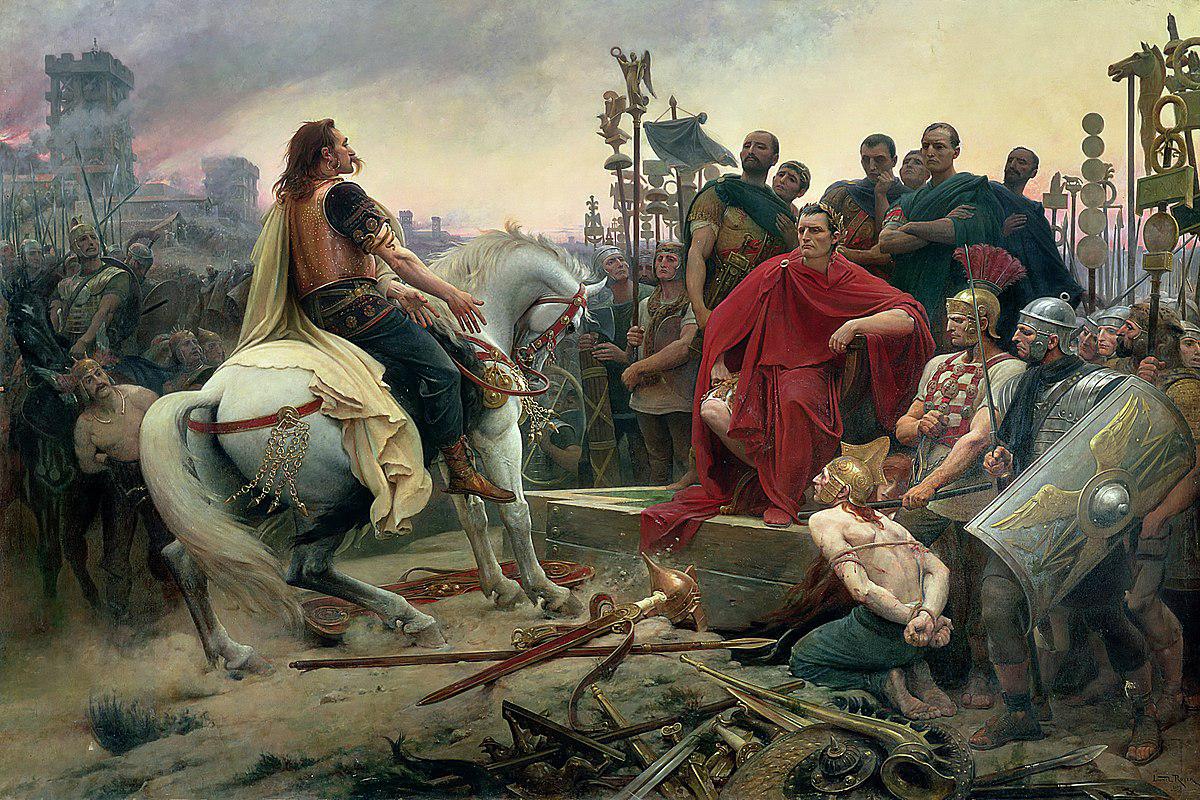
Formant une seule nation
Animée d'un méme esprit,
Peut défier l'Univers.
Or:
Forming a single nation
Animated by a common spirit,
That can defy the universe.