Review of Art, and the changing times
By: Michael A. Arnold

Modern art seems so divisive, doesn't it? Everyone has seen something ridiculous, like a wicker basket painted blue and given some portentous title, and maybe thought something like 'the emperor has no clothes!' 'All of this is pretentious nonsense!.'Yet googling great works of art, the results that come up are, mostly, the 'masters of the past' who painted scenes that were stunningly beautiful. Modern art does not compare against all that splendor, and the people spending millions of pounds on a wicker basket are just gullible saps trying to look more cultured, right? What gives?
Obviously, something fundamental has changed. This is one of those questions: commentaries and histories could fill entire libraries and still not completely explain it. Because of this, no account will probably ever be definitive, but there was a paradigm shift in the early 20th century bringing a tidal wave of not just new ideas of composition techniques and subject matter, think of the dream worlds of Salvador Dali for example, but also questions of what art could even be. For an example of artists rethinking and redefining what art is, look at Marcel Duchamp's 1917 'Fountain,' when he put a public urinal in an art gallery. This could be seen as making art out of the ordinary, and so democratizing art, but it was revolutionary. This wave of new energy and creativity is now referred to as Modernism, a vague term when you get into the finer details. The many reactions to it and against it, or both, include things like Postmodernism, Pop Art, and conceptual art - all attempt to redefine or question what art is.
From the medieval era until about the Romantic era (roughly the 1800s) artists worked mainly by commission. Often these would come from wealthy patrons or the church. Sandro Botticelli's 'The Birth of Venus' was painted on commission for the Medici family of Florence. Michelangelo's 'The Creation of Adam' was painted into the Sistine Chapel for the Vatican. This practice more or less carried on as time passed, and different tastes and styles came in and out of fashion. These tastes and styles always had a governing philosophy around 'art' that was (to potentially misuse a term for simplicity) Realism – or a realistic depiction of the subject. Even when the subject was fantastical, like the Greco-Roman gods, they were painted realistically. To artists of those times, a work was judged on its aesthetic beauty and its accuracy to life.
But by the early 1900s this underlying philosophy of Realism was starting to be questioned. Thinkers like Fredrick Nietzsche had already expressed the fundamental, philosophical questions of Modernism with his rejection of a single unified Truth. Modernism itself might be defined as a rejection of then accepted norms and expectations of the world (particularly by the then bourgeoisie), a trust in expertise over authority, an interest in the new and original, and an emphasis on impressions and subjectivity (or simply: how we see a thing, rather than how the thing really is). In literature this is perhaps very succinctly expressed by T.S. Eliot's poem 'The Love Song of J. Alfred Prufrock,' which starts like a rather traditional rhyming poem:
While the meter is perhaps a little unorthodox, a reader of poetry in the 1910s might expect something like this from any poetry popular poet. The next line is like a slap in the face:
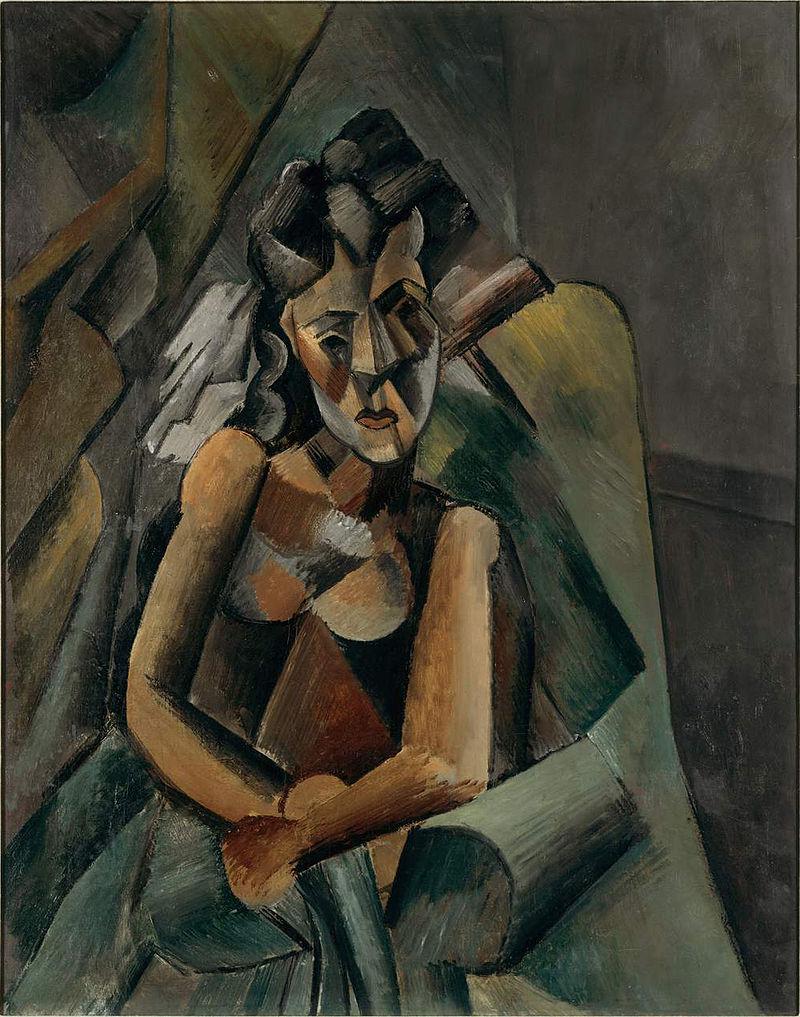
Comparing the sky to a psychiatric patient, having been knocked out to stop them from screaming is an odd simile, even a little shocking, but it is very Modernist. This is the same era that saw an explosion of abstraction in art. Paintings were not being made of beautiful pastoral landscapes, instead the focus turned to the unconscious, or war and machinery, or of seemingly recognizable figures being drawn in unexpected ways, such as this painting of a woman by Picasso: The nightmare images of Francis Bacon, H.R Giger and Beksinski were just around the corner. This is based on the idea that art is not about Realism and any objective standard of beauty, but subjective experience, and a reinterpretation of the world. Sometimes the world is not pretty, sometimes it is very disturbing. And there even might be a kind of beauty in ugliness and horror, just a different kind of beauty - and what does 'beauty' even mean?
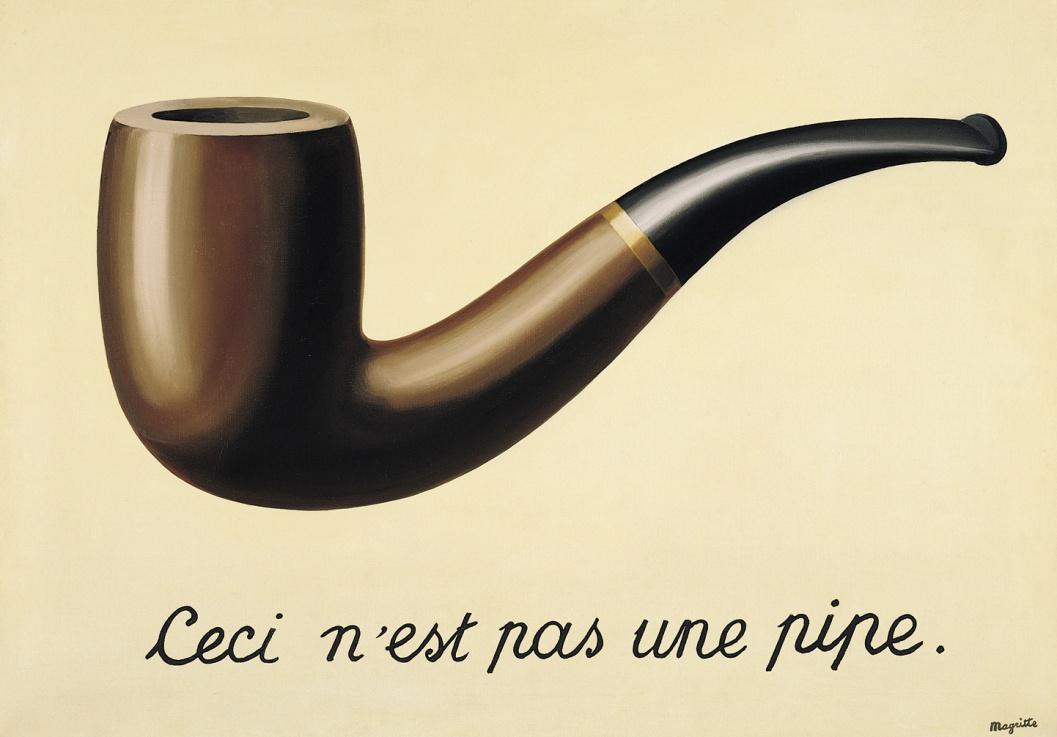
Modern art also took inspiration from the modern, more urban world, such as René Magritte's 1929 'The Treachery of Images,' which looks a lot like an advertisement of the era:
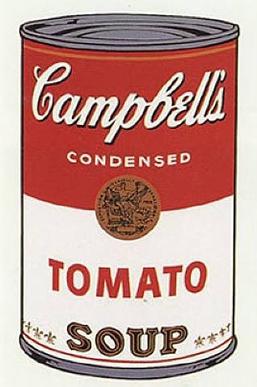
As does a lot of the Pop Art of Andy Warhol:
As modernism evolved into, or (and both are correct) Postmodernism came in response to, Modernism, the attitudes toward questions like 'what is art' started to change too. The key difference between Modernism and Postmodernism is that while Modernism still values reason and the values of the enlightenment (because it lamented the loss of them since the Romantic era) Postmodernism embraces this loss, and rejects the idea of grand narratives. Take the two paintings above related in some way to advertisement, Magritte's and Warhol's. Magritte's uses 'cesi n'est pasune pipe' or 'It is not a pipe' to bring attention to the fact it is a painting, and not really an advertisement. Warhol's painting could just be an advertisement. While Magritte's piece is self-conscious, Warhol's is self-consciously unself-conscious. Is this art? Is has been put in galleries, it is seen in people's poems, so it is. But it is not considered 'classically beautiful' like a painting of some Arcadian land of peace with mountains and deep forests like you would have seen in traditional landscapes.
We are further from Warhol and the Pop Art movement as he was from the height of Modernism. In that span of time, we have had even more time to think about, and test the boarders of what can and cannot be considered art, and what can and cannot be considered beautiful. This does not mean that all pieces of modern art needs to be admired, people are always going to have their own opinions on things they see. Quite a lot of modern (not Modernist) art is Conceptual Art, or art that is far more about the concept trying to be expressed than the piece itself. This is stuff like as Tracey Emin's 'My Bed,' and 'Everyone I have Ever Slept With' being a tent with a load of names in them. Or Martin Creed's 'The Lights Going On and Off' which was a room which had the lights turning on and off, and won the Turner Prize in 2001. This is not a work in the same way Warhol's paintings are work. 'My Bed' is, objectively, nothing much more than a messy bed, but it is everything around the piece that makes it more meaningful, and so (arguably) makes it art. Maybe anyone could have done that and called it art, but not everyone did do it, and that is a crucial difference.
This is often why critics of modern art point to things that on the surface seem lazy, like the example in the first paragraph of a wicker basket painted blue. The thing itself is not really the point, the point is whatever the thing is trying to suggest. Perhaps the wicker basket is a commentary on capitalism trying to put a new coat of paint on old ideas to sell them, perhaps it is something else. The point is that even if a work is not understood, it is no longer necessary for a work to inspire emotions for it to be considered art. Imagine, for example, we have put an untouched blank canvas in an art gallery and given it the title 'fear.'This could be seen as lazy, but it could be an attempt to communicate that someone staring at a blank canvas with no ideas coming to them is a scary thing, or it could mean the blankness of the universe – or the emptiness of fear itself. All of these interpretations could be true at the same time, and so the only question left here is could this really be considered art? And if the answer is subjective, what is the purpose of art at all, then? There is no answer to this.
In the era of modernism, another major change was that art was no longer commissioned, and so had to be to the artist's expression and tastes. Artists were working more or less for their own interest and were so much more free to experiment and try new things. This change came about mostly because of the change in how people encountered art: from the private art room, or private showing of some aristocrat, or being seen in a church, to art galleries open to more and more people. This is not to mean that art was democratized, but only that it was available. Also, the more shocking, original, and controversial works were pushed boundaries and could now make money because controversy is a powerful tool for advertisement. Like Oscar Wilde said, 'the only thing worse than being talked about is not being talked about.'Big money never left the art world, it had simply found a new way to enter it.
You might not like modern art, you might not even like Modernist art or Postmodernist art. In a way it does not matter, because you are being asked to question what 'art' even means, and what it is for. We will probably never go back to the times when art was all about beauty and realism, there will always be people who push boundaries. It is also worth remembering that most artistic works are quickly forgotten, and we only remember the greats because they were kept around for whatever reason. For every Picasso there were hundreds of artists from his era that we no longer collectively remember– and now Postmodernism is slowly dying, and 'Meta Modernism' is on the rise, there is a new movement to potentially bring a few great works but a lot of rubbish too. That is simply how this all works.
Let us go then, you and I,
When the evening is spread out against the skyLike a patient etherized upon a table.