Review of Pieter Bruegel the Elder's The Hunters in the Snow
By: Michael A. Arnold

So, winter is here. It is almost Christmas. Good, I love this time of the year.
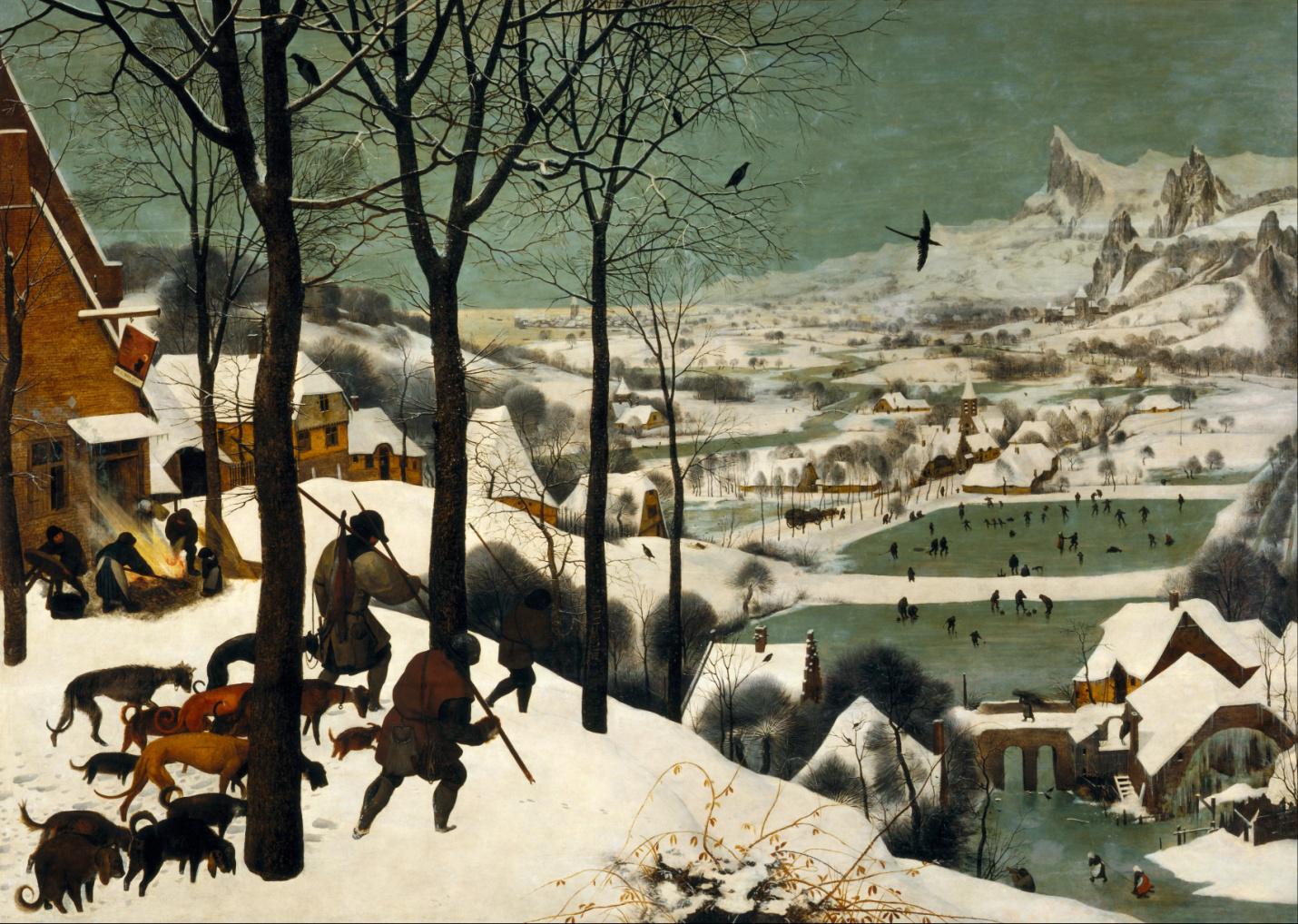
Few paintings crystallize winter for me than the 1565 painting 'The Hunters in the Snow' by the Dutch artist Pieter Bruegel. There is something in all the stark colours - the crispness in them, the hard black lines of the trees, and the long snowy background of distant mountains that captures the feel of a snowy winter day. Also, because it contrasts all of this with the image of people enjoying the ice and snow, it captures both sides of the season: the fun and the hardship. Anyone who has seen entire days of snowfall can probably feel the ice-wind breathing off this painting, or can imagine the caws of the birds in the trees over a world that feels dead. Then you will get some warmth, like from the fire of in the left of this scene, and smell the chicken (or turkey, or whatever) being cooked, and you know that by nightfall everything will be nice and cosy.
The painting was part of a collection, of which only five have survived, depicting life during the different parts of the year. This was part of a Renaissance tradition where artists would depict a series of 'Labours of the Months', focusing on the work of ordinary people, and their struggles to survive in the world. Over the years, paintings from the collection have changed hands and maybe gotten lost, and it is actually quite difficult to find concrete information on what exactly happened to all of them, but the paintings we still have continue to be popular, and have an importance and influence.
In 'The Hunters in the Snow' we see a pack of hunters returning to a rural village with their dogs, dogs that look sad and dejected - apparently, they have not had a successful hunt. To the left of the hunters, a group of women are building a fire to start cooking. Both of these groups are hard at work, trying to provide what will be needed for the coming winter days. Even the birds in the trees just above the hunters are doing something like this. They are watching over the landscape, presumably looking for food themselves, and one is flying away from the scene – as if it is moving on because it has not spotted anything or has seen something and is ready to attack. We can only guess, but there is no respite for wildlife on a snowy winter day either. The hunters, those about to cook, and the birds above them are doing their necessary day-to-day tasks to stay alive.
But in the valley below we can see people enjoying themselves, rather than working. It looks like they are having a good time. Children are playing, dogs are running around carefree, men and women are skating together, it even looks like some people are playing a game of curling. There is a happy, even idyllic life down in that valley. But work is never too far away: on a bridge down there, you can see someone carrying a large bushel of straw or twigs, and a horse and carriage carting piles of wood somewhere. Even among the all the fun there is still work to be done.
But in the background, in the wilderness behind everything, there is a tall and sharp mountain range, and the white featureless snow is reaching into the horizon and distant hills. This is, I think, important to understanding the potential meaning behind this painting. There is an order to the scene: our focus is initially drawn to the hunters in the foreground because of the thick, very bold trees they are walking through, and they are the most clearly visible characters in the scene. These trees are so black and bold that they might not even look like trees at first and they genuinely demand our attention. Then we might notice the wider scene, the people playing down below. Then, finally, we might look deep into the background at the wild beyond.
Since there are people working all around the villagers having fun, the implication is that time spent in leisure is always thanks to time spent in labour. We should never forget the sacrifices that other people have made so we can have our fun, because there is always the blankly white wilderness in the background of everything, just like the background of this painting. Nature is cruel, unsympathetic, and unsentimental, and if the necessary work of the world is not done then we will suffer in that wilderness. This is especially true for wildlife; winter is still a time of great hardship - and sadly not everything survives it. In this sense, we cannot take our luxuries for granted. But at the same time, there is also good sense in enjoying winter too. Winter is a time to be thankful for what we have, but it is also a time to enjoy what we have – and perhaps that is a way of showing our gratitude.
This is especially true during Christmas – with all the chestnuts and large meals and present giving. This is a time for celebration. 'It's the most wonderful time of the year' as that song goes. And even though some of us might not see a white Christmas like the one in this painting, it still radiates a wintery cold from every line and brushstroke. But it is not a dark, lifeless kind of cold – not really. It is that Christmas Carol kind of cold, where a warm fire with your loved ones is only a street or two away.
We have all had a hard time this year, and I think we deserve to have a good holiday. I hope you have a very Merry Christmas! And see you in 2021.