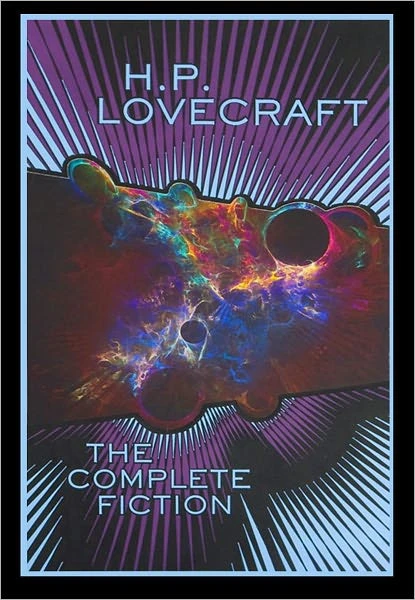
Rereading H.P. Lovecraft
By: Michael A. Arnold

I have been rereading the works of H.P. Lovecraft to get in the mood for Halloween. He is an interesting writer who wrote in a number of genres, but most people read him for his horror – his monsters and his gloomy atmosphere. Some Lovecraft stories are pure mood, and not a huge amount of plot can happen within any 1,000 words or so. He could also be criticized for how many of his plots are basically the same: a man goes somewhere he probably should not, sees something weird, and runs away screaming. However, one thing often missed about Lovecraft's writing is how his stories encourage you to doubt things in them, and there is (perhaps) more under the surface than his critics and fans often talk about.
There are details in most of Lovecraft's stories that are inexplicable and mysterious. Most of these point to further layers of the horror than is ever directly described. Take for example 'The Terrible Old Man', where an old man is burgled in the night, but his burglars are found dead the next day in mysterious circumstances. There is a suggestion in the story that the eponymous 'terrible old man' has some kind of supernatural connection with or control over his former shipmates, whose souls are now trapped in little glass bottles with names that sound very nautical: 'Long Tom' and 'Spanish Joe'. That detail is never explored in detail, and what exactly happened during the robbery can never be exactly known, all we really know from the story is that something strange happened, and three people are dead from a number of sword wounds. It could be the old man is still strong, and was able to defend himself, but the uncertainty around details like those little glass bottles help Lovecraft's stories stand up to a rereading.
This uncertainty is actually a key part to some of Lovecraft's stories. At times we can doubt if a story really happened or happened exactly the way the narrator describes it. This can be seen from some of Lovecraft's earliest stories - in the very early story 'The Tomb' we have every reason to doubt what the protagonist, Jervas Dudley, tells us. He has been put into a mental hospital, and the story seems to stress that what he tells us is not the same as what other people saw. At the same time as Lovecraft wrote 'The Tomb' he also wrote 'Dagon', a story that prefigures a lot of what would be called (never by Lovecraft) the 'Cthulhu Mythos'. The story focuses on some unknown god-like entity being worshiped by strange alien beings on a mysterious island never before or since found in the southern pacific, but this story also has an unreliable narrator. The narrator, when landing on the unknown island, walks for two days before seeing the horror – and then seems to run immediately back to his boat, making it sound like it is a short distance. This is a weird touch, and might be only a quirk of the narrative, but the detail of the narrator walking two days is a strange addition to the story and should not be overlooked. Rather than being inconsequential, details like this create a strange sense that nothing should be trusted completely, so we are left with as many questions as the narrator.
Lovecraft used the unreliable narrator throughout his writing, but it is used most impressively, and where it is most often overlooked, in the famous story 'The Call of Cthulhu'. This story is a sort of later, much more developed redraft of the earlier 'Dagon', and is about a young man reading a collection of papers left by his recently deceased uncle George Angell. As he reads, he pieces together vague facts of a worldwide cult and a giant alien living in a sunken city under the waters of earth – the titular Cthulhu.
It is important to point out that the protagonist himself never actually sees anything. All he does is read letters and papers. For all we really know, nothing described in the story ever happened. The papers collected by Angell could be notes for a novel the old man had planned to write for all we really know, and the protagonist does not know any better than we do. The first paragraphs of the story does say that one day humanity will piece together some great horror from 'dissociated knowledge' but the narrator himself has edited the story together from the scraps of information and believes it. The information he finds is certainly compelling, and does combine into a sinister narrative that the story encourages us to believe, but it is also true that everything we read is second-hand information – and who really knows where it all came from. In this sense, the story is more postmodern than it is usually given credit for.
Unreliable narrators are often interesting, and it is fun trying to find a real story behind the narrative, but Lovecraft is trying to make us problems with no possible solutions – a bit like scientists. Though a lack of concrete answers, Lovecraft is trying to give us an almost existential dread of 'the truth' –trying to give us a sense that there is a 'truth' behind the story, but our brains are not built to handle it. One of the clichés of Lovecraft's writing is when someone sees something terrifying they will instantly go insane. Lovecraft wrote in the first sentence of his essay 'Supernatural Horror in Literature', published in 1927, that 'The oldest and strongest emotion of mankind is fear, and the oldest and strongest kind of fear is fear of the unknown'. A lot of Lovecraft's protagonists go in search of the unknown, trying to find the truth, and suffer for their curiosity – losing their grasp on reality. In Lovecraft's stories, the monsters are not our main enemy (they could be taken as mere metaphors) we need to fear our inability to understand the larger, hostile cosmos around us.
This is not to mean that every story, especially every story, with a first-person narration should be considered an unreliable narrator. It would be interesting to debate which narrators we can and cannot trust. It also does not mean that because Lovecraft's stories reference each other, such as the 'Cthulhu Spawn' seen in At the Mountains of Madness, or the mentions of several other 'Old Ones' in something like [The Whisperer in Darkness], that we should treat Lovecraft's monsters as a serious cosmology. Lovecraft probably did not take his creations as seriously as his fans often do. There are family trees of Lovecraft's alien 'gods', and this is perhaps missing the philosophical point Lovecraft's writing so often conveys just below the surface, expressed so memorably in the opening of 'Call of Cthulhu'. A lot of these references might just be jokes, put in for the regular readers of [Weird Tales] - the magazine he most often published his stories through. Lovecraft was a fun writer, and arguably a great writer, but he is also a writer whose reputation has affected the way he is read.
We think of Lovecraft as a 'horror' or a 'sci-fi' writer. but he had much more to offer than that. He had a keen interest in the earliest era of mankind's history and wrote stories set during the Greek and Roman eras. He also has a series of fantasy stories called the 'Dream-cycle' (a pastiche of the British fantasy writer Lord Dunsany) and he even wrote comedy stories. He has two stories called 'Ibid' and 'A Reminiscence of Dr. Johnson' that, if you understand the joke, are genuinely funny. Lovecraft's great stories are his horror stories, but his stories in other genres can be surprisingly strong too.
Lovecraft is one of those writers who does reward a closer, more careful and thoughtful reading. Often, people will only read a handful of the famous stories by a writer and not bother with much more than that, and that is a shame. Plus, it is easy to miss out on the depth in stories we think we know. If we look closer, we might find more things to like, and that make us like the writer more than we did before.