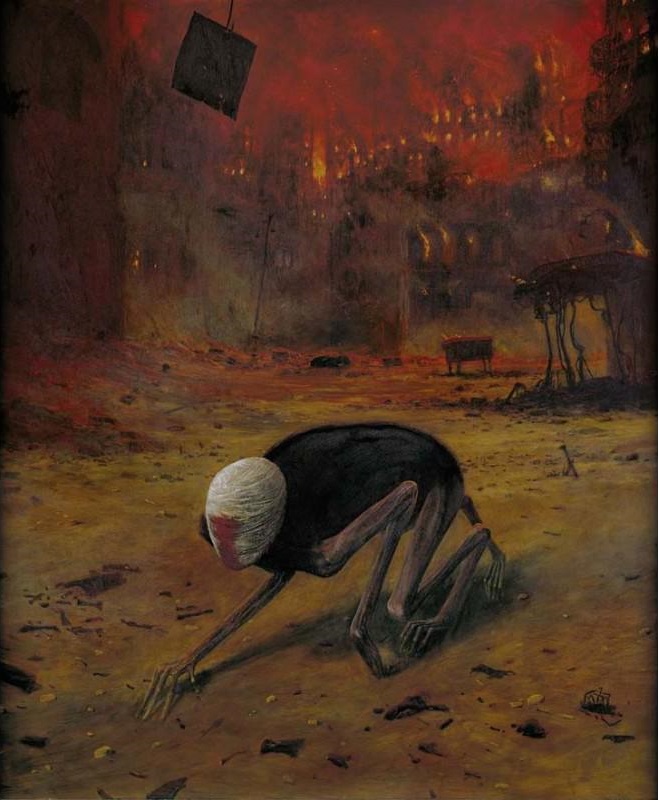
Review of a painting by Beksinksi
By: Michael A. Arnold

Everyone has nightmares - some artists can see them for what they really are. Zdzislaw Beksinski was one of them.
Born in 1929 in Poland, Beksinksi lived through one of the most destructive and unnerving periods of history, WW2 and then the Cold War as his home country was a satellite state of the Soviet Union. The horrors of this time are strongly reflected in his art, Beksinski's style and subject matter was distinctively outside conventional taste, and almost always grim. His work focused on hell-like landscapes full of strange creatures, or humans either distorted or dead. A lot of the time his work also features a lot of familiar things that are twisted or corrupted in some way, or made from disturbing materials – such as one piece of the Notre Dame cathedral but it is made of human bones. Again, to be outside of convention, Bekinski never named any of his works – this is because he believed giving a piece a name would influence the viewers appreciation of the work through the artist's interpretation of it. Art was for him entirely democratic, and he did not really like the idea work would be interpreted either.
The distortion of familiar things can be seen in the painting above. It one of Beksinski's paintings of a ruined landscape - he painted a number of landscape portraits, and one this is perhaps one of the most famous. It is clearly an urban area, but one that has been very severely firebombed – or it is the aftermath of a nuclear explosion. In the foreground is a strange, vaguely humanoid creature creeping toward the viewer, while behind it and to one side are strange robotic creatures that look like cattle. These cow creature/robots seem to be moving toward the background, and to what might be other things like them or dead bodies laying among the ruins.
These creatures are unsettling because they seem both familiar and monstrous at the same time. They are moving calmly through a world of total devastation, but they also seem in pain. The creature closest to us, for example, has a head that looks like it is wrapped in bandages with a red mark across it the color of blood. There is something pitiful about it, even as it repulses us. With the creatures and the ruined city in the background, the prevailing emotion of this piece is of a deep, oppressive sadness – and for some viewers the landscape itself will also simultaneously repel and attract them.
What has happened to the world in this painting? We can only speculate, just as we can only speculate on what the intentions behind this piece were, or if there were any intentions at all. It is worth asking: where does art really come from? A lot of artists have something to say, but is the message like a garnish on the top of an initial idea, or is it at heart communicating something harder to describe with words? Even if he might not (important words being 'might not') have had conscious messages in his work, Beksinksi's work was certainly expression of something – and came from both what was inside him, and how he saw in the world. Otherwise, where else could it have come from? But whatever inspired him, and made him create art, it was bleak and full of nightmares. In the ruined world of the painting, the creatures who live in it are trying to continue as best they can - if we were cynical, we might say that this is also true of us.
This expression of bleakness could be itself the message. We humans live in the world we have molded and remade for ourselves, and it has inspired nightmares like the one we see in this painting. WW2 saw fighting on every continent on earth and previously unseen levels of destruction. The Cold War threatened a level of destruction far more massive than even that – and could have ended all life on earth. Since this painting shows what seems to be the aftermath of a nuclear war, with horribly mutilated creatures and a ruined landscape, perhaps the inspiration for this painting is all too obvious. His painting is a reflection of the horrors we can do to ourselves, and we are the monsters we create.