Review of David by Michelangelo
By: Michael A. Arnold

It was a hot day in Florence, they usually are. There were already a few people moving around the Piazzo Della Signoria, but it was still a bit too early for tourists. Except for tourists like me, who had a ticket into the castle-like Palazzo Vecchio.
A waiter in one of the restaurants on the piazzo, who had just started putting out chairs and putting up parasols, said I could sit in the shade if I promised to come back later for a drink. As I waited for my tour to start, I had time to admire one of the most famous statues in western art. It was just outside the huge wooden doors to the Palazzo Vecchio, with large wide eyes pointed in the direction of Rome - Michelangelo's David.
But what I was seeing was not the famous version of David, the one that everyone sees when googling a picture of the statue though. That version was just around the corner, in the Accademia di Firenze. What I was looking at was a replica. The original once stood there, beside doors of the old castle for hundreds of years before it was moved in 1873 in efforts to preserve it. Either way, across the large and then empty square the effect was probably about the same: the pearly white marble statue standing against the dark brown medieval walls of old Florence, and under the bright Tuscan heat would leave a powerful impression on anyone seeing it.
The statue is so famous that we do not tend to think there might be anything unusual about it, but when put back in its historical context there is. It was one of the first representations of David to not contrast him with, or depict him with, his biblical nemesis Goliath in any way. There is a not quite as famous bronze statue made by Donatello, shortly before Michelangelo's, showing David, sword in hand, holding Goliath's severed head; and this was itself something different from the norm because of how graphic it was. Before Donatello's David, many representations of the hero showed him actively fighting the giant. Michelangelo's David is instead deep in thought, his fight with Goliath has not yet happened, and he is holding back.
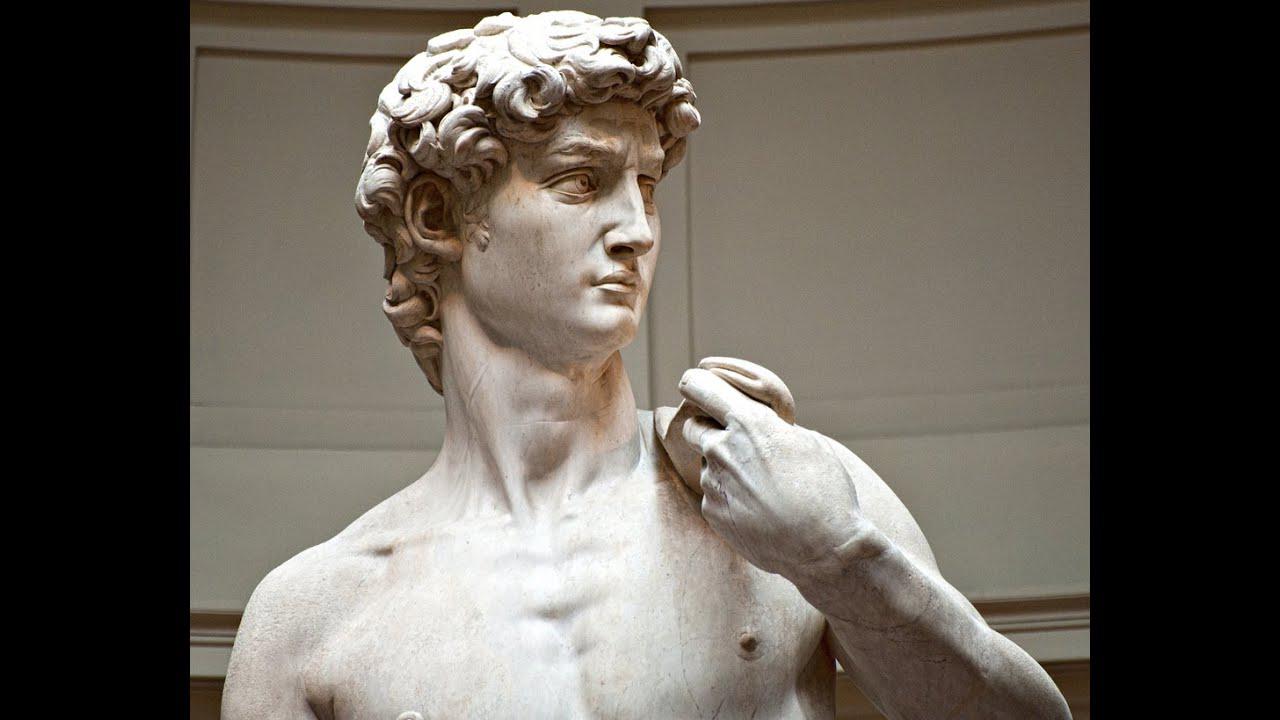
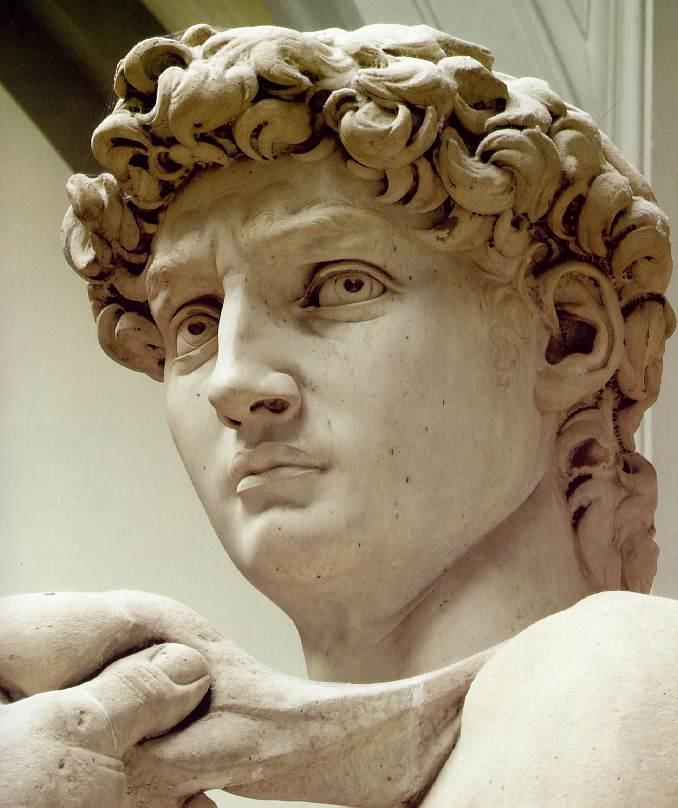
This is interesting because David's expression and emotion seems to change when seen from different angles. As seen above, from straight on he looks confident, and perhaps a bit arrogant. From another side his face is more expressive, showing what could be fear or even apprehension, with a level mouth, puffed out upper chin, and wide eyes that are taking everything in: This capturing of different emotions, and so different aspects of the story with Goliath, does a lot to humanize this version of David. We see him as both brave and intelligent, but also afraid and human. This is a sign of the great ingenuity and skill of the artist, especially considering the dedication it must have taken to carve this statue out of a single block of marble over a handful of years. As an artistic achievement, on just aesthetic grounds, this statue is a masterpiece.
Even so, we must ask why Michelangelo decided to depict David.
The symbol of David fighting Goliath was a particularly important figure for Florence as a symbol of victory and the defeat of evil. There was no unified government in Italy during the medieval and renaissance periods, instead the peninsula was ruled by a number of independent city states that often fight wars with each other, while Italy saw invasions from both France and the Holy Roman Empire who were pursuing their various political goals. It was a violent time, and in such a turbulent climate the symbol of David the Giant Slayer would have been extremely important to any city like Florence, which was always eager to imagine itself in the best way possible. David was emblematic of how they wanted to see themselves.
In 1494 the image of David fighting Goliath took on even more political dimension: the Medici family that had ruled for Florence for years had been exiled, and the before mentioned bronze David by Donatello was moved from the Medici family villa to the Piazzo Della Signoria, where the council of Florence would meet (and was formally the offices of the Medici government) as a symbol of the Florentine republic's victory over the old Medici tyrants.
Michelangelo would have been aware of the political climate when he was working on his own David. When his version was finished in 1504, it replaced Donatello's statue in the Piazzo Della Signoria, and by doing so, with David's eyes looking in the direction of Rome (where the Medici were then living in exile) ready to attack, the message was clear: ‘Come back to Florence and we will kill you'. Italian politics in those days was pretty cutthroat. This political message was not lost on anyone either. When the statue was first unveiled a crowd of people who were still loyal to the Medici family attacked it with rocks, but the statue was undamaged and remained in place, and did so even after the Medici family returned to Florence just less than a decade later.
But there more to this statue than just Italian politics during the Renaissance. Despite the fact that David is a biblical character, in appearance and style the statue is primarily influenced by the aesthetic ideals of Ancient Greece and Rome. David is depicted as fully nude, which is typical of representations of males in Greek art, but is rare in Christian art, especially depicting scenes from the bible. The point is that the Classical and the Biblical worlds are together in this statue as if they are one. This was no accident, since Renaissance thought was a mixture of the rediscovery of the Classical world and the deeply religious concerns more emblematic to us of the earlier medieval period, which is something that is easily forgotten. We often want to view the increasing scientific progress of the time as the result of a more secular society than it actually was.
However, a great work of art never remains static in meaning to the audience, and in our increasingly secular world, Michelangelo's David still has that uncertainly defined power found a true masterpiece. It still somehow speaks to us, even if it is only of its beautiful appearance, without the political or cultural subtexts, and that is why it remains so valued. There is something indefinably beautiful and life-affirming in it.
Florence has been called the largest open air museum in the world, and that is no understatement. Around every corner is something amazing to see. What also is incredible is how much of this work has survived both the entropy of time and some quite destructive wars, including the allied bombings during WW2. When I first visited Florence, I was reading the book The Stones of Florence by Mary McCarthy, and in it she detailed how intense the allied bombing of the city had been. The bombings been so devastating that entire areas of the city were flattened, and all bridges in the city were destroyed except the Ponte Vecchio. Great works of art like Michelangelo's David not only survived all that, they have remained largely untouched. This is a wonderful fact, because these works are an incredible reminder of some of the best things about humanity: our resilience, our appreciation of beauty, and our ability to endure whatever life might throw at us – all with the same bravery and expectation seen in this image of a warrior about to strike.