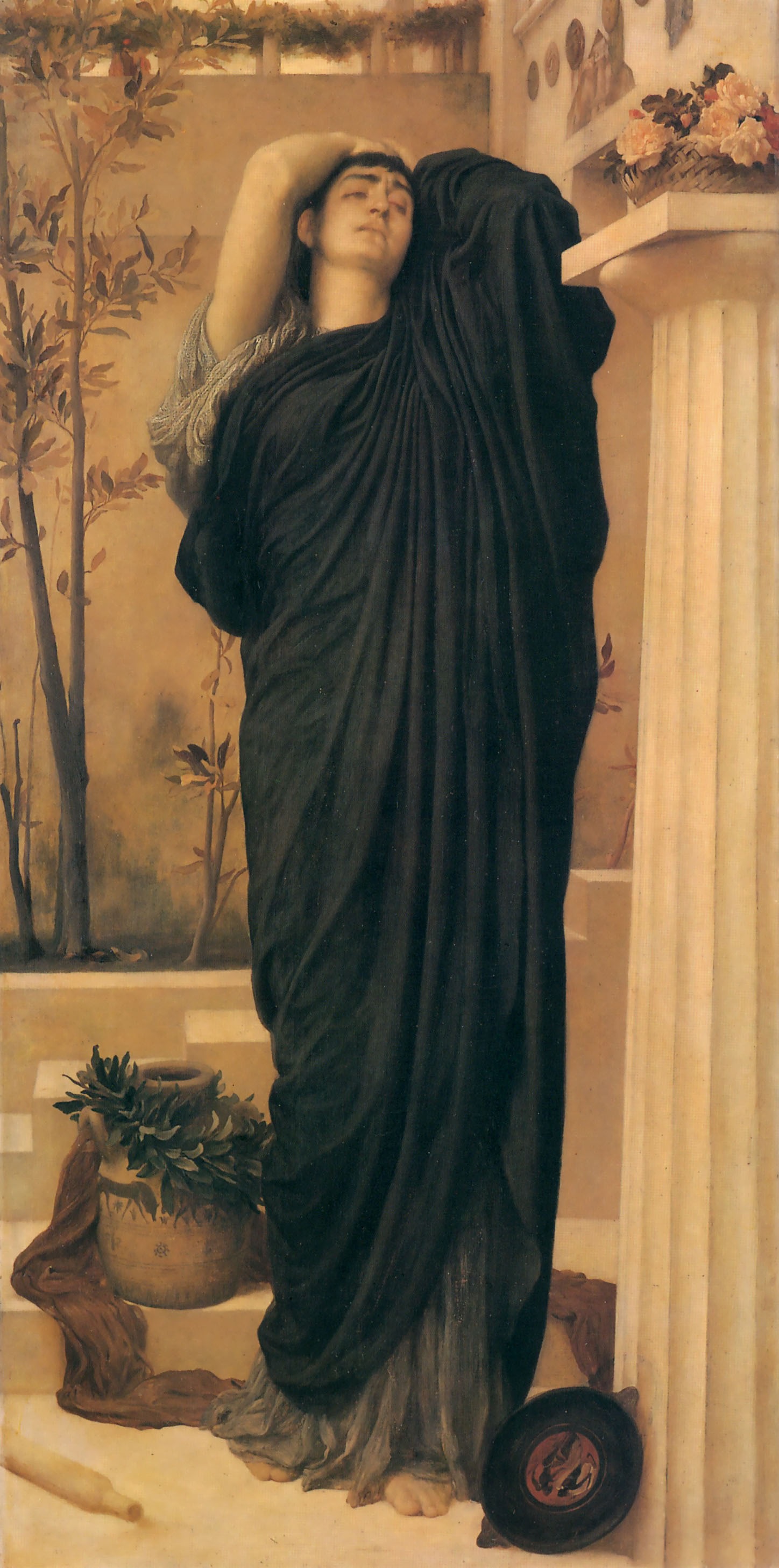

Review of Lord Frederic Leighton's Electra at Agamemnon's Tomb
By: Michael A. Arnold

The prayers to the pan–god Dionysus were coming to an end. The day was dying. A once–hot wind was blowing warm against the huge hill overlooking the city; crowned with a temple to the city's patron god. On the lower slopes, everyone had gathered in the great theatre. The long grass was chirping and singing, and the smell of cooling mud was everywhere. There been a number of trilogies of tragedies performed over the previous few days, with an extra comedic play to cap each sequence off, and raise the spirits of the audience again. Now it was time for the judges – which trilogy would be considered the best?
I don't think we know what the vote count was. The event I'm picturing happened in Athens in 458 BC, and a lot has been lost since then. We do know that Sophocles came second, who would later write Oedipus Tyrannus — one of the greatest plays ever. I cannot imagine, though, that the votes did not go (and very clearly go) to the aging Aeschylus for The Oresteia – a trilogy that tells how the royal family of Atreus, the rulers of Mycenae, came to a violent end in a cycle of madness and murder.
To call The Oresteia a masterpiece is in some ways not really enough, it is probably one of the best pieces of literature ever written. It touches on many diverse and complicated issues, as relevant when first staged in 458 BC as they are today, primarily: war, feminism and the power balance between the genders, morality, justice and human nature. The court drama in The Eumendies (the third play in the series) brings all these different themes together and discusses them, and the series is, to get straight to the core of it, about one of the most central, difficult and (unfortunately) common problems mankind collectively faces: our tendency to fight and how we should ideally treat each other without resorting to violence. Aeschylus had seen war firsthand, being a veteran of the Persian wars, and fighting at The Battle of Marathon when Athens stood against the might of Persia – the largest empire then known, and Athens won. These are also the wars that saw the famous Battle of Thermopylae, where 300 Spartans (and modern estimates say about 7,000 other Greeks) stood against the might of the Persian army (that estimates place somewhere between 70,000 and 2,000,000 people strong). Plays like The Oresteia asked questions about war, violence, and justice, and they were things their audiences would be keenly interested in — and not just in some abstract, philosophical way. The audience at the first staging of The Oresteia had recently been fighting for their lives on very real battlefields. Because of the grand themes at stake in The Oresteia it is always interesting when it is evoked by other people – in literature, music or art. One very beautiful example is Lord Frederick Leighton's painting Electra At The Tomb of Agamemnon painted in 1868.
The painting depicts the Greek princess Electra in the opening scene of The Libation Bearers, the second part of The Oresteia. This appears to be just before the very beginning of the play, when Electra meets her brother Orestes who will, in a short while, murder their mother Clytemnestra, and Clytemnestra's lover Aegisthus. Electra is standing at the entrance of her father's tomb, grieving. Behind her is a line of plants, and just behind her feet is a large amphora jar (covered with leaves) for the libations, a kind of offering to the dead, while just before her feet is what looks like a small shield. She is wrapped in a pure black cloth, and is the image of someone mourning the death of a loved one.
It is important to take note of the things physically around her in this painting. The libations she has, in the painting, just poured are to her dead father so, as we find out from the play, her mother Clytemnestra will stop having bad dreams that seem to prophesy her own death. With the amphora jar being physically behind her, there is also the implication that that is also in the past — and she is also standing — looking away from the door to Agamemnon's tomb, the death is in the past and she is trying to move on. Literally and figuratively, that part of the Oresteia story is over, and what is before her is symbolized by what looks like a small shield at her feet — suggesting the further violence that is to come soon. The object before her is far too big to be the lid for the libations jar— and it would be difficult to think of anything else it could be but a dueling shield. It is also, by ancient Greek standards, an extremely small shield. It looks like a either a dueling shield or a shield for use on horseback – either way it is not just a symbol of war and violence, it is also a symbol of Electra's place in society — she is an aristocrat, the only people who in Ancient Greece who could afford horses, especially during the era the Trojan War is thought to have taken place. What will play out in the 'future' is the violence which will destroy her aristocratic family.
The plants in the background, behind Electra, are (although alive) painted with dark and muted colors, a lot like the background of the story this painting is showing a small part of. There is a curse on the family of Atreus, placed long before the events of The Oresteia, because of a series of disturbing events that happened (even in the plays) a long time ago. Yet the flowers just before Electra are bright and colorful, even if in her current emotional state she is not looking at them. Her eyes are closed, and with her head tilted upward she would not see them if her eyes were open. There is actually (as strange as this might sound to someone who has not read it) a happy ending to the trilogy, and in a sense, the beauty in the resolution to the plot of The Oresteia is there before her, but at the moment in time this painting is showing Electra is in a sense blind to it.
This painting is, before everything else, a moment of pure grief and sadness. In a way, this painting is a freeze frame of a story in motion, a bit like the two embracing figures in Keats' poem 'Ode to a Grecian Urn'. Because a painting is not animate, this Electra will never meet Orestes. Orestes will never commit the murders, and so never be chased by the demonic Furies, but these are also things forever in the 'future' of this painting, never to be fulfilled. There is this suggestion of the story moving forward by the placement of objects around Electra, but this is an image frozen in time so to really show the human side of this tragedy.
This stasis, the moment in time captured in this painting, heightens the pathos and emotion of it – and it is difficult to not find this piece moving on some profound level when the full story this painting is only showing a small part of is known. It is clear in her face, Electra is utterly distraught by the things going on around her — which is perfectly understandable. Her own father is dead and her mother has killed him, and her brother is going to try to kill their mother in revenge. This is an image of the sadness and horror at the heart of The Oresteia.
Pathos is central to Greek tragedy, especially because of the impact a story is supposed to have on the audience. Tragedy, as Aristotle says in The Poetics, is supposed to have a cathartic effect on the audience by the way they experience the story. When Oedipus rips his own eyes out at the end of Oedipus Tyrannus we feel bad for him, because Oedipus was a good person who made understandable decisions — but decisions that are revealed to be mistakes when he finds out he was, himself, the monster he was searching for the entire time. It is a horrifying end, but one also filled with sadness, and this emotion is supposed to be shared by the audience as a way of expunging those darker feelings from themselves. The Oresteia is similarly full of this simultaneous horror and sadness — but one that really makes it immediate and deeply personal. The ending of the series goes in a different direction admittedly, as said above it ends quite complexly but ultimately happily, but this horror and sadness — that is such a key characteristic of Greek tragedy — is still there, haunting us. What Lord Frederic Leighton's painting accomplishes, then, is a reflection of this effect of Greek tragedy in a representation from it.
A single image is never going to capture the full complexity, emotion, and the eventual full majesty of The Oresteia, but if it can capture either the horror or sadness (the complexity might be frankly impossible to capture on a canvas) then that alone might be enough for any artist. And that is what Lord Leighton has captured in this painting, in the image of sadness on Electra's face — frozen in a story both as it is happening and as it is about to begin. This painting is used for the cover of the Oxford World Classics edition of The Orestia, and that is perhaps the best choice to put on that book's cover.