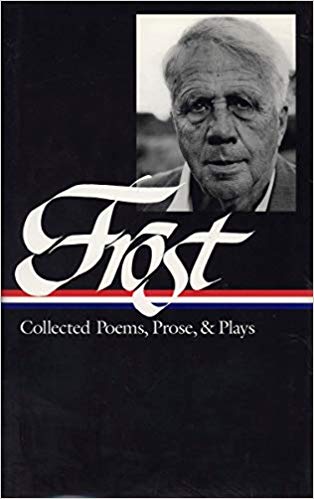

Review of Robert Frost: Collected Poems, Prose and Plays
By: Michael A. Arnold

There was reason to celebrate when Library of America released their collection Robert Frost: Collected Poems, Prose and Plays. It was, in a way, a final vindication — this is a poet to be taken seriously. Finally, the literary gods have seen that.
To introduce Frost's poetry to somebody, there would certainly be worse first poems of his than this late epigram:
'Forgive, O Lord, my little jokes on Thee
And I'll forgive Thy great big one on me.'
This probably best shows the tone of Frost's poetry, if nothing else. Depressed, yet there is a hint of a sense of humor in there too. With that humor, there is a tiny hint of hope, but a kind of hope that that has been hard–fought for, and hard won.
Robert Frost has a pretty secure place in American poetry, and maybe within the history of poetry generally, but within Modernism (one of the major artistic eras of the last century) he's somewhere on the outside. And yet, he's increasingly becoming accepted as a Modernist, as unlikely as that might first seem. With such prestigious names as T.S. Elliot, Ezra Pound, and James Joyce in the Modernist movement, this is something that is worth discussing. To be honest, Frost's 'outsider' position to Modernism is probably exactly what he wanted. As a person he was not one for being in a group, but always wanted to be outside — doing his own thing. But this outsider position has also resulted from his style of poetry. Reading a Robert Frost poem can be pretty easy, especially when compared with the complexity on the surface of, say, an Ezra Pound poem. Compared to Pound, Frost's poetry (set primarily in the rural New England where he lived) can seem very homely and traditional.
But, is it really? When Frost is read with a different point of view, perhaps after knowing one of his great influences was Emily Dickinson, he becomes much more complex, much more important, and much more interesting. Emily Dickinson is a poet who is only properly appreciated when read in whole. She used her poetry as an expression of her innermost thoughts, and throughout her life you could see her attitudes to things change, and her religious convictions weaken and strengthen; all framed around her contemplations on death and love. One poem can contradict another one, and when taking the two poems together their contradictions create more intense mysteries which are there intentionally for us to think through. Frost's poetry is no different.
There's a now famous breakdown of one of his most famous poem, 'The Road Not Taken', which is often read as an affirmation of going your own way, and be your own person — a kind of Emmersonian self–reliance. But, when looking more closely, the two roads before the protagonist of that poem 'both that morning equally lay', and this is often forgotten as soon as the reader gets to the pumped up, empowering ending — when the protagonist of that poem is really just fooling them self. In reality, it probably didn't matter which road he took, and it's just a choice — as meaningless to the cosmos as anything else. This is just a hint at the complexity that can be found in Frost's work, and keeping this poem in mind is a good start.
There is no god in Frost's work. Frost often references god, and often uses religious imagery, but his is a world where it is at least questionable that there is a higher power. There is certainly room for a god, and from his poetry you get the impression Frost would even like there to be one, but that higher knowledge is not yet known — or potentially unknowable. This attitude is seen as early as his first collection, A Boy's Will, with the poem 'Stars'. To make it absolutely clear what his position is, in the first edition of the book he included little notes on the title page to briefly describe either what each poem meant or what they basically meant – the note for 'Stars' is 'There is no oversight of human affairs'.
Ambivalence is a major theme in Frost's work. In the poem 'Out, Out', when a young boy's arm is cut off and he dies, the poem ends with this:
No more to build on there. And they, since they
Were not the one dead, turned to their affairs.
These two lines show Frost's ambivalence perfectly. 'No more to build on there', as if a human is only something to be worked. And the others in the poem (just his family?) having such a muted response can seem cold and robotic. Is it that, or is it that they are sad but dealing with the death in their own way? Or is it because they know if the work is not done then they too will suffer, and even could die in the rural wilderness they all live in. Nature is cruel enough to kill a young boy, so should humans be reflecting that? These questions are not answered Frost simply gives us this ending, just like he gives us the ending to the boy's life, without comment or emotion, so what can we really take from that?
These are the kinds of questions Frost is inviting us to ask, but if there are answers to them they are hard to pin down. There may not even be answers at all, and 'answers' could just be things people tell themselves to feel better about living in such a wild and unforgiving universe as this one. This is not at all to suggest that Frost does not have positions – he does, and when you read enough of him you begin to see them, but it is that ambivalence, or void — and an awareness of it — that is constantly being returned to. Frost seems to think that our response to that void is what makes us who we are.
Frost, then, is in no way a moralizer. He's asking you to come up with your own ideas, be self–reliant as experiencers of life. Just like the New England landscape he portrays in his work, the world, in his vision of it, is a wilderness. New England to him is a place where people are struggling, suffering, arguing, crying, laughing, dying. Often the people he portrays are presented objectively – fairly, both sides are heard. This is especially true in the many long, blank verse poems that are conversations between two characters — such as the ones that appear in his second collection North of Boston.
This isn't what often comes to mind when actually thinking about Frost's work, however. For some reason, the image that keeps coming back to me is of a crow sitting on a wooden gatepost cawing, in front of a stark and foggy autumnal day. Which is quite a bleak image, but Frost is often bleak. He suffered from depression throughout his life. It is also, I think, quite a beautiful image. Scenes of beauty run throughout Frost's work, but they are always a natural beauty. There is nothing artificial or urbane in Frost, the real world is enough. Whenever the city is referenced, it is either quite negative or an extension of the natural world, such as in the poem 'Acquainted with the Night'.
Frost is not an urban poet, and so he can be directly contrasted (in basically every way) with a contemporary like T.S. Eliot. Eliot, at least early Eliot, is a poet of the city – especially with poems like 'The Love Song of J. Alfred Prufrock'. Frost is decidedly rural, focused on nature's effects and its reaction with human beings. But there is more to it than just this. Reading Eliot and understanding the surface of the poems, what is actually happening and finding out basically what his poems are trying to convey is hard work. Any handful of lines needs at least a few rereads or some good annotations just to understand them in some way. Frost is not like this. Frost is immediately more direct with both his subject matter and his imagery. It is quite easy to read a poem like 'Mending Wall' or 'Death of a Hired Man', especially when compared to a poem like 'The Love Song of J. Alfred Prufrock'. Yet, once you start puzzling out the obscure references, the shifts in tone, voice, speaker, and finding the intent in Eliot he becomes a lot more comprehensible. Frost is nothing like this, instead he offers something closer to the real ambiguities of the world. When reading Frost we have to ask ourselves 'why he is telling us this'? What is tone — is he joking? And is there something he is not saying? In a way, reading Eliot is a lot like viewing a painting by Picasso or Matisse, while reading Frost is like one of those late night conversations with a friend who is having some kind of deep existential crisis. To put it another way, Eliot is 'intellectual' (and this is not critical of Eliot not at all) while Frost is intellectual. In many ways he is the poet of human weakness. He asks the questions we all ask ourselves, and the universe, in our darkest moments. But in Frost, like in our own lives, it is our jobs, and only our jobs, to work these questions out for ourselves — his poetry can only help us along the way — because he does not have the answers either. This is arguably deeper than any of the other Modernists were willing to go, Frost is constantly questioning the central questions to the human condition — not just the questions at the heart of modernity.
Because of this, Frost fully deserves his place in modern poetry — and 'Modernism' by any metric, and also he deserves the recognition as the really great poet he actually is. To read Frost in full, in any of his collected works, is to experience both a great poet and a human mind battling with existence itself, and what it really means to exist.
'Forgive, O Lord, my little jokes on Thee
And I'll forgive Thy great big one on me.'
This is why his recognition as a major American poet by Library of America is so important.
The major thing about this collection is that it includes a lot, perhaps not all but almost everything, of his uncollected and unpublished work too. These are, for the hardcore Frost fan, just interesting, they never quite reach the amazing highs of his best work, and some of them frankly are from his youth and are not even very good, but they are interesting to see. It also includes his plays, and a healthy amount of his prose — including early short stories, and Frost was a decent short story writer. There are also essays, random articles, and a handful of letters that would be important to students and scholars of his work. There will be, and are, more comprehensive collections of Frost's letters and prose elsewhere, but the ones collected here are judged to be the most important – and there is enough here for any aspiring poet to learn from and be inspired by. All of this is obviously secondary to his poetry, there are few people who remember Frost as being a great playwright or essayist, but these are just additions to a fine collection of his poetry.
But the major selling point of this collection, over all the others, is the editing. Good editing can be the single most important factor in deciding to buy a book for the discerning reader. To show an example of what I mean from another writer, the British ghost story writer M.R. James, the first sentence of the story 'Oh Whistle and I Will Come to You My Lad' is originally:
'I suppose you will be getting away pretty soon now full term is over, Professor,' said a person not in the story to the Professor of Ontography,
While a recent editor decided to change it to this:
'I suppose you will be getting away pretty soon now, full term is over, Professor,' …
The separation of the person's comment into two distinct clauses not only changes the meaning of the comment, but also its implication. The implication in the second is that the professor needs to be reminded that the semester is over and it is now the summer holiday, which is a little ridiculous.
If you were to pick up another edition of Frost's poetry, the most commonly reprinted text of his work was edited by Edward Connery Lathem, who made choices to change certain things while editing Frost's texts such as putting a comma when there was not one in the original manuscript. However innocently intended, an editor's choices might lead to shades of meaning, or meanings, that the original author might have never wanted or intended, and could at worst obscure what was actually written, like in the example above. This was a major criticism had this current volume's editors had against Lathem's edition of Frost's work – the two editors here are Frost scholars Richard Poirier, who wrote an excellent book on Frost regarding his place in the Modernist canon called Robert Frost: The Work of Knowing, and Mark Richardson who previously collected and edited Frost's prose, and who also recently collected all his correspondence into two authoritative volumes. These two editors are eminent in Frost scholarship, and their work on this book should absolutely not be ignored nor underestimated. Their editing involved, which happens with all Library of America books, going back to the original manuscripts and re–examining them — trying to find what later editors either missed, failed to understand, or changed to suit their own tastes.
This collection is, in short, a vital edition of a vital poet's work. Robert Frost is a poet that rewards reading, and rereading — which is perhaps more important. Frost is so often characterized as an emblematically American poet, when in reality he is not just that. Instead he is a profoundly human poet; and one who can say something to anyone — even those who only read him on a surface level. There is value in a surface reading with Frost, because even then he is a really good poet. Those who want more can instead find a deeper, richer, darker poet — who is also a really good friend.