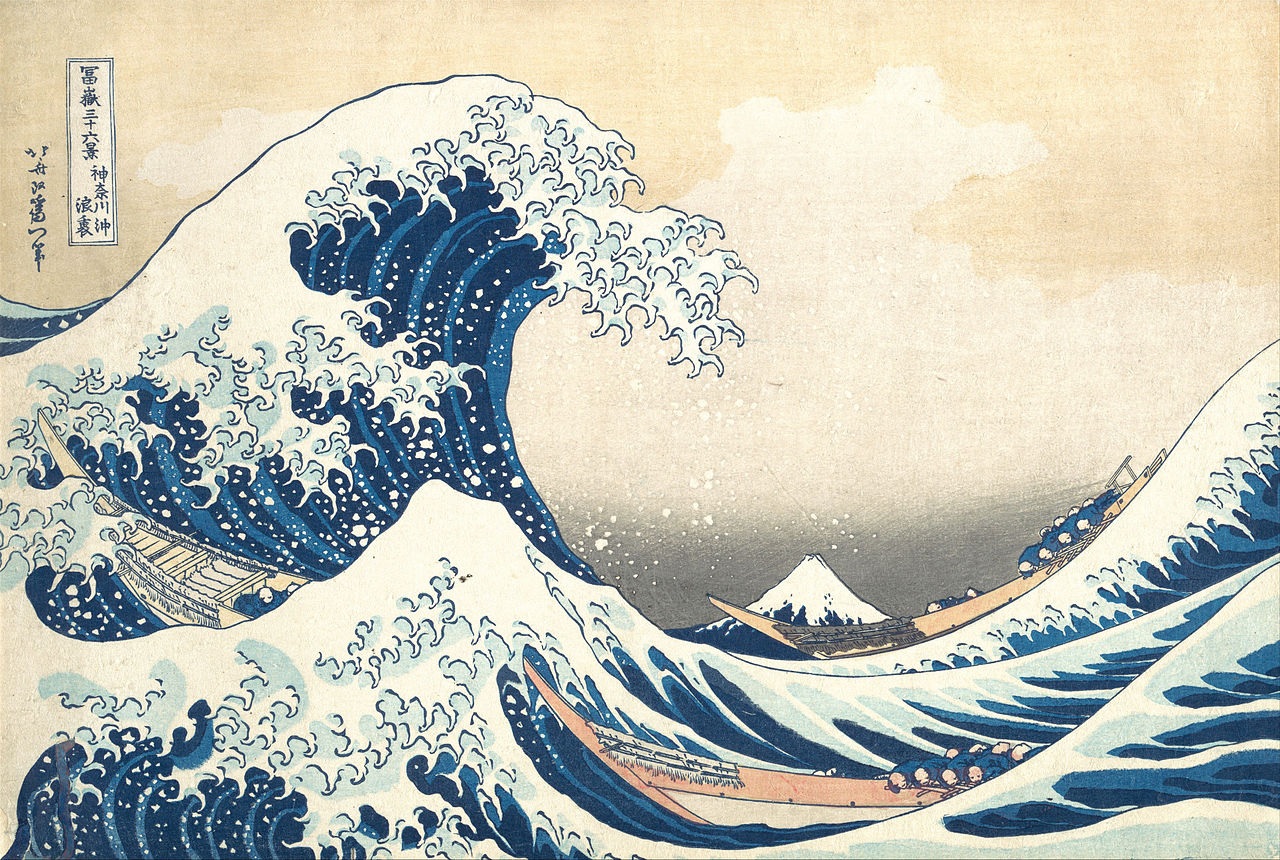

Review of Hokusai's The Great Wave off Kanagawa
By: Michael A. Arnold

Japan is unique. It holds a huge fascination for westerners, and it has since about midway through the 19th century. Japanese art has been highly respected by western writers and artists, from Van Gogh onward, and it has greatly inspired their own works. Also, Japanese things have been popular in the west more generally, especially after the rise of anime after the 1980s and 90s. These days the wounds of WW2 have been largely forgotten, and the old ideas of Japanese conservatism and Imperialism appear to be (from the outside at least) something of the past. It can now seem strange to think of Japan as anything other than a kind of endlessly interesting, high–tech wonderland of cat cafes, robots, and video games, but for most of its history Japan simply was not like that at all.
For most of its history, Japan was extremely conservative and isolationist. It was not until 1853, when Commodore Matthew Perry of the United States navy arrived in Edo (now Tokyo) Bay and demanded Japan open its markets to foreign (particularly American) trade that the majority of foreigners were allowed on Japanese soil at all. Before that, only Dutch sailors were allowed to enter a few, select cities in the west of Japan – and this was only because of unusually good relations, and because they imported a lot of gunpowder.
This being said, in a painting like The Great Wave off Kanagawa (painted sometime around 1830) the influence of the western world is not unseen. The primary color for the sea is a deep blue, known as 'Prussian Blue', which was originally from Germany and had first come to Japan through Dutch traders — people who also shared their art with the Japanese during their trading missions. In a sense, then, this painting is the result of a connection between east and west, but what influence western art had on Japan at this time was probably very limited, because of the heavy restrictions on foreigners at this time. However, this painting was not seen, and still is not really seen, as a prime example of Japanese high culture. This painting was originally painted in a book of woodcuts — supposed to be mass producible and inexpensive to appease the middle class' demand for art. While it saw popularity, it was considered quite a low–brow — which is probably why a western influence was more acceptable here than elsewhere.
If Japan wanted to keep its political and social systems intact, history seems to suggest that caution, like travel restrictions and isolation, was the way to do it. Almost immediately after Japan opened its markets in the 1850s there was a rushing wave of changes that led to the collapse of the Edo period (around 1603 to 1868), the Boshin War (which saw the fall of the Samurai) and the beginning of Japan's modernisation. But, we should not think of late Edo artists like Hokusai as being at the foundations of Japan's artistic modernity, knowing how that period of Japanese history ended. Any interpretation that suggests this might be somewhat anachronistic at best, and at worst ignoring the development of Japanese artistic tastes up to that point. However, a painting like The Great Wave off Kanagawa (painted sometime around 1830) can so easily be seen in that way – which may be one way this piece continues to have such a unique power. The painting is absolutely beautiful, depicting a terrifyingly huge wave starting to crash down on a few small fishing boats, while Mt. Fuji stands in the distant background. Mt. Fuji itself, even today, is seen as symbolic of the Japanese national identity, and it is almost like the wave is falling onto it, as well as the fishermen it is literally falling on. It is almost as if the painting is saying that Japan itself is being smothered by a soon coming wave of change. But this is far too easy, and (again) almost certainly anachronistic.
Mt. Fuji, with its snow–capped single peak, is an exceptionally special symbol for the Japanese for themselves, as a symbol of beauty itself, and also for immorality too. It is not known where the name came from, but one interpretation of 'Fuji' is 'deathless', or 'not death', and the mountain is a vital religious symbol for the native Shinto religion. While the heat from the volcano could kill everyone, the natural water that comes down from the mountain is also a source of fertility and life. Because of this, the mountain has been seen, since ancient times, as a dwelling place for the gods. The fact it stands at the back of the painting is very important.
In the painting: there is a dark sky behind the mountain, but otherwise the sky is light — and so light and darkness are in one. The wave is a huge, almost monstrous thing, with white sea horses that look almost like claws, visually suggesting the movement of the water as it collapses onto the barely seeable fishermen below. The sea itself will obviously be an important symbol to an island nation like Japan, who is reliant on it for a big part of their diet, but it is also something to be feared and respected. This is something shared by many island nations around the world. There is something very beautiful in the sea too, and this appears to be suggested in the painting by a smaller wave, at the bigger wave's base, that is just slightly taller than Mt. Fuji, with the white of the rising sea almost, but not quite, mirroring the snow on the distant mountain top. This is associating the wave with beauty and immortality directly, but it is also dangerous — with the huge wave reaching high over it. As such, this is a symbol of a simultaneous savagery and beauty in the sea – or perhaps even nature itself.
A big part of Japanese cultural history is the idea that all things are only temporary. This is an ancient, and deeply entrenched idea, found as early as the ancient Japanese masterwork The Tale of Genji, written by Lady Murasaki Shikibu (who lived around 973 to 1031). Japanese aristocrats, even as far back as the medieval Heijan period, were expected to be sad at the fleeting nature of life — and of beauty too. There was the understanding that all things in this world, even things of great beauty and importance, will die and fade, and one day be forgotten. This quote from The Tale of Genji sums this up cultural meme well: 'Like the waterfowl that play there on the lake, I too am floating along the surface of a transient world'. This is not a symptom of any kind of depression Genji might be experiencing — this is something central to the culture the novel is set in. This outlook has continued to roughly modern times, it is a major theme of the work of Yasunari Kawabata – that something can seem so beautiful it makes the viewer sad, because either the moment of appreciation will soon pass. Beauty always dies, and it is worth remembering this when looking at The Great Wave off Kanagawa.
The waves in the painting are so big and dramatic they almost look like they are climbing over and crushing Mt. Fuji, like they are climbing over and crushing the sailors that are literally below it. Yet the light on Mt Fuji's snowy peak seems to suggest that this scene is happening in the morning. There is death, in the implied death of the fishermen, but the new day also suggests new life. There is beauty in the scene, and the painting itself is very beautiful, but also there is also the darkness, and the sea's fury. With these things together, there is a kind of harmony captured in the painting – a kind of yin and yang. Yet you cannot have beauty without the death of beauty, just as you cannot have life without death — because for things to die they must first be alive to die. This is a duality, and this painting is a visual presentation of it.
This painting is the first in a series called 'Thirty–six Views of Mount Fuji', which is a collection of scenes from around the mountain. This painting is perhaps the most famous of this collection, but they all in some way capture images of normal life and nature in the area, at various points in the year. The series often shows a contrast between the calm permanence of the mountain with the violence and turbulence of the world around it, and in doing continues to show the duality of death vs permanence that The Great Wave first introduces. Yet this is also suggestively complicated by the 'Great Wave' being higher than Mt. Fuji. The implication could be that while people may die, Mt. Fuji is in the background and is always permanent, and yet there is also the darkness behind the mountain. This darkness might be snow clouds, or might be the night that is passing on. It can also be taken as both, and perhaps this is the point: the darkness behind the mountain, and the violence of the sea, are in harmony with the image of Mt. Fuji and the breaking morning. While the great wave is drawn to be much higher than Mt. Fuji, from the viewers' perspective, there is also much more light in the sky than darkness. The darkness is still there — yet there is the holy permanence of Mt. Fuji itself. It is a bit like the thought experiment: what happens when an unstoppable force meets and immovable object? In the resulting conflict a balance is created. And yet not only is great wave taller than Mt. Fuji, it looks like it reaches the clouds themselves. The balance could be unbalanced.
When the Japanese markets opened up to western trade, Japanese art flowed out of the country like never before, and found new audiences and appreciation in the west. Particularly in France, there is a direct influence in the Japanese use of color on the then emerging Impressionist movement. The Impressionists moved away from the staunchly 'academic', purely realistic Romanticism that had come before. The focus for Impressionists was less on the exact right color, but instead giving an impression of the scene. Compare, for example, a work like Paul Delaroche's Bonaparte Crossing the Alps with Camille Pissarro's Boulevard Montmartre — which does not seek to appear like a mirror of reality but instead shows a kind of interpretation of a scene. This new use of color was directly influenced by Japanese art like The Great Wave of Kanagawa. And yet, this painting, too, shows that the west inspired the Japanese with a new use of color too, more exactly with new colors coming from the west. If there is another kind of balance in this painting then it is a balance between east and west, but from a Japanese perspective. This is probably one reason why the painting continues to be so loved and reproduced to this day.