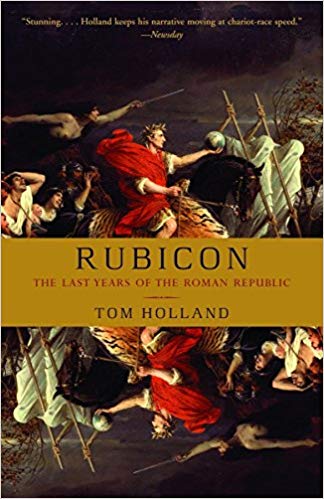

Review of Rubicon: The Triumph and Tragedy of the Roman Republic by Tom Holland
By: Michael A. Arnold

The death of the Roman republic – is there a better example of an idealistic idea falling apart? Life was brutal in the classical world. Babies born with obvious 'imperfections' were left in the wilderness to die, and slavery was not only an alternative to killing POWs in war — sometimes wars were fought specifically to enslave other human beings. Democracy in Athens soon fell to dictatorship, and the kind of freedoms we enjoy now would not be seen for at least another thousand years. Life was 'nasty, brutish, and short'.
And yet, as unfair as it actually was in practice, the ideal of the Roman Republic was pretty revolutionary. It was to be political system where no one person held all the power, instead power was split there two consuls (president–like leaders) at once, advised by the Roman senate, each one to keep each other from becoming too powerful and so could become a tyrant. This was done so everyone's ambition was kept in check in some way. Another aspect of this system is that anyone, from the richest to the poorest citizen, could have their voice heard in some way. Of course, this was with certain conditions: you had to be male and you had to be a citizen, and poorer Romans were not considered to have as much value politically as wealthier Romans, but still, everyone had some part in the running of the country. Senatus Populusque Romanus – SPQR – The Roman Senate and People. At that time, in a world full of kings and tyrants, this sort of system was unique.
And yet, like Athens' democracy, the Roman Republic failed in a cascade of violence — leading to empire, and the dictatorship of the emperors. How this happened is explored in Tom Holland's 2004 book Rubicon: The Triumph and Tragedy of the Roman Republic published by Anchor Press. Unlike Athens, by the time the Roman Republic fell apart it had hegemony over (pretty much) the entire Mediterranean Sea – Portugal to about the western border of modern day Iraq. So something huge must have happened, right? The punch line is Julius Caesar.
Julius Caesar is one of those rare people who singlehandedly changed human history — his political and military genius was only matched by his ambition. It's hard to not blame at him alone, but this book does point to a lot of the complexity and the wider world — things that are often missed in this subject. In his history of the classical world, Robin Lane Fox said that the Roman Republic could have, and should have, recovered from Caesar's ambition but it did not. Was there more to the end of the republic than just the ambition of one brilliant general? That question is what this book is built around.
This book starts with a very evocative and very effective depiction of Julius Caesar with his thirteenth legion on the banks of the Rubicon River, spending all day mediating on a single decision. He had just won Gaul, which was all of modern day France, for Rome and yet because of some corrupt political maneuverings of his before the war, and the fact he subjugated the entirety of France without actually asking anyone in the senate if he could (killing easily over a million people, some of them Roman allies), he was being called back to Rome to answer for his crimes. He had two options: either 1) stay in Gaul and keep his head down, hoping he'd be forgiven in time, or 2) cross the Rubicon and return to Rome, face trial, and be arrested — possibly executed. Caesar decided to cross the Rubicon with the thirteenth legion, declaring war on Rome, famously saying 'let the dice be thrown', more commonly 'let the die be cast' — a reference to gambling, declaring war on the Roman government was quite a risk.
From there Tom Holland goes back in time, looking for more in–depth reasons behind any instability in Rome's political system, and trying to find the seed of the tree that uprooted the whole republic. He goes back to the Punic Wars with Carthage, and then takes us forward through the Roman conquest of the Mediterranean, the life and times of men like Sulla (a particularly controversial figure in Roman history) before returning to Caesar and his wars. The book is asking us to question wither a man like Caesar inevitable, or was he a symptom of a larger problem? The historical events this book describes was what determined the rest of Roman, and ultimately European history, so who or what is ultimately to blame?
There probably is not one answer to any of these questions, and the book is rather more framed like a story than an actual exploration of these questions. This is clever in two respects, principally because Tom Holland is an excellent writer. His description of Caesar meditating on his decision to try and overthrow the republic is exceptionally skillful, and honestly could have made an excellent start to a novel with a bit of editing. Also because there is probably far too much information and too many interpretations of this information to fully explore this topic in a single book. This is not a scholarly book, but a work of popular history – the people who will go into a shop, see this book, and will buy it for themselves are going to be people who want to know enough about the subject, not everything about it. They will probably not want or need to understand every single detail in a rigorous or academic way. A book with that level of detail would probably have to run though several volumes, be extremely boring and meandering, and would certainly become outdated extremely quickly, given how quickly research progresses.
It is actually very hard to prove anything for absolute certain when you look into details more academically. Holland rather bravely admits this in his preface, with reference to Caesar crossing the Rubicon. Yes, Caesar is remembered crossing the Rubicon river, but we don't know if he had any scouts already on the other side, which strategically speaking is good common sense and something he did everywhere else, and we do not know where the Rubicon was. There is a small Rubicon River in the north east of the Italian peninsula, but it was only given that name in the 1930s, and while there is some academic consensus on this identification it is still uncertain. In Classical, Roman times, the Rubicon river separated the province of Italia (basically central Italy) from Cisalpine Gaul (basically modern day northern Italy), but no one knows where Italia stopped and Cisalpine Gaul began. Since we do not know for sure where the original Rubicon River was, this is a margin of error some hundreds of miles wide. We don't know when it happened either, because calendar changes in the 2,000 years since Caesar's day are often hard to work out exactly, and because of this we may not even have the accepted year right — never mind trying to work out which month it might have happened in. All we know for certain is that at some point, Caesar crossed a river, somewhere, that symbolically declared war on the Roman republic – that is not much.
There will always be things we simply do not know, but what this book describes is the generally accepted view of events and puts them forward in a well written and accessible way. It does have a habit of sliding into 'Great Man history', but given the strength of the personalities during this specific time that would be very hard to avoid. There are also details in this book that are presented, and are woven in, but on reflection leave you wondering why they are there. At one point it is pointed out that Roman apartment buildings for poor people were called Insulae, the Latin word meaning 'islands', and then goes on to explain the mindset behind this word choice. While some will find this sort of thing interesting, others will not. But this is something found in all popular history books. Mary Beard hypothesized in her book on Pompeii that, because of the craze for a food condiment called Garum, which was a fermented fish sauce, Romans would have had very bad breaths.
Small details can make a distant period in history come more to life, or feel more vivid once you know them. The thing that should always be kept in mind is that any detail might not be actually 'known', and most things in any book like this could potentially be proven wrong. If someone had only read this book, and assumes that everything happened exactly the way Tom Holland describes, their view of the events will be informed but very limited. This is not at all a criticism of either Tom Holland or this book – this is true of literally every history book that has ever existed. It is actually to Tom Holland's credit that he admits this. It is just that there are entire libraries of findings and opinions on any one person or event described in this book, especially on Julius Caesar and Cicero, and such a huge wealth of information is probably more than any one person could manage to read in their lifetime. Also, if a person was to read literally everything ever written on the fall of the Republic and you asked them why it happened they still might genuinely say 'I don't really know'. History is like sand forever slipping through our fingers; there is enough here to tighten a good fist around, but there will also be a lot of sand grains that fall through.
This is definitely a book worth recommending, and worth reading. If you are really interested in this subject then it is worth reading more. But – if you only had to read one book on this subject, you could do a lot worse.
4 out of 5 stars