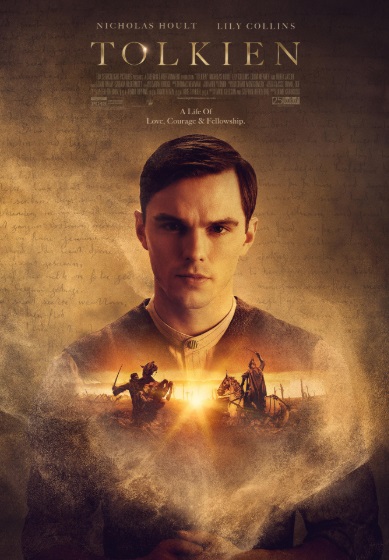

Review of Tolkien
By: Michael A. Arnold

There is something important to say about Tolkien, before looking at the film itself. Before the film was released there was a widely shared news story that the Tolkien estate had disowned the film, but this was not exactly true. Instead, the family had no active part in the development and gave no blessing to the film, and this is a critical difference - this is something they have done with all adaptations of J.R.R Tolkien's writings, even Peter Jackson's excellent The Lord of the Rings trilogy, and in no way unique to this new biopic. There isn't an obvious reason why this news would be, as it has been, so widely shared on social media. It has even suggested to some, even before the film came out, that it is not very good or a disappointment. This might have ended up harming the film at the box office - if so, that really would be a shame.
J.R.R. Tolkien has to be one of the most instantly recognizable names in modern literature. His books are sold worldwide, and have entered our cultural background. His name is in every way synonymous with fantasy, and he is one of those writers everyone has heard of even if they have not read a single word he ever wrote. As such, a film retelling of his life was inevitable at some point, even ignoring the current trend for biopics. The advertising for this Tolkien film has by now dried up, but around the time of release it was very common to see posters of it on the sides of buses. This can be attributed to the studio that produced the film knowing some of the less than enthusiastic air around the release, but in general a film is made or broken (as with anything creative, really) by word of mouth. Especially now Netflix is the phenomenon it is.
As a film, this is extremely well made. The actors are good and natural. Nicholas Holt does not look much like a young J.R.R Tolkien, but this barely matters as he is a very dynamic actor – able to capture an emotion with his face and voice in a way that is natural. The same can be said of Lilly Collins who plays Edith Brat (Tolkien's eventual wife), if this can be said of just the lead actors then that would be good enough, but the supporting cast around them are of such a high standard that every scene feels like events from life, rather than just scenes in a film. Through these performances you learn a lot about each character, and watch them grow up and develop as people. The highlights are the scenes of Tolkien with his school friends, which always feel like genuine friends having fun and being silly together. Each one being so quirky and full of personality it makes them very fun to watch. All this is due to the script being as well written as it is delivered, and it was nice to see the film showing Tolkien's getting into fights with friends, and in general being a typically silly, and at times very lazy young man. We see his flaws, but also how he changes as he grows up, and because of this we the audience really start to care about him.
But history has a way of acting on our lives, and there is something to be said for the influence of history on the present. History has its effect on this story, and the crux of the film is Tolkien's involvement in the battle of the Somme during WW1, as an officer in the Lancaster Fusiliers – this is so important the film opens on it. In Tolkien the ‘present' is the battle, and his childhood and development to that point is shown through the use of flashbacks As we see Tolkien's progression through the battle we see more of his past, and we see a man increasingly confused by illness and the horrors of trench warfare. The suggestion is that the confusion caused by the illness is reflective of his anxiety over his personal life and struggles, and he becomes more disorientated during the battle as the film goes on. This is because the central lesson of the film, and Tolkien's life, had not yet been learned by the Tolkien character. This concerns the effect of history and how memory, cultural (and so history) and personal can continue to affect and influence the way we live and see the world. During the battle the Tolkien character is seeing evil, and is using his memories to find a way to understand it.
This is important, because this film does not exactly match the events of the real Tolkien's life. This is why it must be distinguished between the real Tolkien and the Tolkien character in the film. The real Tolkien probably never stumbled into no man's land looking for a childhood friend, nor are the events of his actual life portrayed with total accuracy, such as his relationship with Edith. This is a flaw, perhaps the greatest flaw with the film. Because it reorganizes and adapts Tolkien's life to be more like a typical biopic, the authenticity of the film is hurt and only serves to cheapen it. Another flaw in the film is that Tolkien's religion is presented as being incidental in his life – even for a time a hindrance. This is simply not true, the real Tolkien was a deeply religious man, and his faith was not just an influence on his fantasy world, it was a fundamental component of it. The religious aspects of Tolkien's personality are there, but they are subtle ‘blink and you'll miss it', and at times even open to interpretation.
This has presumably been done to make Tolkien's life more relatable to a general modern, and probably more secular audience, but this does not sit happily with the message of the film, and a major lesson in Tolkien's life. The past, or things with an artificial distance, like fantasy (or as Tolkien would probably have preferred: fairy stories) and mythology can be a balm that heals the pains of the present – this is actually said directly in the film by Tolkien's friend and philology professor Prof. Joseph Wright, played by Derek Jacobi. This was the key influence on his life and work, and is both directly mentioned in the film and is the major theme of it. Every section of the film, and almost every scene, refer to this theme or develop it in some way. This might sound like the film is dryly pushing a message, but it is not dry. It is done naturally, and because of this the film feels very cohesive and well developed. Despite flaws, these better aspects of the film make it worthy of being seen.
The scenes of battle are probably the best of the whole film, especially with the subtext of of Tolkien facing real evil, the kind he mythologized in his writing. They show all the brutality of WW1, and the sense of danger and brutality on the battlefield is really impressively handled. It is at once like something from All Quiet on the Western Front, and Fear and Loathing in Las Vegas because of Tolkien's hallucinations. The effect of them is to show that fantasy and reality are not just being fused but they are complimenting each other - and not just in the future author's head. Even if these scenes are largely factious, they excellently act as an anchor for the film in a way that is both impressive in a visual way and in an abstract, symbolic way.
This is perhaps not a great film, it is no Apocalypse Now, and it has a few flaws that might take away from the film for some. But with these flaws forgiven, this film is one of the most entertaining, emotionally resonating, and genuinely impressive films about a writer that one could hope to see. This film, unlike so many others, actually has subtext. There is a serious point to be made with it, one that has influenced a lot of Tolkien's writings and is so seldom appreciated by his readers. That is why this film is worth seeing, flaws and all – and the flaws will be more forgivable for some than others.
For the movie Tolkien receives four stars!