

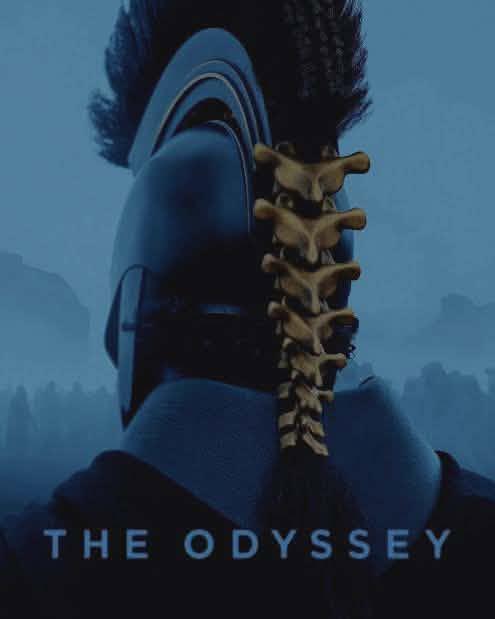
One of the film's most striking departures from Homer is the complete omission of Odysseus's famous ruse: he never tells Polyphemus that his name is "Nobody", never plies the giant with wine, and never relies on the verbal trick that, in the original poem, causes the blinded cyclops to cry out that "Nobody" has attacked him. Without this deception, the sequence becomes a raw physical ordeal rather than a contest of wit.
He was portrayed by Bill Irwin. Nolan cast the veteran physical performer and clown specifically for his mastery of movement. Irwin performed in full-body prosthetics and makeup, supplied live vocalizations and noises on set inside a real Greek cave, and guided the movement of a 60-foot practical puppet so the human actors had something tangible to react to. The result is a deliberately non-cartoony, alien giant (lumbering, saggy, powerful, pitiful, and terrifying) whose odd body language and emotional undercurrents feel rooted in a human performer's intelligence rather than pure digital creation. Nolan has linked the approach to Guillermo del Toro's idea that a monster is never just a monster.
In the film, Polyphemus is depicted as a slim, gnarled giant with pale gray, elephantine skin and massive hands with broken nails. His face features an asymmetrical nose and a single eye set in a vertical slit. He wears no clothing. At approximately 60 feet tall, he ranks among the largest cinematic portrayals of the character.
Polyphemus is the son of Poseidon and the sea nymph Thoosa. He lives a secluded life as a shepherd on Sicily. Each day he leads his flock out to graze and returns them to his cave, sealing the entrance with a massive boulder.
Odysseus and his crew discover the cave after following one of Polyphemus's stray sheep. Hoping to receive hospitality in accordance with Zeus's law of xenia, they take refuge inside. When Polyphemus returns with his flock, he traps the men by rolling the boulder into place and immediately devours two of them before falling asleep. The survivors attempt to kill him while he sleeps but realize they cannot move the boulder without him.
The following day, while Polyphemus is away with his sheep, some of the men manage to escape; Odysseus, Eurylochus, and a few others remain inside. That night Polyphemus returns, eats two more men, and falls asleep again. Odysseus wakes him, and the crew drives a sharpened stake into his eye. Blinded and in agony, Polyphemus cries out to his father Poseidon in a language the men cannot understand—there is no "Nobody" claim, no drunken confusion, and no clever verbal escape.
The next morning, he removes the boulder and feels each sheep's wool as it exits the cave. Odysseus and the remaining men camouflage themselves among the flock by covering their armor with hay and slip out. Once clear of the cave, Odysseus shoots an arrow at Polyphemus. The cyclops howls in pain and pursues them through the forest toward their ship. The entire confrontation unfolds without the iconic naming trick that defines the episode in Homer.
The total absence of the "Nobody" ruse is one of the film's most deliberate and notable changes from the original myth (a choice also made in the 1954 adaptation). By removing both the false name and the wine, Nolan turns the encounter into a pure struggle of force, stealth, and survival. Unlike the mythological figure, the film's Polyphemus does not speak except when he cries out to Poseidon.