
Review of Contemplation in Color, Gérard Fromanger’s Portrait of Jean Paul Sartre
Contemplation in Color: Gérard Fromanger's Portrait of Jean-Paul Sartre
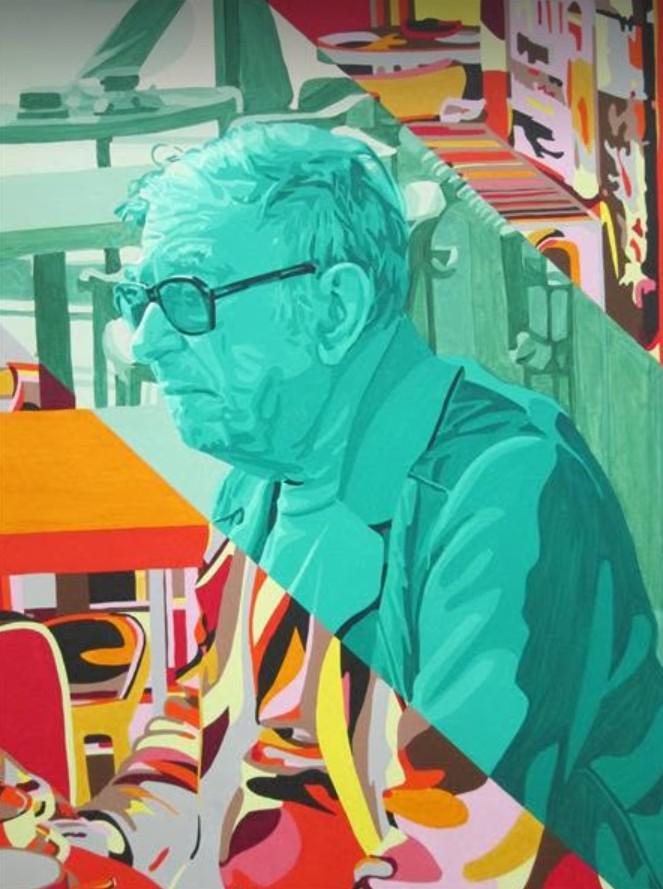
Gérard Fromanger's Jean-Paul Sartre (1976) is a striking Pop Art / Figuration Narrative portrait that matches the description provided. Sartre appears in profile, seated at a café-like table, wearing his distinctive glasses. The composition is structured around a bold diagonal division:
Cool monochromatic palette of teal, mint green, and cyan. Sartre's head, glasses, and jacket merge into a flattened, stylized interior background in the same cool tones, creating a sense of contemplative stillness and detachment.
Explosive warm Pop Art colors (vivid reds, oranges, yellows, pinks, and black) with dynamic organic shapes and flowing patterns that energize his torso, clothing, and the surrounding furniture.
Fromanger's characteristic flat color fields, sharp outlines, and graphic simplification heighten the contrast between cool, passive reflection above and vibrant, almost kinetic energy below. This visual split embodies a dialogue between intellectual detachment and the lively, colorful flux of lived experience—perfectly suited to Sartre's existential themes and Fromanger's engagement with urban life, media, and political energy in the mid-1970s.
Fromanger, a key figure in Figuration Narrative, often mixed photorealist elements with pure color and abstraction. This work belongs to a series of portraits of intellectual friends (including Michel Foucault) from around 1976, in which he dissected figures across different painterly registers. His broader practice spanned painting, sculpture (notably the Souffles inflatables of 1968), film collaboration with Jean-Luc Godard, and close dialogue with thinkers such as Foucault, who wrote about his photogenic painting.
The painting remains a vivid example of how Fromanger used color not as decoration but as a charged, almost political and poetic force.
Quote of the day by philosopher Sartre: "Man is not the sum of what he has already, but rather the sum of what he does not yet have, of what he could have." Some ideas arrive without fanfare. They settle quietly, like a thought you only recognize once it is already inside you. Jean-Paul Sartre's line belongs to that rare category. It does not flatter the self you have assembled. It asks, instead, who you are still becoming.
This tension between the finished and the unfinished finds a vivid visual echo in Fromanger's Pop Art portrait of Sartre. The philosopher sits at what appears to be a Parisian café table, rendered in profile with his signature glasses. A bold diagonal divides the canvas. The upper half is cool and restrained (teal, mint green, cyan) Sartre's face and jacket dissolving into a flattened interior. The lower half erupts in warm, kinetic color: reds, oranges, yellows, pinks, and black, with flowing organic shapes that animate his torso, clothing, and the surrounding furniture. Flat fields, sharp outlines, and graphic simplification turn the figure into a living contrast: contemplative stillness above, restless energy below.
Fromanger's split image makes visible what Sartre argued in philosophy. Identity is not a résumé of degrees, roles, and past achievements. Those are the cool, settled half—the facts already possessed. The warmer, unfinished half is possibility itself: the sum of what one does not yet have, the choices still open, the self still in motion. In Being and Nothingness, Sartre insisted that consciousness is defined less by what it is than by what it is not yet. Humans arrive without a fixed essence; meaning is made, not discovered. Feeling incomplete is not a flaw to correct but the condition of freedom.
In a culture that prizes milestones and polished narratives, this view remains quietly radical. A career setback does not close a life, nor does success seal it. What matters is the capacity to choose again, to project forward, to act amid uncertainty. Responsibility and possibility travel together. Sartre lived this restlessness. Born in Paris in 1905, he moved between philosophy, fiction, theatre, and political engagement, refusing a single fixed identity. His partnership with Simone de Beauvoir and his rejection of the 1964 Nobel Prize in Literature both reflected the same refusal to let achievement freeze a living project into a finished symbol.
Fromanger's portrait, painted near the end of Sartre's life, captures that refusal in color and form. The cool upper register holds the contemplative profile we recognize; the vibrant lower register insists that the figure is still becoming. Together they remind us that as long as possibility remains, the self stays unfinished—and that unfinished state is not a lack, but the very ground of freedom.
Let The Contributor Know What You Think!