
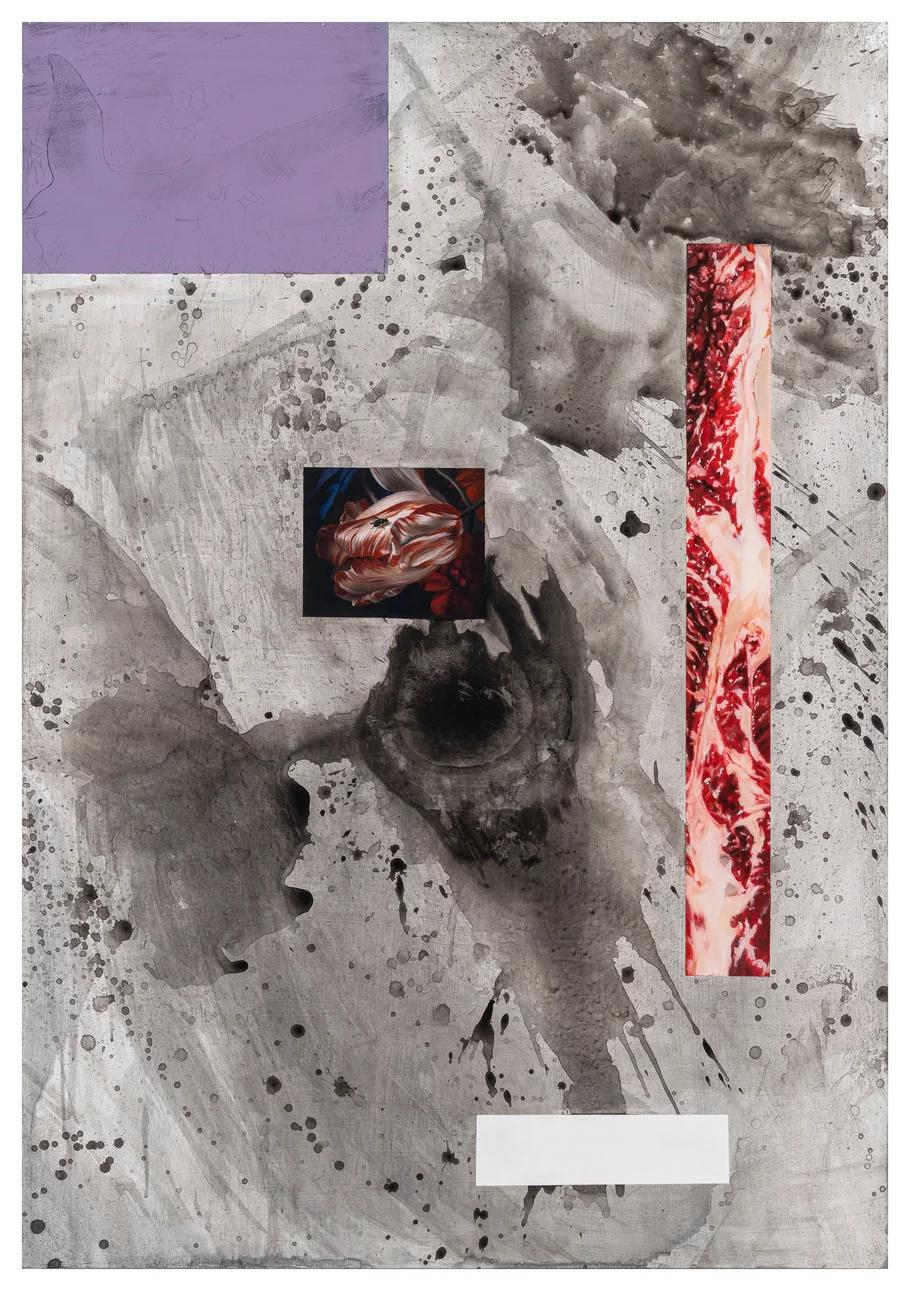
A Fly and a Whale gives you a first impression of collision. The painting does not present one complete scene. Instead, Meredith Sellers places fragments against a gray, ink-washed field: a tulip with a fly resting on it, a long strip of red marbled flesh, a purple rectangle containing a faint historical image, and a blank white bar near the bottom. The result feels like a damaged screen or several images competing for your attention at once.
Formal and technical observations
Sellers builds the painting through contrast and interruption. A few things stand out right away:
• The gray background is loose, stained, and splattered, which makes the surface feel unstable.• The tulip is small but highly detailed, so it becomes the main point of focus.• The narrow strip of flesh creates a hard vertical line that pulls the eye downward.• The purple and white rectangles resemble blocked windows, missing captions, or parts of a digital layout.• The soft ink washes clash with the crisp, photorealistic images placed over them.• The fly is tiny, but its dark body is easy to notice against the pale folds of the flower.
The technical approach is controlled even when the painting looks chaotic. Sellers uses oil, acrylic, and ink on panel, combining transparent stains with sharply painted details. The smooth panel supports the clean edges of the tulip and flesh, while the ink drips and pools across the larger surface. The painting feels divided between accident and precision. That division keeps the eye moving.
Interpretive reading
The painting reads as a study of beauty, consumption, death, and economic power. Sellers borrows the tulip from the rich floral still lifes associated with Dutch painting. The flower looks luxurious, but the fly changes its meaning. In older still-life painting, insects often reminded viewers that beauty fades and living things decay. Here, the fly turns the tulip from a decorative object into a warning.
The tulip also points toward tulip mania, when rare bulbs became objects of trade and speculation. That history connects beauty with price. The flower becomes something desired, bought, sold, and used as proof of status. Sellers places it beside marbled flesh, making the petals and meat echo each other. Both have red and white folds. One attracts the eye through beauty. The other suggests slaughter and consumption.
The whale in the title is harder to find. A faint outline appears inside the purple block near the upper left, almost erased beneath the color. This creates a strange reversal. The tiny fly is clear, but the enormous whale is difficult to see. That contrast may suggest how people notice small signs of death while ignoring larger systems of ecological damage. The whale becomes a ghost inside the painting, present but pushed into the background.
The rectangular sections also resemble images on a computer screen. Sellers has discussed the window as a way of looking at events while remaining separated from them. That idea fits this painting. You can see flowers, flesh, and traces of violence, but every image appears contained inside its own box. The composition copies the experience of scrolling past beauty, shopping, history, and suffering without giving any subject your full attention.
The blank white rectangle strengthens that reading. It looks like a missing label or an advertisement that failed to load. It offers no explanation. The viewer must form connections without being told exactly what each image means. That can feel frustrating, but it also makes the painting active.
Strengths and limits
Strengths:
• Strong contrast between loose abstraction and precise realism.• Historical references that connect beauty with money, trade, and death.• Effective use of scale, with the fly made visible and the whale nearly hidden.• A composition that reflects the fragmented way people receive images through screens.• Visual links between flower petals and flesh that create discomfort.
Limits:
• The meaning depends partly on knowledge of Dutch still life and tulip mania.• The blank rectangles may feel arbitrary to some viewers.• The work keeps an emotional distance because it presents fragments instead of people.• The title gives the viewer an important clue that the image alone may not provide.
Still, these limits feel connected to the painting's purpose. Sellers does not offer an easy story. She shows how images can be beautiful, violent, historical, and commercial at the same time.
Final thoughts
A Fly and a Whale first looks scattered, but its parts begin to connect the longer you study it. The gray stains create a damaged atmosphere. The tulip offers beauty. The fly introduces decay. The flesh brings physical violence into the composition. The faint whale expands that violence into something ecological and historical.
I find myself returning to the difference in scale between the fly and the whale. The fly can be seen immediately, while the whale almost disappears. That choice makes the painting feel like a comment on attention. People often focus on what is close, sharp, and easy to read, while larger forms of harm remain hidden behind color, distance, or distraction.
The strength of the painting comes from its refusal to separate beauty from damage. Sellers makes the tulip attractive, but she does not let it remain harmless. She places desire beside death and consumption beside art history. The result is uneasy and thoughtful. A Fly and a Whale asks you to look again at images that might otherwise pass by without much thought.