

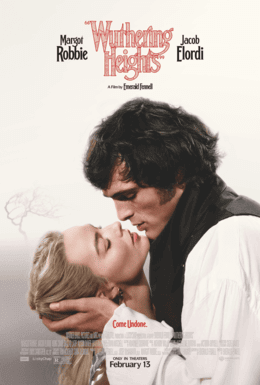
Set in nineteenth-century Yorkshire, the movie's story begins when Mr. Earnshaw brings home an orphaned boy named Heathcliff to live at Wuthering Heights. Raised alongside Earnshaw's daughter, Cathy, Heathcliff forms a close and enduring bond with her that gradually develops into a profound romantic attachment. Despite their deep connection, Cathy chooses to marry the affluent Edgar Linton, believing that his wealth and social standing will provide her with security and a better future. After overhearing only part of a conversation about her decision, Heathcliff mistakenly concludes that Cathy does not truly love him and leaves Wuthering Heights in despair.
Five years later, Heathcliff returns wealthy and bitter over Cathy's marriage. He buys Wuthering Heights and sets out for revenge. Though Cathy is now Edgar's wife, she and Heathcliff reignite their forbidden affair. Their adulterous bond grows more intense, pulling everyone around them into betrayal, conflict, and ruin. Heathcliff marries Isabella Linton, not out of love but as part of his revenge, and treats her cruelly.
As Cathy's health deteriorates during pregnancy, misunderstandings and interference from Nelly Dean further separate her from Heathcliff. Cathy eventually dies before Heathcliff can properly reconcile with her. Devastated, Heathcliff mourns her intensely and begs never to find peace without her, ending the story on a tragic note of obsessive love, loss, and vengeance.
Based on the plot details that have been publicly described, the 2026 adaptation shifts the focus of Wuthering Heights away from the novel's broader themes of revenge, social class, and generational trauma and instead centers on the adulterous relationship between Cathy and Heathcliff.
In Emily Brontë's original novel, Catherine and Heathcliff share an intense emotional bond, but their relationship is largely defined by longing, separation, obsession, and psychological dependence. After Catherine marries Linton, the narrative devotes significant attention to Heathcliff's revenge against both the Earnshaw and Linton families, as well as the effects of that revenge on the next generation. While the novel strongly implies a passionate connection between Catherine and Heathcliff, it does not portray an explicit extramarital affair between them.
The 2026 film, however, reportedly reimagines their relationship as a direct romantic and sexual affair after Catherine's marriage to Edgar. By ending the story with Catherine's death and removing the entire second-generation narrative, the adaptation places the forbidden relationship between Cathy and Heathcliff at the center of the drama. As a result, the film emphasizes themes of passionate love, jealousy, desire, and infidelity more than the novel's concerns with inheritance, cyclical violence, and redemption.
Consequently, the film can be described as a reinterpretation of Wuthering Heights that foregrounds the adulterous romance between Cathy and Heathcliff, whereas the novel presents their relationship as one part of a much larger and darker family saga.
One of the most dramatic changes involves the plot and timeline. The novel spans more than three decades, from 1771 to 1802, and Cathy's death occurs roughly halfway through the story. The second half focuses on the next generation of characters, including Cathy's daughter and Hareton Earnshaw, exploring themes of inherited trauma, redemption, and the repetition of past mistakes. The film, however, ends with Catherine's death and completely omits the younger generation, eliminating this important thematic dimension.
The adaptation also alters several key character relationships. In the novel, Hindley Earnshaw, Cathy's older brother, serves as a central antagonist whose cruelty and abuse shape Heathcliff's bitterness and desire for revenge. In the film, Hindley is removed entirely. Instead, many of his negative qualities, including his alcoholism and harsh treatment of Heathcliff, are transferred to Mr. Earnshaw, who remains alive far longer than he does in the book.
Another major difference lies in the narrative structure. Brontë's novel employs a complex frame narrative in which the story is recounted primarily by Nelly Dean and presented through the perspective of the outsider tenant, Mr. Lockwood. This layered storytelling creates distance and ambiguity, encouraging readers to question the reliability of the narrators. The film discards this structure altogether. Mr. Lockwood does not appear, Nelly is no longer the principal storyteller, and the audience experiences the events directly, largely through Cathy's perspective.
The tone and themes of the adaptation also differ considerably from those of the novel. Wuthering Heights is a deeply unsettling Gothic work that emphasizes obsession, cruelty, revenge, and emotional destruction. Its atmosphere is reinforced by supernatural elements, including ghostly encounters and suggestions of a lingering connection between the dead and the living. By contrast, the 2026 film foregrounds the passionate romance between Heathcliff and Cathy. Its colorful, highly saturated visual style replaces much of the novel's bleak Gothic mood, while the supernatural elements are largely removed in favor of highlighting the emotional and physical intensity of the central relationship.
Wuthering Heights (2026) is a romantic period drama directed and produced by Emerald Fennell. Inspired by Brontë's 1847 novel, the film reimagines the classic story through a modern lens. Fennell described it as an attempt to capture the raw, emotional experience of a young woman and her turbulent, forbidden love for a brooding man. The film stars Margot Robbie as Catherine Earnshaw and Jacob Elordi as Heathcliff, with supporting performances by Hong Chau, Shazad Latif, Alison Oliver, Martin Clunes, and Ewan Mitchell.