

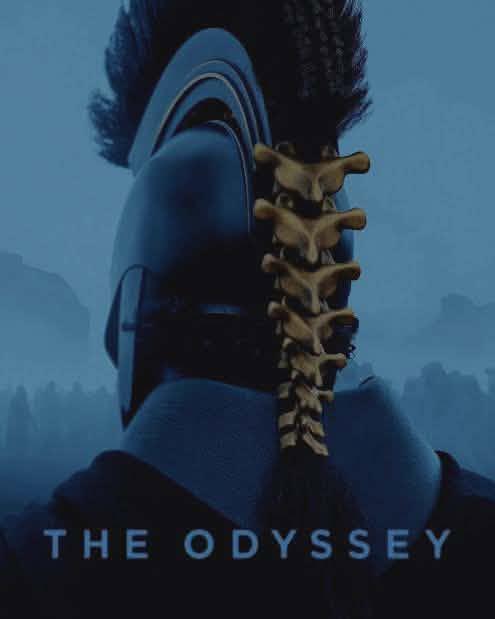
On December 23, 2025, I finally bought my copy of The Odyssey (Collins Classics edition) from Fully Booked at Bonifacio Global City in Taguig. I ordered it through Lazada with Cash on Delivery. The friendly cashier, Kian Crizaldo, rang it up for exactly ₱179.00 (about $10.26) as a VAT-exempt item. I still have the official receipt as proof of purchase, a clean, straightforward transaction with no change needed. It felt good to finally add this classic to my collection!
I watched Christopher Nolan's The Odyssey and found myself drawn into its vast and imaginative retelling of Homer's ancient epic. As the lights dimmed and the story of Odysseus unfolded on the screen, I was carried across stormy seas, distant islands, and encounters with gods and monsters. The film's grand visuals and epic scale transformed the cinema into a gateway to the ancient Mediterranean world.
This is the premise of the movie:
The Odyssey follows Odysseus, the legendary Greek king of Ithaca, on his long and perilous journey home following the Trojan War, chronicling his encounters with mythical beings such as the Cyclops Polyphemus, sirens, and the nymph Calypso, while attempting to reunite with his wife, Penelope. (emphasis mine)
Drawing on a realistic vision of the ancient Greek world, Nolan based his interpretation of the mythological epic in part on Emily Wilson's acclaimed 2017 translation of The Odyssey and the fantasy filmmaking tradition pioneered by Ray Harryhausen.
For The 7th Voyage of Sinbad (1958), Harryhausen designed the film's cyclops. In the story, cyclopes are a race of enormous, one-eyed giants that roam the wilderness of Colossa. They serve as the film's main antagonists and remain among Harryhausen's most iconic monsters. The cyclops' single eye and prominent forehead, crafted by Harryhausen, are also similar to Nolan's Polyphemus.
In Homer's Odyssey, Odysseus and several of his companions arrive on the island of the Cyclopes while making their way home after the Trojan War. Exploring the land, they enter a cave stocked with food and supplies. The cave belongs to the Cyclops Polyphemus, who returns with his flock and seals the entrance with a massive boulder. Ignoring the sacred Greek tradition of hospitality, Polyphemus seizes two of the intruders and devours them.
When Polyphemus returns and kills more of his men, Odysseus offers him strong wine. Drunk, the Cyclops asks his name, and Odysseus replies, "Nobody." After Polyphemus falls asleep, Odysseus and his companions blind him with a wooden stake. When the giant cries for help, claiming that "Nobody" has harmed him, the other Cyclopes dismiss his pleas.
Odysseus and his men escape by clinging to the undersides of Polyphemus's sheep as they leave the cave. Once at sea, Odysseus reveals his true name, provoking the Cyclops's anger. Polyphemus then prays to his father, Poseidon, for vengeance.
One of the main reasons Odysseus spent ten years trying to return home after the Trojan War was the vengeance sought by Polyphemus. After escaping from Polyphemus's cave, Odysseus proudly revealed his true identity, provoking the giant's anger. Polyphemus then prayed to his father, Poseidon, the god of the sea, asking him to punish Odysseus and prevent his safe return to Ithaca.
Odysseus could have arrived home much earlier if he had not revealed his name to the Cyclops. After successfully blinding Polyphemus and escaping from the cave, Odysseus was already safe at sea. However, driven by pride, he shouted back his real name to the Cyclops. This allowed Polyphemus to pray to his father, the sea god Poseidon, and ask for revenge. Poseidon answered the prayer by creating storms, obstacles, and hardships that delayed Odysseus's return to Ithaca for many years. If Odysseus had remained anonymous, Polyphemus would not have known whom to curse, and Poseidon would have had no reason to target him specifically. Therefore, Odysseus's decision to reveal his identity was a crucial mistake that greatly prolonged his journey home.
In the article "Odysseus the Destroyer? Christopher Nolan's New Odyssey Adaptation Revives an Ancient Moral Question," Michael La Corte and Stephan Blum of the University of Tübingen offer an alternative interpretation of the Polyphemus episode. Rather than accepting the conventional portrayal of the Cyclops as a monstrous antagonist, the authors reconsider the encounter from Polyphemus's perspective, thereby raising important questions about heroism, violence, and moral responsibility in Homer's epic.
In the scene of Odysseus v Polyphemus, the cyclops is cast as a brute, a savage who traps the hero and his men in a cave. Odysseus responds with legendary cunning: wine, lies, a sharpened stake – and escape.
From the outside, it is textbook heroism, yet Homer himself hints at the cost of that victory. He has Odysseus reveal his name only after the escape: "Tell them it was Odysseus, sacker of cities, who blinded you." It's a moment of pride, not necessity – the spark that seals his fate. In that instant, the clever survivor becomes the arrogant aggressor, and the story's moral axis begins to tilt.
Yet if we shift perspective, the story changes. Polyphemus is a solitary shepherd, living in peace. Strangers break into his home, steal his food, kill his livestock, and leave him blinded and broken. His cave isn't a prison but a home under siege. His violence, while brutal, emerges from desperation. You could easily argue that Polyphemus isn't the villain. He's the victim.
Filming took place from February to August 2025 across several countries, including Morocco, Greece, Italy, Scotland, Iceland, Western Sahara, and Malta, with additional work completed on a Los Angeles soundstage. Reportedly produced on a budget of $250 million, the film is regarded as Nolan's costliest project to date and the first feature ever photographed entirely with IMAX 70 mm cameras.
The Odyssey is an epic fantasy action film written and directed by Nolan and adapted from Homer's classic Greek epic. Starring Matt Damon as Odysseus, the king of Ithaca, the film follows his perilous voyage home after the Trojan War and his quest to reunite with his wife, Penelope, portrayed by Anne Hathaway. The cast also features Tom Holland, Robert Pattinson, Lupita Nyong'o, Zendaya, and Charlize Theron. Produced by Nolan and Emma Thomas through their company, Syncopy, the film brings one of literature's most enduring adventures to the screen.