
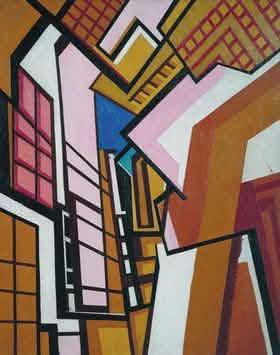
I recently purchased Imagist Poetry, a Penguin Books edition with Wyndham Lewis's painting "Workshop" on the cover. "Workshop" is one of Lewis's quintessential Vorticist works, an oil on canvas now in the collection of Tate Britain in London. It exemplifies the Vorticist style: bold geometric abstraction with sharp angles, diagonal lines, and fragmented forms that evoke the energy and machinery of the industrial age. Lewis celebrates the modern workshop environment (suggesting factories, tools, and mechanical processes) through a dynamic, angular composition that conveys movement and structure without traditional representation.
This painting dates to the height of Lewis's Vorticist period, just before and during the outbreak of WWI. Like other works from this time (e.g., "The Crowd"), it reflects his interest in the machine aesthetic and the "vortex" as a symbol of concentrated creative and modern force. Post-war disillusionment with mechanized destruction, combined with the movement's brief lifespan, meant Vorticism did not endure, but pieces like "Workshop" remain important examples of British modernism.
Ezra Pound coined the term "Vorticism" (or "Vorticist"). Pound introduced the idea of the "vortex" in his writings, describing a concentrated point of energy and creative force (a "radiant node or cluster" where ideas rush through). He applied it to the emerging group of artists and writers centered around Lewis. The name first appeared publicly in the Vorticist magazine Blast, which Pound helped promote. Lewis was the main founder and driving force of the movement itself, but Pound provided the name and was a key theorist and advocate.
Pound was the primary driving force behind the Imagist movement and authored (or heavily shaped) its foundational statements. Often attributed to F.S. Flint but largely written or dictated by Pound. It outlines the core principles of Imagism. In "A Few Don'ts by an Imagiste," Pound presents what became the most famous and influential manifesto of the Imagist movement. The essay defines the concept of the Image and offers concise, practical advice for poets. Pound emphasizes three core principles of Imagism: first, the direct treatment of the "thing," whether it is subjective or objective; second, the elimination of any word that does not contribute to the presentation of the image; and third, composition according to the rhythm of the musical phrase rather than the rigid beat of a metronome, thereby favoring free verse when it best serves the poem.
Pound famously defined an Image as "that which presents an intellectual and emotional complex in an instant of time". He championed clarity, precision, and economy of language, prioritizing the power of concrete, vivid presentation over abstraction, ornamentation, or the verbosity typical of Victorian-era poetry. A quintessential example of this approach is Pound's own short poem "In a Station of the Metro": "The apparition of these faces in the crowd: Petals on a wet, black bough". The Imagist movement had a profound influence on modernist poetry, shaping the work of poets such as T.S. Eliot, H.D., William Carlos Williams, and many others who followed.
Lewis and Pound were close friends and collaborators. To commemorate their longstanding friendship, Lewis painted a notable portrait of Pound in 1939. The work depicts the American poet, critic, and leading modernist figure, who had co-founded the Vorticist movement with Lewis.
The painting shows Pound reclining in a wooden armchair; his body angled diagonally across the composition. He is dressed in a dark suit with a white collared shirt, his head tilted back and slightly turned to the right. His eyes are closed (or nearly so), conveying a deeply introspective, almost meditative state as if lost in thought, listening, or resting after intellectual exertion.
To Pound's left (from the viewer's perspective) stands a small round wooden table containing several everyday objects that contribute to the intimate and lived-in atmosphere of the scene. On the table are a glass, possibly holding water or another beverage, and a collection of folded newspapers or periodicals. These items, along with other small personal belongings, suggest habits of reading and reflection, offering a glimpse into the daily life and intellectual pursuits of the subject. The background is abstracted and atmospheric: loose, swirling brushwork suggests a window or view onto a landscape/sea.
The portrait displays the distinctive style of Lewis's later work, characterized by bold, angular lines, strong contrasts, and a fusion of realism with modernist simplification. The composition is structured around dynamic diagonal elements, particularly in Pound's pose, which are balanced by the vertical forms on the left side of the painting. Created in 1939, following a series of preparatory sketches made in 1938, the portrait stands as a tribute to the friendship between Lewis and Pound despite periods of tension in their relationship. The work received high praise from Walter Sickert, who regarded Lewis as one of the greatest portraitists of his time.
The mood is quiet, intellectual, and slightly melancholic, a private moment capturing Pound's intense, contemplative personality. Lewis's Vorticist roots and modernist sensibility are evident in the energetic handling of form and space.
After the First World War, Lewis largely moved away from the bold abstraction of Vorticism and shifted toward a more figurative style, with portraiture becoming a major focus of his later career.