
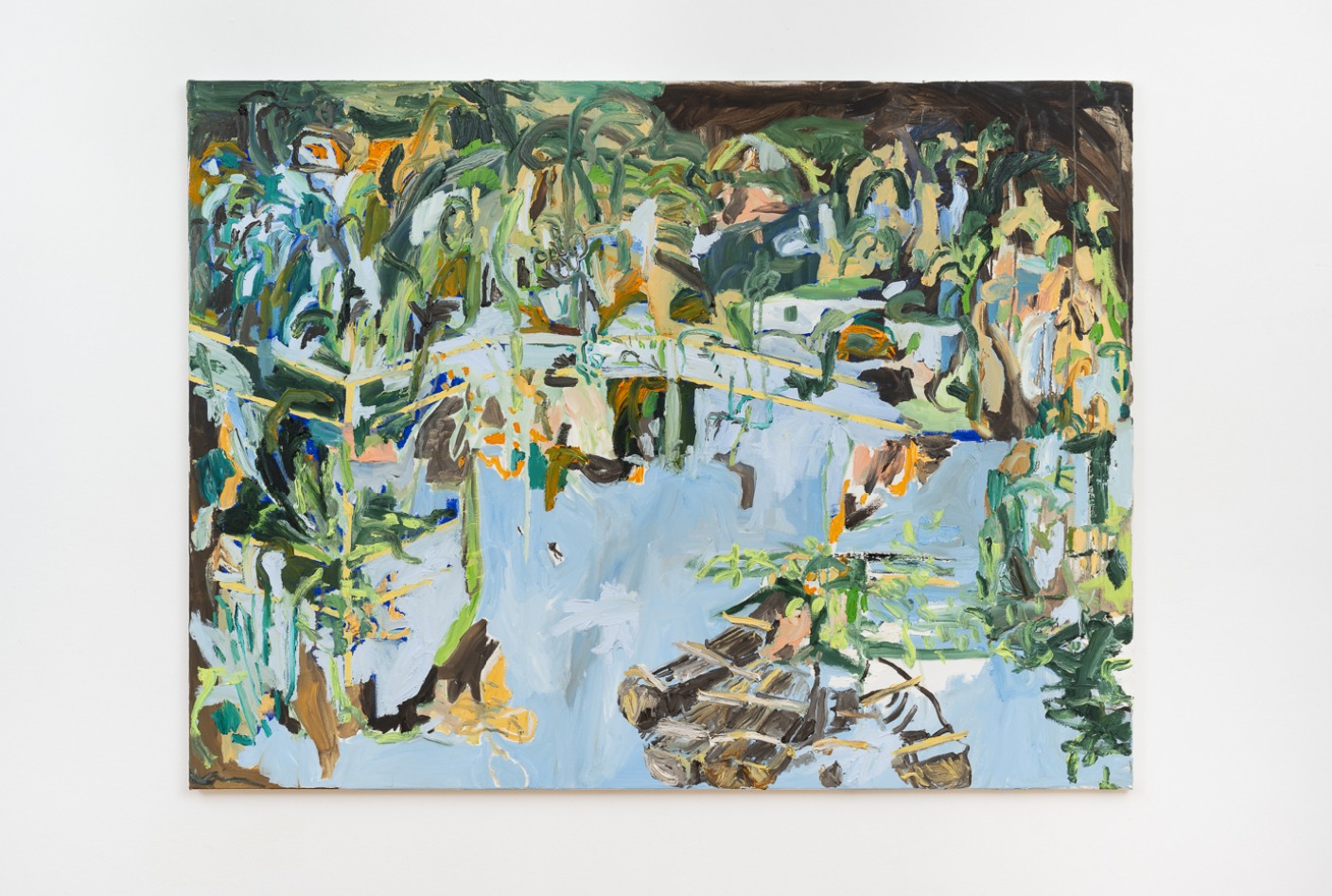
Dedham II gives you a sense of calm before anything else. The painting holds a stillness that feels earned, not staged, as if Cabral paused time at the exact moment when the air settles and the landscape exhales. You look at it and feel the quiet spread out. The scene does not call for attention. It lets you arrive at your own pace.
Formal and technical observations
Cabral works with a controlled palette that leans into soft neutrals and clean, open light. A few things catch your eye right away:
The horizon is placed with careful balance, neither low enough to feel dramatic nor high enough to dominate the frame.
Brushstrokes are restrained, almost modest. Texture appears only where needed.
Light sits across the surface in a thin veil that keeps the landscape unified.
The forms are simplified. Trees, water, and distant structures are reduced to essential shapes.
Negative space plays a strong role, giving the composition space to breathe.
Nothing feels rushed. You sense Cabral's interest in clarity. The painting has the same kind of discipline you see in work that values observation over embellishment. She does not add noise for effect. She holds her choices close.
Interpretive reading
Dedham II reads like a meditation on place and distance. The landscape exists as a memory, or maybe as a moment you only catch once before it moves on. There is no obvious story. Instead, the emotional pull comes from how the space feels held in suspension. You might recognize the scene, but you cannot fully place it, which adds to its pull.
Cabral's restraint encourages you to look slowly. The quiet tones turn the landscape into a mental space rather than a geographic one. You start to read the fields and water as extensions of thought rather than physical terrain. The painting asks you to sit with that feeling. The calm is not empty. It is layered with a quiet awareness.
There is also a sense of distance built into the composition. You stand apart from the land, watching it but not entering it. That distance creates room for reflection. Dedham II feels like the moment you stop on a path and simply look, not thinking about where you were going or what comes next.
Strengths and limits
Strengths:
A steady, confident sense of calm.
Clean composition that avoids distraction.
A palette that supports the emotional tone without leaning on sentimentality.
Clear structural discipline that keeps the piece grounded.
Limits:
Some viewers may want more visual complexity.
The emotional range stays within a narrow, quiet register.
The restraint might read as too subtle for those who look for bold contrasts or narrative detail.
These limits sit naturally within the work. Cabral's focus is on atmosphere, not drama.
Final thoughts
Dedham II is a painting that understands its own pace. Cabral builds a space that invites reflection without demanding interpretation. The quiet becomes the subject, and the landscape becomes a way to experience it. You leave the painting with a steadier breath and a sense that stillness is more than a lack of motion. It is a form of attention.
I keep thinking about how the horizon holds the scene together. It sits there with quiet confidence, guiding your eye but never insisting on itself. That is the heart of the painting. Cabral gives you a view that feels honest, measured, and patient. In a time when images often try to impress quickly, Dedham II offers something slower and more thoughtful. It stays with you because it gives you space to stay with it.
-