
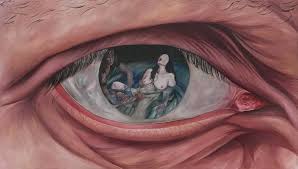
When I first saw Eye (Birth), 2022 by Srijon Chowdhury, I felt I was being drawn into an interior world that is at once raw and mythic. The painting, oil on linen, about 72 by 126 inches, is part of his Same Old Song installation, where each piece takes a sensory organ such as the eye, ear, mouth, or nose as a portal.
In Eye (Birth) the canvas is dominated by the iris of a giant eye. Within that circular field is a moment of ecstatic, painful gestation. In the iris lies a birthing scene: a naked mother in mid-labor, her face contorted in anguish and transcendence. Two attendant figures flank her, as if guardians, saints, or ancestral spirits. The intensification of scale collapses the ordinary into the symbolic. The eye becomes an opening, a lens, and a convener of memory and myth.
Formal and technical observations
- Chowdhury's technique is tight, confident, and layered. His brushwork is precise in rendering flesh, textile folds, musculature, and hands, yet sinuous in the transitions between figure and ground.
- The palette is richly saturated with warm flesh tones, deep umbers, muted reds, and subtle greens and grays. He builds contrast through chiaroscuro but avoids harsh drama. Light is modulated, emerging as reflections in skin or ocular glints.
- Compositionally, the work is ambitious yet controlled. The circular boundary of the eye focuses attention, while the birthing scene is centrally placed within it. The boundary between the eye and the inner world is porous. Eyelashes, veins, and folds suggest continuity rather than partition.
- Chowdhury compresses and flattens space. The figures inhabit a shallow stage. There is little sense of atmospheric depth. This flattening heightens intensity. The viewer does not look in from afar but peers directly into a crucible.
Interpretive reading
At first glance, the birthing scene is startling in its exposure. Yet it is not merely anatomical spectacle. It is an existential event. The eye, in symbolic language, is the seat of vision, consciousness, and the soul. To birth within it suggests creation from perception, a new self-emerging through the act of seeing. The mother's labor is both physical and metaphysical.
The attendant figures could represent many archetypes: lineage, unseen forces that assist creation, or the dual nature of witness, compassion and judgment existing side by side. Birth is often associated with thresholds, beginnings, and sacrifice. Here, the mother is both the site and the agent of transformation. Her nakedness signals vulnerability and power. There is pain, but also radiance. The eye's rim holds her in a ring of watching, implying that the act of coming into being is always under observation by ancestors, by symbols, by history.
Chowdhury often weaves cultural, religious, literary, and mystical references into his work. He draws from William Blake, Islamic geometric patterns, poetry, architecture, and natural imagery. In Eye (Birth), these influences converge. The symbolic layering is dense: the eye as emblem of seeing, the birth as nascent subject, and the attendants as guides across a boundary between realms.
Seen within the larger Same Old Song series, Eye (Birth) converses with other works centered on sensory organs. Chowdhury turns the human head into an archive of memory and myth. The eye is not a passive receptor but a generative force.
Strengths and limits
Strengths
- The emotional impact is immediate. You cannot pass this painting without stopping.
- Chowdhury balances realism with poetic abstraction. The anatomical precision grounds the work, while the symbolic overtones expand it.
- Scale, form, and myth interlock to make the canvas immersive without drifting into decoration.
Limits or challenges
- The density of symbolism may distance some viewers who prefer literal or narrative clarity.
- The compressed space leaves little visual relief. Eye, figures, and background press close, demanding sustained attention.
- The balance between spectacle and intimacy is fragile. For some, the scale and intensity may overwhelm subtlety.
Final thoughts
Eye (Birth) is a violent and beautiful meditation on creation. It insists that you slow down, look again, and confront the mysteries of vision, body, and genesis. In Chowdhury's hands, the birthing woman framed by the eye becomes the emblem of the artist's purpose: to bring new worlds into being through the act of seeing. This painting is not about what is born on the canvas but what is born in the viewer's consciousness.
If there is a shortcoming, it lies in how some motifs remain only half formed, their meanings implied rather than revealed. Even so, that restraint deepens the painting's mystery. Eye (Birth) stands as one of Chowdhury's most compelling works, a piece that demands to be seen, felt, discussed, and remembered.