
Review of Spare by Prince Harry
By: Michael A. Arnold

This
is the strangest book about the British royals in some time, maybe
ever. Someone has already said that but it is true. I have not read a
book quite like this before, and reading it just after its
publication, seeing the reactions sprout up across the internet was
really strange.
You
already know who Prince Harry is, even if only vaguely. His father is
the now king of the United Kingdom and his grandmother was the
recently departed Queen Elizabeth II. He was always going to be
famous, even if he lived recursively. Famous – but not well
known, his life has been controversial. At the time of writing you
can barely open a news site or turn on the TV without him being
talked about or mentioned, at least here in Britain. The Netflix
series with him and his wife Meghan Markle has been consistently
recommended – I do not watch a lot of TV, but Penguin Random
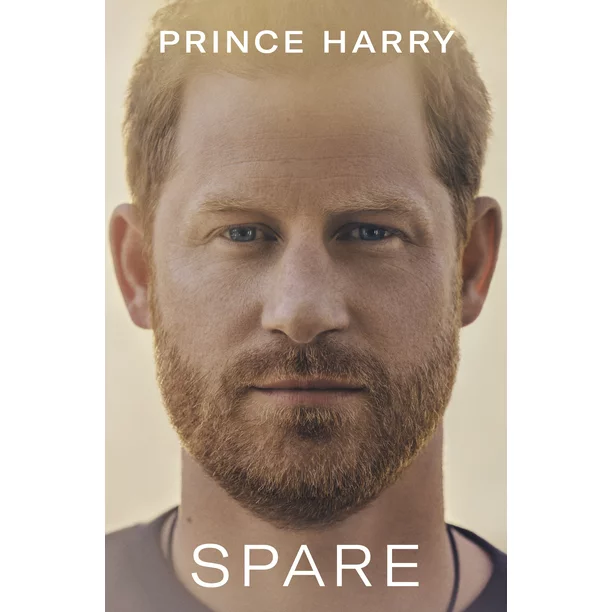
House published his book Spare on the 10th of
January. Books are my territory. I had to check it out.
Looking
back over its four hundred or so pages, the book is difficult to
analyze intelligently. The first question to ask a memoir is: ‘what
is the point this person is trying to make?’. This book is an
attempt to justify to everyone, as he says himself in the prologue,
why Harry stepped away from Royal life and decided to move (or ‘flee’
as he put it) to the United States. It was to get away from the
British press, who have made his life miserable. It was also to get
away from Royal processes and restrictions, as the last few chapters
suggest he was increasingly isolated from other members of his
family. Ultimately this book is as much about the culture inside ‘the
palace’ as it is about the newspapers and their attitude to the
royals. However, this book is incredibly sloppily structured. Events,
memories and details seem to float by like blades of grass in the
strong current of a stream, and not all of them have much of a
purpose. If this book was only about the press and Harry’s
relationship with his family, there are far too many odd details
cluttering the narrative to make it a coherent whole.
So it
is in part a memoir, in part a series of recollections. At times
there is anger, making the book more of a rant than an argument, or a
justification, Harry is trying to present to us. He is upset about
how his life has gone and been affected by circumstance - things he
does not seem to fully understand or have had contextualized. But it
would be easy to call him stupid, as some people have, and this is
not fair. He may not be a very clear thinker but he is not an idiot -
despite errors in the text that we will get to.
Part
of this might be because of how this book was written, or
ghostwritten. What seems to have happened is: the ghostwriter, J. R.
Moehringer, interviewed Harry over a number of days – and then
rewrote his words into this book. Memory is never a perfect
recollection of events. Biases and suggestion are known to affect
memory in strange but powerful ways. This is something Harry even
admits early in the book:
In
other words, what is in this book might not be strictly true, but it
is Harry’s truth. It is the truth as he remembers it and
understands it.
However
this ghostwriter, J. R. Moehringer, might not have been the best
choice. There are factual errors that cannot be overlooked, and
anecdotes that feel like lies. An example of an error occurs really
early on, when Harry was at school just after the death of his mother
Diana, he receives a Xbox gaming console as a birthday present. He
states, and saying twice, this was in 1997 and he was 13. The Xbox
would not exist for another four years, being designed in the year
2000 and released for sale in 2001. Perhaps Harry was thinking of a
Playstation, the king of gaming consoles in the 1990s, and
misremembered. If this is what happened, the ghostwriter simply took
Harry’s words and rewrote them without any fact checking or
research – which is incredibly sloppy.
Such
things harm the trust we ought to have in this book, making other
claims harder to believe. There was a widely publicized incident
Harry attended a costume party in a Nazi uniform. It was apparently a
costume party with a colonials and Native Americans theme. Harry
states that at some point a Nazi uniform was suggested, and William
and William’s then girlfriend Kate Middleton thought this would
be hilarious and encouraged him to wear it. Harry excuses this as him
being 20 years old and not thinking, which is believable. What is not
believable is that Prince William, the third in line to the throne,
would also think this was merely funny and encouraged it. William,
being third in line, he must have been keenly aware, and constantly
reminded, of remaining distant from any potential controversy –
which is a strong royal tradition.
It is
difficult to read that section and not think Harry is lying, but
there are other sections that have been lied about. One of the
weirder things that I have seen is this idea Harry claims the British
army trained him to think of enemy combatants as like removing chess
pieces off a board, which is simply not true. Harry says taking out
enemy combatants felt like that because he was piloting an attack
helicopter or directing bombs on a laptop. He was using a simile, not
saying that is how he was trained to think. Another, it has been
claimed Harry says he was William’s best man during his
marriage to Kate Middleton. Again, this is not true, Harry does use
the words ‘best man’ when referring to himself in that
section, but it is clear from context that in using those words he
was making a little joke. The most part he had the ceremony was
carrying the wedding ring for a little while, he describes none of
the other duties typical of a best man, and he even refers the actual
best men as the best men while he stood to the side in his army
uniform.
But
there are also details and passages that leave you wondering ‘why
are you telling us this?’ and the book is maybe too honest in
place. Honesty in a book like this is refreshing, but some of the
choices and stories included here are baffling. Like a moment when he
talks with a bin in Courtney Cox’s house.
But is
this book worth reading?
Maybe.
This book is a rare look behind the curtains of royal life. You see a
lot of the constrictions and regulations they have to live with. It
is a different world – one so far removed from the work-a-day
lives the rest of us have. At times you get the impression that they
are themselves prisoners of circumstance – that their cage may
be gilded and ornate, but it is still a cage. Living with
never-ending press intrusions and their obsessions, and having to
strictly adhere to tradition must be hard. I found myself wondering:
would they would all be happier if they were not royalty. That’s
a question you can feel behind the text, but Harry either does not
address it or shies away from it. Yes they do good works –
Harry is rightly proud of all the decent things he has done like
organizing the Invictus Games, supporting charities for Africa and
war veterans – none of that would have been possible without
the privilege that has also cost him a lot too. Things here are
complicated.
Also,
this book is, despite its flaws, beautifully written. J. R.
Moehringer is an excellent writer of sentences. You notice how good
the writing and word choices are in the few pages of prologue. For
example:
I glanced now into the distance, towards the mini skyline of crypts
and monuments
We wheeled, formed a line, set off along the gravel path over the
little ivy-covered stone bridge. These
were taken more or less at random, and there is a lot of this
throughout. It has a clear style, able to create complex images with
very few words, and any creative writer would probably benefit from
reading this. However, it must also be said that as the book goes on
the good description does become less frequent or noticeable. It is
also able to put you directly in the shoes of someone else. At times
you feel like you are in Harry’s head, it is almost like you
can feel the weight of his clothes on yourself.
So it
is well written. It is informative. And it arguably shows, with some
bizarre and random deviations, the points it was trying to make. Why
does giving this book a recommendation feel so difficult?
Because
this book is not structured. It is not like the book jumps around in
time (it does in location, but that could not really be helped) but
it really feels like a collection memories in chronological order.
There is like there is no core to this book other than frustration
and personal issues, something you cannot say about a memoir like
Stephen King’s On Writing, to pick a totally random
example. It seems that when drafting this book, no one looked at it
as a unified whole and asked what the point of different parts were,
or how they may be seen or interpreted. As such, this feels less like
an intelligently structured essay and more like a rant filtered
through good prose – and so there will be few reasons to reread
it.
If
this book did not have Prince Harry’s name on the cover, and
was not about what it is about, I doubt this book would have been
considered ready for publication. It feels like the draft of a better
book that still needs to be edited. Maybe it should have spent longer
being incubated but it is out now, and has since became the fasted
selling non-fiction title in at least the United Kingdom’s
history. Does it deserve to be? No.
This
is not a bad book, at all, but it is not a good one either. Yes, it
is well written, and even interesting, but it is shallow. It might be
worth reading, but it is not worth keeping.
Whatever the cause, my memory is my memory, it does what it does, …
there’s just as much truth in what I remember and how I
remember it as there is in so-called objective facts.
Another gust of wind. Funny, it reminded me of Grandpa. His wintry
demeanour maybe.