Review of Banksy and Anonymity
By: Michael A. Arnold

We
would lose a lot if we knew who Banksy is. Mystery makes him more
interesting. That much seems indisputable, but the quest to find the
illusive artist’s identity never seems to go away. People will
always want to know – we love investigating a good mystery as
much we like good answers, but in a detective story once you know who
the killer is the mystery, and the attractiveness of the story, goes
away. Life is more interesting when we have unknowns. In this age,
when science has become so sophisticated, we still need our small
mysteries.
But
this is not the only reason we should let him remain anonymous.
Banksy is not just a great artist, in a way he is also showing us
something that we tend to forget about art – that it can be and
perhaps should be appreciated and even interpreted as itself, without
biases or reference to biographical details, or anything like that.
If you go to read about a painting by Picasso or Andy Worhol,
typically the first thing that is mentioned is the artist’s
life around the piece and their attitudes to the times it was
produced in. Because we do not know who he is, we can only infer
Banksy’s messages and concerns through his art and our own
viewpoints.
What
we can know about Banksy from his art alone is that he is British,
culturally and politically astute, apparently a leftist; and we can
infer just from where his art has appeared he is wealthy and
extremely clever. No one who has evaded identification while able to
travel across continents, and even into Ukraine during the war, could
do so without being resourceful and intelligent. Of course this adds
fuel to the mystery, but it might mean that Banksy’s identity
will only be revealed on his own terms – when he wants it to be
known.
It
does not seem like that will happen soon. Banksy is having too much
fun being a mystery man for our time, evading both authorities and
art experts. There is something romantic in that too, which is
another reason why it would probably be best kept a secret. The
reality of who Banksy is will be far more mundane than the fantasies
we can put onto them, and would certainly rob his work of its
mystique and unique place in modern art.
It is
also interesting that Banksy has used graffiti, street art, as his
medium, which is associated with vandalism and a sort of urban
corruption. This is in the vein of the Postmodernist mixing of high
and low culture, the comic book and the opera, and blurring the lines
between those two things. If graffiti can be art then anything can be
art, and that is not meant to devalue art or say something noble
about graffiti – it is based on the now old idea that art can
literally be anything. All that seems to matter is the intention of
the artist, the emotion or message they are communicating, and to a
lesser extent the skill with which they have communicated that
through.
It
cannot be denied that Banksy’s work is high quality, and people
who have studied his work have put a lot of effort and time (and
words on Wikipedia) into describing exactly how he produced his
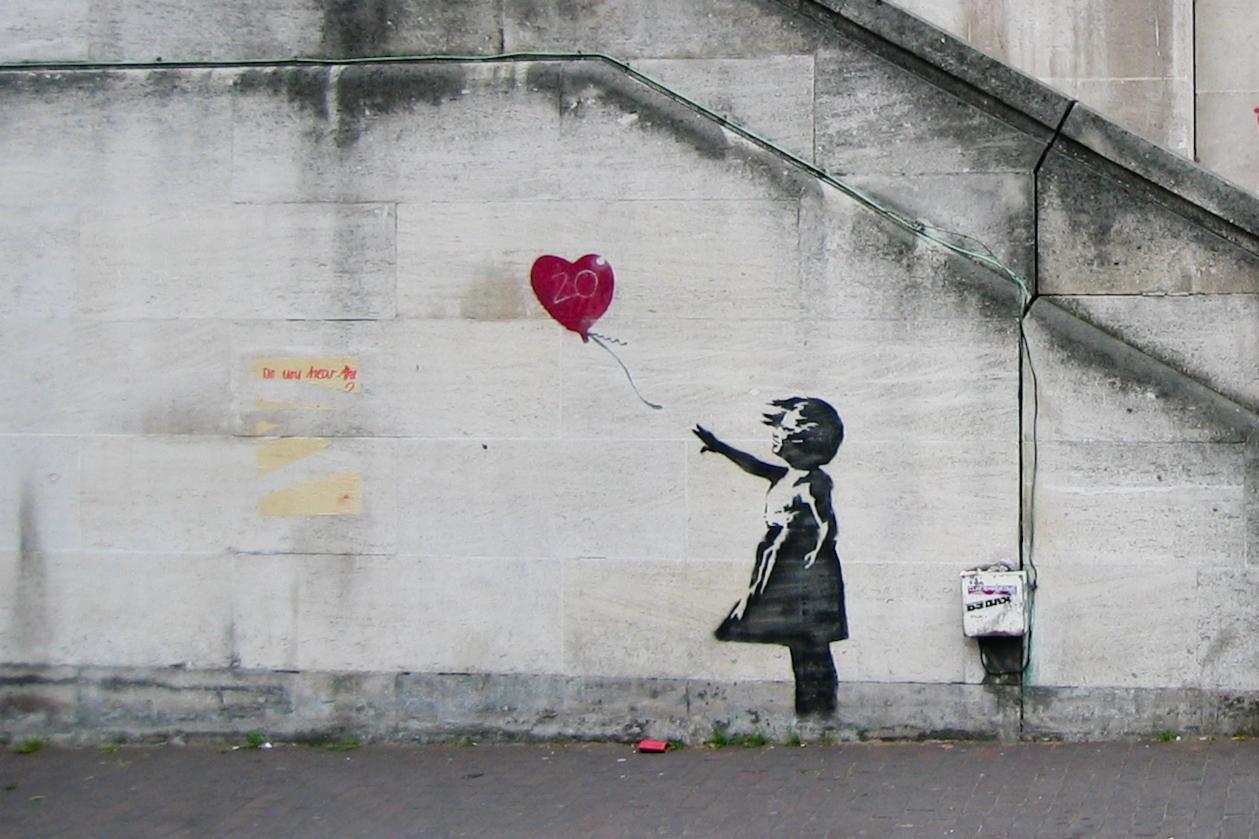
works. But
his technique or the way he creates new symbols out of old images
like he does (like he did with the above image of a girl letting go
of a balloon for example), is not the main point of his work. Nor,
really, are the individual pieces. Of course individual pieces are
important, but we need to look beyond them to understand Bansky as an
artist.
Banksy
being anonymous is, instead of just a quirky part of his career, the
point of it. Through his anonymity he is critiquing the snobbery and
over-specialization of the art establishment. Anyone, regardless of
their level of education or their exposure to art can enjoy a Banksy.
He uses very common symbols in interesting ways, and he can be very
direct at times. You will not find something obscure or off-putting
in his work either, and yet it is very skilfully made: with symbolism
and a purpose. Also, importantly, Banksy’s art is found in the
streets and not in the museums or art galleries. They are supposed to
be seen by ordinary people.
He has
a different intention and modus operandi from the more traditional
artist, who wants their work appreciated by the art community. Banksy
is trying to democratize art, reminding us that culture is whatever
the majority of people make of it. This is why it would be better if
we never found out who he is, and we should never try to find out –
if we did discover his identity we would rob him of his wider
message, and the very impetus of his art. Art should never be
restricted to the experts. In a way, we all understand art just by
appreciating it.