
Review of One Evening in October by Tua Forsstrom
By: Michael A. Arnold

It
was published by Bloodaxe Books in 2015, a company based in
Northumberland in the United Kingdom. Since their founding in 1978,
Bloodaxe have developed an incredible reputation for releasing high
quality books by both well established and promising new poets that
are always worth buying. They published books by the likes of John
Agard and Tess Gallagher, giants in the poetry world, and helped
start the publishing careers of Simon Armitage and Tracey Herd.
Tua
Forsstrom is a Finnish-Swedish poet, writing mostly in Swedish, who
is widely read in those countries. This book is bilingual, having the
original Swedish text on the opposite page to the English translation
by David McDuff, which is always nice to see even if you cannot read
the original language. If you are brave, you can read the original
without knowing it, and get some sense of what the words actually
sounds like. But this is not the first time Tua’s work has been
seen in English. Her poetry has been known for some time, but she
still seems to be more of a poets’ poet than someone you might
see in the big bookshops, like Seamus Heaney, Simon Armitage, Maya
Angelou or someone like that.
Her
work needs to be better known. This book is full of delicacy,
imagery, emotion and even mysteries that reward a number of
rereading’s. One of the big mysteries is how to treat about
this book. There are titles for individual poems, or sections, on the
table of contents pages, but their titles are really just the first
lines – and so it is possible to consider this book both as a
collection of strongly connected poems or as a long, single poem with
many different parts.
The
delicacies do not just come from the words themselves either. There
is a lot of blank space on the pages when you look at each section
(or poem). These blank spaces should not be thought of as a lack of
content however, yes, the book is short (with both the English
translation and the Swedish original this book is still about 80
pages) that blankness is symbolising silence. The empty spaces are
the peace in the world, and the words are a breaking of that harmony.
The words are where our focus is being directed in the wild, snowy
landscape of Scandinavia. This book is set between Sweden and
Finland, Stockholm and Helsinki, but it seems like the natural world
is always close: lakes, deep forests and snowstorms lashing down
everywhere.
This
collection is like a concept album where each part builds on the last
and leads onto the next, so themes are explored with deeper
complexity and resonance. Reading this book is like being taken into
its world where the people and places float past like ghosts but the
thoughts remain in your mind. These thoughts, the observations and
imagery, are evocative, and remain in the mind much like how we live
our own day to day lives.
The
duel themes of this collection are of the troubled human condition
and the threatened natural world, and those themes intertwine as the
collection goes on. You can see the introduction of these two themes
on the first page or section:
The
darkness, the rain, the kindness
An
evening with roses that sink to the bottom
slowly
a frozen street in Mejlans a perfectly ordinary evening
The
darkness and kindness in humans with the rain (of sadness?) between
them – in a sense the rain between those two things might be
the earth renewing either itself or us. This might be the
justification for the next line, where roses ‘sink to the
bottom’ (of the lake in the book’s title?) and then
switching immediately in the next line to the image of a ‘perfectly
ordinary evening’ and a street in Mejlans - a district of
Helsinki. It is like the world is both disturbed by the actions of
people and is also a reflection of those same disturbances.
As
the book develops these concerns, images and scenes float by –
capturing an eloquent brevity that is hard to not appreciate. Even
though the setting, or scene changes often, everything is united in
subject and under a melancholic tone. It never feels depressing, but
instead it is careful, and there is an expectation the reader pays
attention to the images and what is presented:
You
wouldn’t reproach me
You
wouldn’t turn your face away
Hail
and gravel blow in the face
The
alders’ pollen blows on the water
And
the image of water, of the titular lake, is forever in the
background. Since this seems to take place in both Sweden and
Finland, we should not think of this lake as a literal place. Instead
it is a place of the imagination, perhaps symbolising the world
itself. There is a connection between this symbolic lake and the
poet’s experiences:
Hail
and gravel in the face
The
alders’ pollen blows on the water
These
two things (or worlds) are compared and intertwined. Both humans and
the natural world are reliant on each other. Global warming has shown
this is the case: any stress or danger to one is a stress or a danger
to the other.
There
is another recurring image introduced after a few pages, a bundle of
papers and chapters, as if while this book is being read by the
reader its author is writing it. Toward the end we have a refrain of
‘The next chapter is called’, pointing us to different
details we should be paying attention to in the following sections.
This refrain is one of a number of phrases repeated throughout,
strengthening the unity this whole book has, and when there is a
repetition we are being encouraged to think about why that phrase or
image is being repeated – think of it as a clue or a key to
unlocking the book’s complexity.
This
book (or single poem) talks about a number of different issues around
modern life and our relationship with the natural world. That alone
makes recommending this book easy to people who enjoy poetry, and it
is from a Finnish/Swedish poet, one who will have a perspective and
that is not seen much in the English-speaking world. At first, this
book might seem strange, and read it in the wrong frame of mind it
will leave you cold – like it did with me. However, read it
with genuine curiosity and it will bloom with tight and beautiful
writing. Every time you reread this book you make more connections,
see more of what it is trying to do and say. It must be read a few
times to be properly appreciated. Some things are hard to unpack, so
they tend to be buried deep in language when we try to talk about
them – making it more fulfilling when you unearth them.
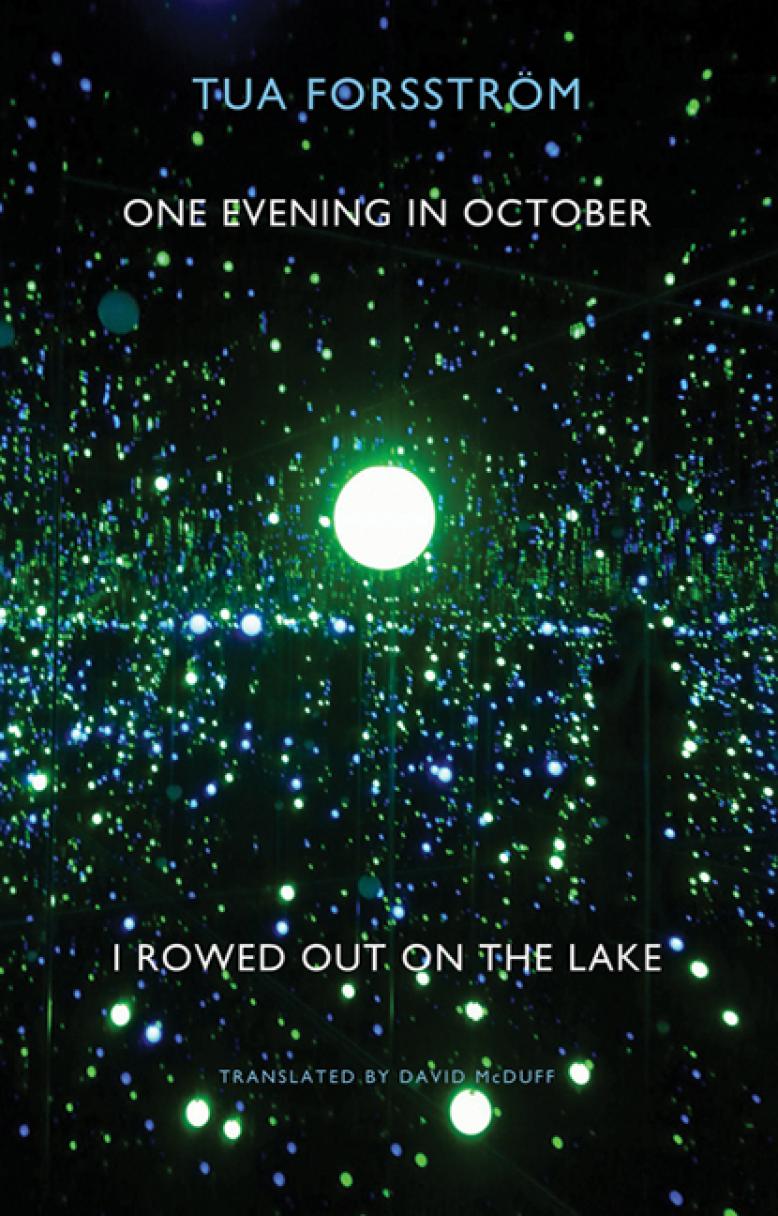 Sometimes
a book grows on you. A first reading can leave you cold but later you
read it again and it is wonderful. That is what happened with Tua
Forsstrom’s book, One
Evening in October I Rowed Out on the Lake.
It is a long title, which is strange, but it helps to set the tone
for the book.
Sometimes
a book grows on you. A first reading can leave you cold but later you
read it again and it is wonderful. That is what happened with Tua
Forsstrom’s book, One
Evening in October I Rowed Out on the Lake.
It is a long title, which is strange, but it helps to set the tone
for the book.