Review of Aeneas Flight from Troy by Federico Barocci
By: Michael A. Arnold

Fires
rise into the sky as Troy burns. Screams and swords clanging echo
across the city, but the battle is already lost. It has been a long
fight, legends say it lasted ten years, but it has led to a brutal
end. Small groups of survivors are fleeing and only the gods know
their fates. Among them is the Trojan prince Aeneas and his family.
People
have imagined the end of the Trojan War many times, but perhaps the
most dramatic version is still in Virgil’s Aeneid.
In that epic Virgil’s hero, Aeneas, flees Troy and spends
several years exploring the Mediterranean and looking for a new
homeland, eventually setting the foundations for the Romans. At one
point in Virgil’s story he lands in Carthage, where he
describes how the Greeks savaged Troy to Dido, the queen of Carthage.
When he is telling his story to her he is a refugee in a strange
land, but we should not assume he is making it up or exaggerating the
drama for sympathy. Aeneas is many things, but he is not a liar, and
his description of Troy’s fall in book two of The
Aeneid
is brutal and chaotic – showing ‘man’s inhumanity
to man’.
There
has not been a large amount of art inspired by Virgil’s epic,
and that is surprising. It is so rich with drama and imagery that
much more could be done with it. It certainly is famous enough,
although perhaps not quite as well-known or read these days as the
Homeric epics, The
Iliad
and The
Odyssey.
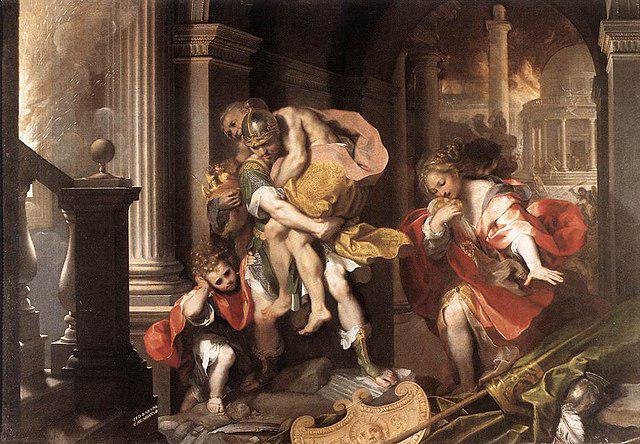
‘Aeneas’ Flight from Troy’ by Federico Barocci
(1533 – 1612) is one example of Aeneid
inspired art, showing the hero with his father Anchises on his back
and his children at his side. When looking at it you can feel the
drama and horror of the scene radiating from the painting: it feels
like Aeneas’ story in Virgil’s poem.
Seen
from inside some kind of a building or archway, the whole frame
forces us focus on the characters as they flee from the destruction
visible in the street behind them. People are moving around in the
background, and it is unclear if they are fighting or if they are,
like Aeneas, attempting to flee as well. From the architectural
details we can see a very developed, classically inspired Troy - we
will get back to this in more detail, but because those background
details are darkened and the use of light in the forefront, our
immediate focus is on Aeneas as he leads his family into an uncertain
future.
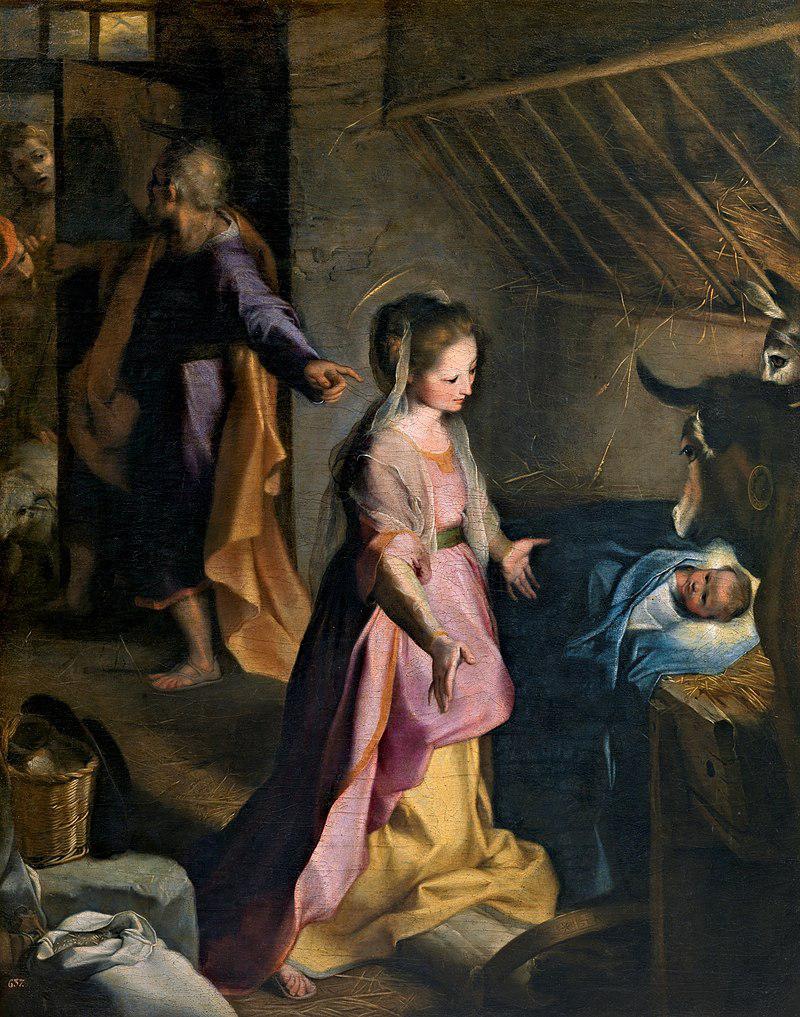
The
sense of the movement in this painting is really interesting.
Barrocci's previous paintings were often a single moment captured in
time, with characters in the act of moving around the scene, such as
1597’s Nativity: Paintings
like this one show that Barocci had, and was continuing to develop, a
keen sense of action in his work which is on full display here in
‘Aeneas’ flight from Troy’. You can easily imagine
the few seconds before and the few seconds after this snapshot of a
scene, with Aeneas struggling under the weight of his own father on
his back while also trying to lead his family to safety through the
street fighting. This image is one of horror, but also ultimately of
a small hope that they can escape and begin anew somewhere else.
It
is difficult to not see the symbolism here when you remember the
story of The
Aeneid.
Aeneas is leading his family, and so leading the future Roman people
while carrying his father on his back – symbolically carrying
the weight of experience or tradition into the future the Romans (his
children) will be ‘birthed’ and ‘mature’
from.
This
scene was painted twice by Barocci, both times for wealthy patrons.
One patron (it seems, records have been largely lost) was Emperor
Rudolph II of Austria, emperor of the Holy Roman Empire, the other
was Cardinal Giuliano Della Rovere of the Papal States, at the time a
country ruled by the Catholic Church. With patronage always comes
expectations of the work’s contents, like how the Medici’s
commission of Botticelli to paint ‘The Birth of Venus’
dictated the symbolism and style of that work.
Much
of the documentation around this painting has been lost, or is
otherwise difficult to find, but through the symbolism we can made
inferences into the meaning of this painting. Looking behind Aeneas
and his family you will see a Troy whose architecture is very
reminiscent of Ancient Rome. If the Troy described in Homer ever
existed, it would absolutely not have looked anything like this. This
background is echoing the ‘future’ of Aeneas’ line
and the Roman empire he would plant the seed of, suggesting that like
Troy, Rome too would have eventually burnt.
This
is suggesting a cyclical nature to history, a popular idea that has
existed for centuries, that great civilizations will naturally rise
and fall across the years in more or less the same way. With great
power comes great danger, and it is always useful for any leader who
imagines they are great and powerful to remember this. People in
positions of power cannot become complacent, because all things (even
the greatest of empires) will eventually fall. When this painting was
finished the glory days of the Roman Empire were already long in the
past – and the power of both the Papal States and the Holy
Roman Empire were on the decline. Instead by the 1500s, the empires
of Spain, England and France were on the rise, who eventually would
dominate Europe and the world.
One
way of seeing this painting is this: as one civilization falls, like
Troy, another will eventually rise to take its place, like Rome,
which will itself fall and another power will rise in its place. It
is a warning, but there is also a hope too - small yet fertile as it
is. Great things can grow from small seeds. But you can see this
painting as both tragic and tragically heroic. You can see it as
heroic and hopeful. Or you can see it as simply the start of a new
cycle: Aeneas fleeing Troy will lead eventually to another Aeneas
fleeing another burning Troy, and another after that. Barocci’s
message is ultimately ambiguous, and the viewers themselves must
decide what message they take from this piece. They are the ones who
must decide what it means for them.