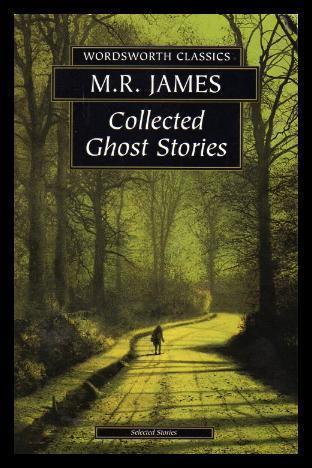
Review of Collected Ghost Stories by M.R. James
By: Michael A. Arnold

A
horse drawn carriage drew up before the doors of a mysterious
mansion. A young boy steps out, enjoying how the light of the setting
sun sparkles on the house windows, ‘making it glow like so many
fires’. He is greeted by a strange man who welcomes him inside,
but angry ghosts are also watching. In time they will make their
presences known. This
is the opening of ‘Lost Hearts’ by the ghost story, or
horror story writer Montague Rhodes James 1862 – 1936 (from
here on referred to as M.R. James, as he is more popularly known). He
has been criminally neglected by modern horror audiences, never
becoming a household name like Edgar Allan Poe or H.P. Lovecraft
have. But, he has never been ignored or forgotten either – here
in Britain you will see an adaptation of one of his short stories
pretty much every year at Christmas. A production of the story ‘O
Whistle and I’ll Come to you my lad’, starring John Hurt
shortly before his death, was extremely well received, and made a big
impact on Twitter. Ghost
stories being shown on TV at Christmas might sound strange, but
during the Victorian era it was something of a yuletide tradition -
to warm yourself with fear against the bitter cold of the dark
wintery nights. Fittingly, M.R. James was very Victorian in his
personality and opinions. His stories were often debuted at
Christmas, most commonly at get-togethers with friends and colleagues
at Cambridge University (where he lived and worked for most of his
life as a medieval scholar). Once he had written enough short stories
they would then come out in a book. This might at first have been for
just his friends and students, but they soon attracted a wider
audience. These
days it is typical to find all of James’ short stories in a
single volume, often with a few extra unfinished pieces and one or
two essays on writing ghost stories. Looking at these all these
stories together, M.R. James was easily as good as any other big name
horror writer. For example: Lovecraft is so enjoyable because of his
ability to build a thick, gloomy atmosphere; M.R. James can do that
just as well with his isolated country mansions and lonely windswept
beaches, but he is also a lot more versatile than Lovecraft. James
can be funny while able to still keep a mysterious and unsettled tone
- building to an ending that can be genuinely nasty. These stories
are often intelligently multi layered too, meaning rereading them is
almost always more than worthwhile. There is also thick core of
occult and the arcane secrets here too – James’ settings
and monsters come from little known or forbidden medieval or
ecclesiastical knowledge and mysteries. It is much different from the
cosmic or the gothic horror of other writers.
James
was a medieval scholar, and a lot of his heroes have an in-depth
knowledge of, and love for, the past – which is often to their
detriment. Any reader who has an interest in history would probably
sympathize with the protagonist of the first story ‘Canon
Alberic’s Scrapbook’ – a story about a scholar who
is touring France when he finds a scrapbook filled with strange and
otherwise unknown medieval writing. He buys the scrapbook from
someone who is weirdly desperate to sell it – and is followed
back to his hotel room by a strange and unknown force.
An
obsession with the past and antiquarianism is found throughout this
collection, and it can bleed into the actual writing itself. In the
story ‘Martin’s Close’ we are shown the records of
a court case from the 1600s and quirks of the English language from
around that time is recreated in such a convincing way, alongside a
clearly in-depth knowledge of the period, the story feels authentic.
James is also able to develop characters with small touches. This
section from ‘Martin’s Close’ shows James’
characterization abilities, even with historical people like the
‘Witch Finder General’ Judge Jeffries - we see his
famously cruel sense of humor:
L.
C. J. - Ay, I remember it in my own country, in Shropshire. It (a
song) runs somehow thus, doth it not? (Here his lordship whistled a
part of a tune, which was very observable, and seemed below the
dignity of the court. And it appears he felt it so himself, for he
said:
) But
this is by the mark, and I doubt it is the first time we have had
dance-tunes in this court. The most part of the dancing we give
occasion for is done at Tyburn.
This
bit is talking about a song that plays an important role in the court
case and story. The reference to Tyburn is made because at the time
the story takes place it was where criminals were often hung. This is
a bleak joke at the defendant-murderer’s expense, but also
authentic to the time period and to the historical Judge Jeffries’
personality – he was a notorious bully. This sort of attention
to historical detail is typical of James, who not only was an expert
in medieval history but was also a keen antiquarian and lifelong
learner.
Many
modern editions of James’ stories come with notes explaining
these references, but there is still a lot that is mysterious or
aspects of the story that are only vaguely alluded to. If you read
these stories a second time you tend to notice a lot more detail, and
the stories do become richer. But saying this, James is not really
that difficult a writer either. If you know more about the eras and
subjects he refers to, you will take more away from the story, but
such knowledge is not strictly necessary. The way James is able to
combine genuine historical knowledge with his own inventions, and
make it all believable, is something anyone who likes horror stories
should see for themselves. He is a criminally underappreciated
writer.