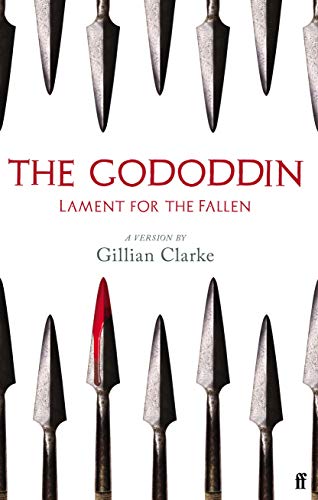
Review of The Gododdin: A Lament for the Fallen Translated By: Gillian Clarke
By: Michael A. Arnold

So,
recently I had Covid. I genuinely do not believe numerical scores can
stand for complex opinions but if I was to give one: 0/10 - would not
recommend. At least it gets you a week off work, I guess.
But
while I was lying in bed, thinking of all the things I could have
been doing instead of being very sick, I had this overwhelming
feeling of loss. I was losing time, that kept slipping away so
quickly even though being ill is boring, and I could have been doing
so many things instead. Loss is very much a theme in the poem we are
looking at today too.
Before
the birth of England, the British islands were a warzone. Long before
the English arrived in around 600 AD, when the Angles, Saxons and
Jutes (known collectively as the Anglo-Saxons) from Germany and
Denmark migrated and settled in the south east, there were other
tribes and peoples that called Britain home. Many of them are now
lost to history because Anglo-Saxons wiped out most of them out when
they conquered what is now England, but it was a long process and
there was a lot of fierce and bloody resistance.
The
Gododdin
(or in the original Old Welsh, Y
Gododdin
– apparently pronounced ‘God-oth-in’) is a poem
about that resistance, and in 2021 it was translated into modern
English by Gillian Clarke, who was the Welsh poet laureate between
2008 to 2016. Clarke’s version has breathed new life and
interest into this ancient poem, but if it will become a commercial
success with the general reader like Seamus Heaney’s Beowulf
or Simon Armitage’s Sir
Gawain and the Green Knight
still remains to be seen. At the very least this poem does deserve to
be more widely known, read and appreciated.
This
is a bilingual book, with the original Old Welsh is on one page and
the English translation on the opposing page, which is something that
should really be a lot more common when a book has been translated.
Also, I do not know Welsh, and certainly not Old Welsh; this is (for
me personally) not like reviewing Armitage’s Sir
Gawain
or the poetry of Catullus, where I either already have or can easily
access the original text, and I can read both Latin and Middle
English well enough, especially with the help of a dictionary or a
glossary. As such, I can only be reading and reviewing The
Gododdin
as a casual reader. I do not know very much about the history of the
original text, or the historical context it was written in.
Apparently
historians know little for sure about this time period as well,
making the text of Y
Gododdin
quite mysterious. We think it was written by a Brythonic poet named
Aneirin, someone we do not know very much about. The poem, in the
form we have it, was written in Edinburgh, Scotland, sometime in the
13th
century AD, but the poem itself is much older - dated to about the
7th
century AD. It is not an epic poem like Beowulf or the Iliad, a
narrative based around a theme, but instead it is a series of laments
to the fallen after a battle at ‘Catraeth’ (maybe
somewhere in Yorkshire) against the Anglo-Saxons.
The
Britons lost that battle but it is unknown how many people were
killed, and strangely not even the poet seems to know either: at some
points it is suggested three people survived, at some points one
(presumably the poet himself). He also simply gives the number three
hundred people in connection with the battle, but it is unknown if he
means three hundred Briton lords leading their own soldiers against
the Anglo-Saxons, or three hundred people that made up the entire
Briton army, or three hundred people combined from both the Briton
and Anglo-Saxon army. It is also not known exactly where this battle
occurred. With three hundred being such a prominent number in this
poem, and it is a series of elegies (basically poetic laments) for
dead warriors, and the poem is so long, you might have assumed that
there would be three hundred stanzas – fitting into some kind
of theme, but there are only one hundred stanzas and less heroes than
that named and lamented. There are a lot of questions marks, and we
may not (ever) fully understand all this fully.
But
when reading this poem it is easy to feel a strong sense of loss and
what once was. Close your eyes and you can almost imagine the people
being mourned, as you listen to this poem being spoken in a mead
hall. Many of these stanzas feel very heartfelt, and feeling the
emotion is very easy. It is almost like you yourself knew these dead
warriors in a past life. This is a series of elegies, but The
Goddodin
is also a long series of little snapshots of different people’s
personalities that the poet cared for deeply, and so reading this
poem is an emotional experience.
In
her introduction, Clarke says that she made no attempt to recreate
the poetic beauty of the original poem. This might be true, but there
are still some really beautiful lines and stanzas here. For example
stanza 29 to a warrior called Isag begins:
Isag,
esteemed man of the south, his
manners
smooth as summer seas,
genial
and generous
as
flowing mead.
There
are also small details that are genuinely mysterious. In stanza 99 we
have what might be the first ever reference to King Arthur:
He
fed ravens on the fortress wall
although
he was no Arthur
And
that is it, and what this could mean and who this Arthur is has left
scholars puzzling ever since.
But
despite all this mystery and beauty, it is not easy to read page
after page of elegies with basically the same or similar styles and
conventions in a single sitting. It might be easier to read this poem
piece by piece, putting the book down for a while between bursts.
This is absolutely not the fault of the translator, or really the
poem, it is simply the nature of this type of poetry –
especially considering we do not have any real connection to the
people named here, like the original audience would have.
That
original audience, and their culture and everything about them, is
irreparably lost. As such, this poem is a kind of a message from an
almost forgotten past. A kind of indirect ‘we were here once’.
This poem is a eulogy, a style of poetry usually written to remember
the dead, and it has since become a eulogy for culture it came out of
because of the cruel of history and its scythe. The sense of loss
here is not just from the content or words themselves, but the loss
of the world this poem come from.
If
you are interested in British history and medieval literature then
this is certainly a book to look at. It is different, and it is well
written – it is exactly the sort of thing that would have
inspired J.R.R Tolkien like other literature, Norse and Anglo-Saxon,
did. However, it might be a slight disappointment too – and for
reasons you might not be able to really explain, even to yourself.