Review of Our Flag Means Death
By: Jenna Sparks

Comedy is synonymous with comfort, and perhaps that's because as the adage suggests laughter is the best medicine. It stimulates many of your internal organs, which then release endorphins. It's even a stress reliever and further increases circulation that can decrease tension. And while some of the most excellent entertainment in recent years has been intense, heart-pounding thrillers and slow-burn mysteries, there's still something to be said about comedy in today's age.
When Taika Waititi's name is attached to various projects, especially in the realm of Disney owned media, it sets off a curious interest among fans. And while we really only see Waititi in smaller roles or enjoyable cameos outside of his directorial and producing gigs these days, his is a welcome face on screen. So of course, when information started coming out about Our Flag Means Death, starring Taika Waititi and long-time collaborator, Rhys Darby, it was easy to get excited about the project.
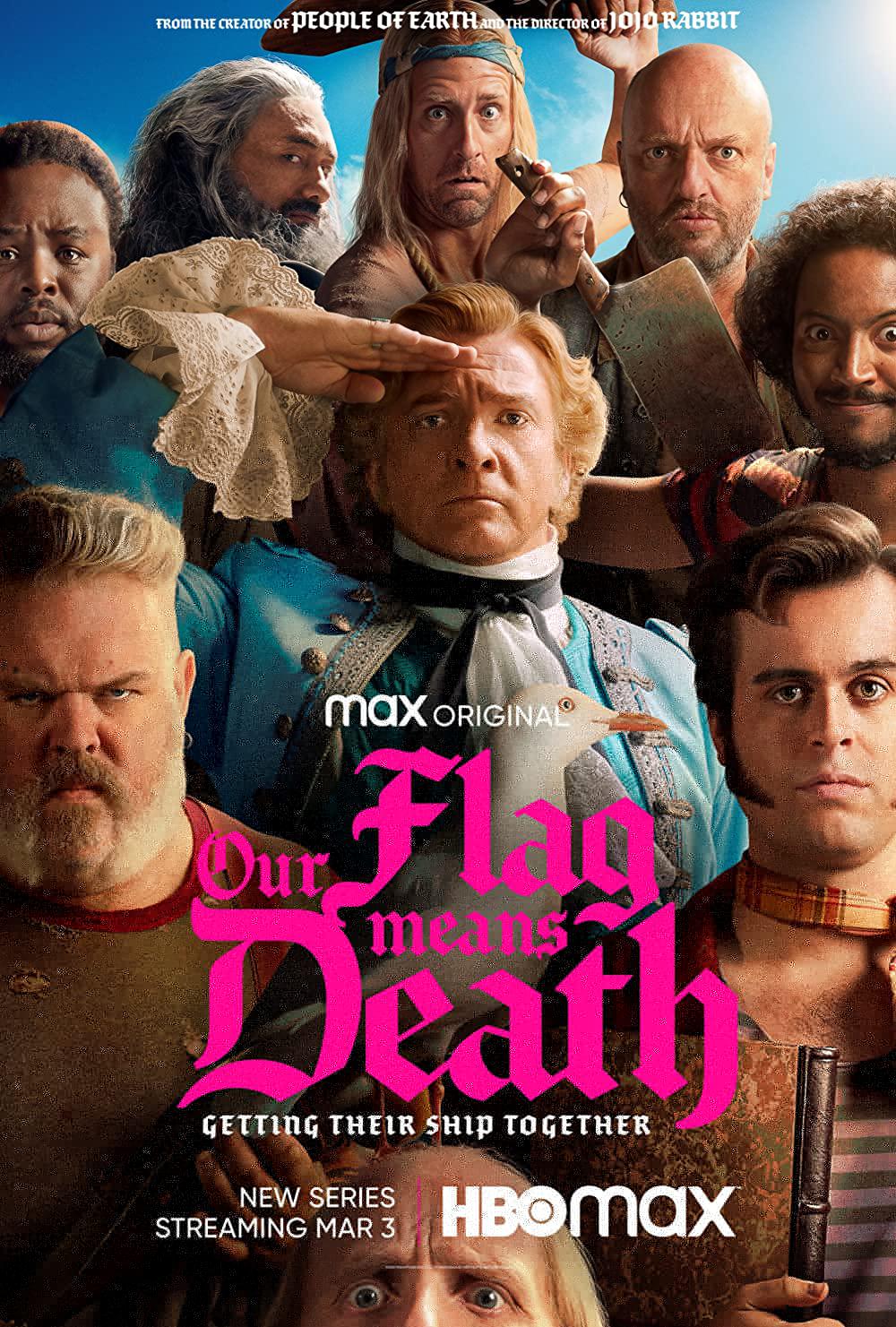
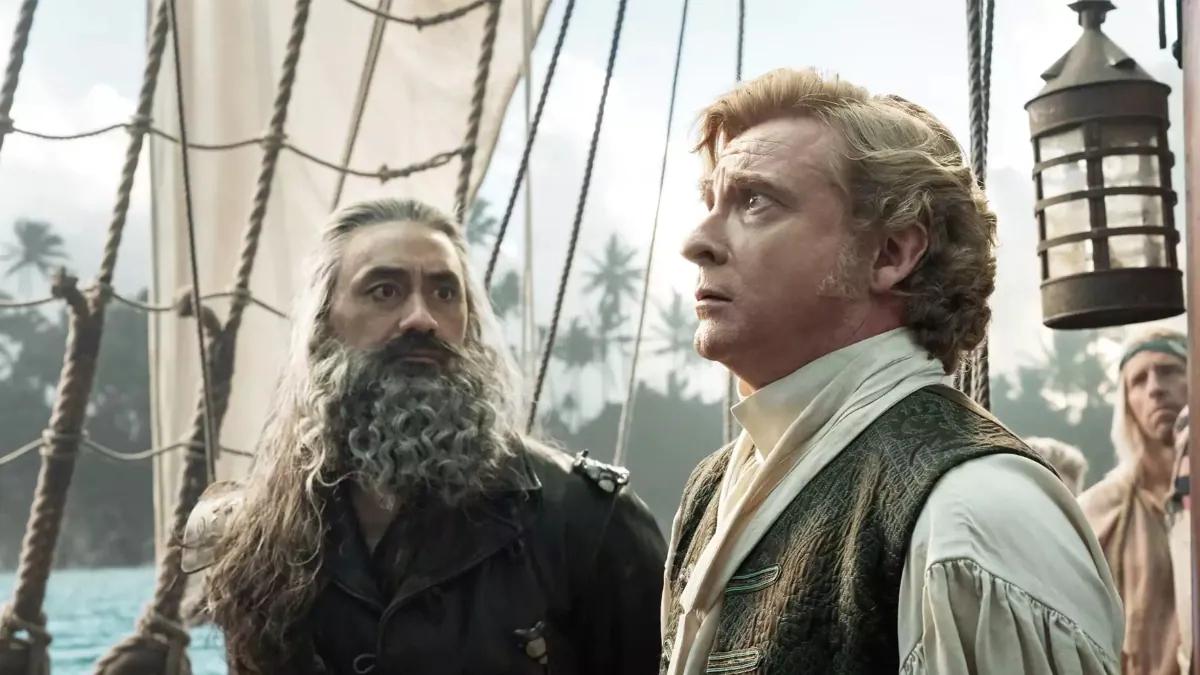
Creator David Jenkins pitched the series as a historical pirate rom-com, and there is no lie to be found in that short summarization. The story revolves around real people, the Gentleman Pirate, Stede Bonnet, and the notorious Blackbeard, also known as Edward Teach. Set in the early 1700s, the series takes from historical aspects of Bonnet and Teach's lives respectively, and as with most media depicting real figures, adds a little polish (and omits some of the more problematic aspects of their lives). Darby plays Bonnet, a former landowner from Barbados who gave up his life and abandoned his wife and children to seek a life of adventure and piracy. While the series plays off the trope of Bonnet having experienced a mid-life crisis (played by Darby, who is in his late forties), the actual Stede Bonnet was in his late twenties and wouldn't even reach age 31.
In both the series and reality, Bonnet had a ship built, named The Revenge, and hired a full crew, even going so far as paying them wages, something relatively unheard of in piracy. He also met Edward Teach and the two sailed together for quite some time. Bonnet, again in both the show and real life, allowed Blackbeard to captain the Revenge for a period.
While the series also depicts other real figures from the time, there's an obvious whimsy to the respect of reality and fiction, including Blackbeard sporting an ensemble that is nearly identical to Mad Max's in "The Road Warrior". There are plenty of modern-day nods without ever taking the audience out of the setting. Admirably, the series utilizes the same technology as "The Mandalorian", in which the soundstage hosts the ship's set that can be taken apart and arranged for necessary angles and shots, in front of projected LED walls featuring ocean-scapes, further allowing audiences to succumb to the fantasy of being on the sea in 1717.
While we can appreciate the set design and costuming, the series' strongest regards come in the shape of the brilliant cast. As mentioned, the series stars Taika Waititi as Blackbeard and Rhys Darby as Stede Bonnet. Additional featured players include Joel Fry (Game of Thrones, Cruella), Ewen Bremner (Trainspotting), Nat Faxon (Oscar Award winning writer of The Descendants), Con O'Neill (The Batman), Kristian Nairn (Game of Thrones), Rory Kinnear (Black Mirror, Penny Dreadful), Vico Ortez (Everything's Gonna Be Okay, The Sex Lives of College Girls), Samson Kayo (Truth Seekers (underrated series that should never have been cancelled)), Matthew Maher (Captain Marvel, The Killer Inside Me, Clerks (TV Series), and small roles in Dogma, and Jersey Girl), and a plethora of phenomenal talent. In an interview, David Jenkins expressed the ability to discover these players gifts outside of the source material, something you can clearly see in the evolution of the ten-episode first season, and something he has said he hopes to be able to expand upon should the series return for a second season. There is something organic about the way each actor takes on their appointed characters, and it always feels like the actors have played a major role in shaping the character and their humor and comedic timing. There's a cohesion to their dynamic, as well; each actor seems effortless in how they play and riff off the other, very much like both the film and series that share the same name, What We Do in the Shadows, wherein both main casts fit together with such ease and delight, you couldn't fathom the operation of the driven stories without a single one of them.
While it is worth noting, and on the subject of, the humor is very reminiscent of What We Do in the Shadows, which is also produced by Waititi (who penned and directed the film in which the show is a spin-off of). It's the near absurdity of the scenarios that allows the humor and characters to shine in plots that are otherwise typical and formulaic. While Our Flag Means Death features a unique overall storyline, the episodes feature ideas that aren't anything special. Silly shenanigans galore, jealous rivalries, misunderstood bad guy turns good, and so on. While that may sound like a negative notion regarding the series and its writers, it's actually its strength. Because at the end of the day, the series is a romantic comedy where the gimmicks are the silly adventures, not the characters themselves.
From nearly the first episode, there's the faintest idea of what the show is gearing toward. It only takes a short time for the audience to see the comprehensive characters unfolding as each episode passes, and it easily becomes a haven for viewers.
In many LGBTQ stories put into mainstream media, there tends to be a conservatism that to a lot of people feels radical but is ridiculously biased. As Alexandra Iciek puts it in their feature article regarding authentic queer representation, "In a big blockbuster hit, you can be queer as in 'first gay character' queer, or queer as in 'young and confused' queer, or queer as in 'it's all in the subtext' queer." It's something we see time and time again, and while a vast array of queer stories are more important than ever, we see repetitive patterns, particularly in telling stories of trauma associated with queerness. And this is the wonder of Our Flag Means Death. It is not a gay pirate show, but rather, stories that feature queerness in unapologetic means. The conservatism regarding budding relationships is not built on catering to homophobic audiences with subtext that can easily be disregarded or ignored, but rather in allowing audiences to see characters coming into their own, beyond their romantic desires.
Taking the LGBTQIA factors out of the story, we are, again, left with a romantic comedy. And most romantic comedies feed the narrative that our characters are singularly dimensional and only exist to court their romantic interest. While times have shifted and are gradually evolving, it's absolutely refreshing to see the stories in Our Flag Means Death get the care and consideration they deserve.
When you're a queer person watching media with any LGBTQ representation, you tend to go in with a hesitant hand placed over an eye; what kind of jokes will be made or what kind of distress will be used? How will these characters ultimately suffer? Will we fall into the wide array of tropes featuring the "bury your gays" model or "queer-bating"?
To summarize one tweet that perfectly encapsulates what this show means for its LGBTQIA audience, "It really hasn't hit me until now that Our Flag Means Death gave us exactly what we needed. Every queer kid understands queerbaiting and has been hurt by it, and Our Flag Means Death flipped all our fears and created an incredible love story where we have people like us actually being happy."
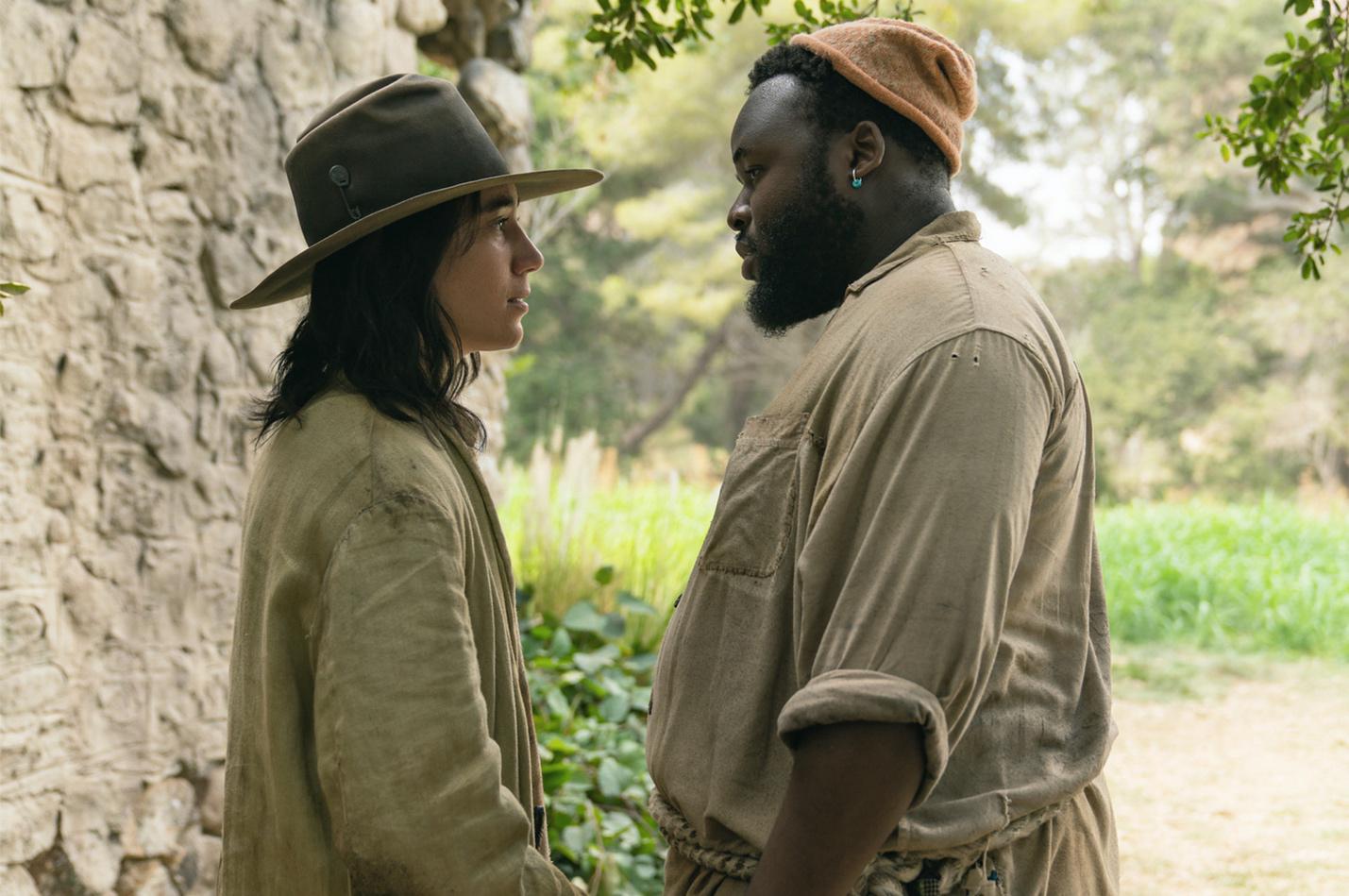
Not only is the cast and crew made up of many LGBTQIA actors and writers, non-binary actor Vico Ortez plays Jim, a non-binary pirate seeking revenge against those who killed their father. In an interview, Vico said, "Well, when I first read the script, I cried. I was like, 'I can't believe that I'm not even asking for this to be a thing.' In part, it's because we had three non-binary writers in the writers' room. So, there's already this space in which this character is being nurtured and taken care of. It's not just like, 'Oh, we're going to hire a non-binary actor to do this. And then they'll fend for themselves.' There was already this space that's created that people already are vouching for this character and their storyline. It felt incredible."
Jim's existence in this world is unquestioned. They are simply a person who exists, like most trans people. After Jim's identity is revealed, the crew aboard the Revenge does lay out a short list of questions regarding how they ought to refer to Jim. Jim responds with, "I'm just Jim," and the story moves on and everyone respects who Jim is.
And at the end of the day, that is the absolute marvel of this show: aboard The Revenge, everyone is free to be who they are without judgement. No one challenges anyone's gender identity or sexual orientation (and trust me, there is a whole other essay to be devoted to homosexuality and pirates). It just simply is, and it brings to mind what Dan Levy had said regarding his character in another widely popular show, Schitt's Creek and "projecting a version of our world that was kinder and more empathetic."
The fact that Our Flag Means Death has cultivated an intense fanbase suggests that there is something so desired in what we see regularly in film and TV. And this is a series that did it with such ease and sensibility and absolute sincerity. There are no ploys or tricks, and while there are plenty of jokes regarding these delightful and beloved characters, the jokes are never at the expense of their gender or sexual orientation or race (another factor that the show tackles) which has set the tone for the future of comedy and that there is no room or need for exploitation for the sake of edginess, something far too many comedians are eager to do. As drag superstar BenDela Crème puts it, "If you can't things funny without alienating a group of people, you're not that funny."
While the fate of the series has been left in the air, fans and creator, David Jenkins, as well as Taika Waititi, are all adamant that the stories left to tell are far from over. Jenkins has said that if HBO decides to call it quits, they will seek all avenues to be able to give us more insight into the lives Stede Bonnet and Blackbeard. While you can easily just hop onto Wikipedia and read up on their real-life counterparts' fates, it looks safe to say Jenkins has every intention of moving away from historical accuracy.
This is a series that has maintained and even gained popularity since it first aired on HBO Max at the beginning of March. While it stands at a pretty solid 7.9 on IMdB, it's clear to see the show was lambasted with 1 star reviews based on the fact that it features gay characters, blaming it on politics and not the fact that LGBTQIA people, just like, live among us and always have (hot take, right?). As one reviewer eloquently puts it, "You can watch this if you want to watch lesbian and gay love. The characters are funny at first and then the guys are all making out with each other.................."
That being said, Our Flag Means Death has plenty to offer, and I'm not alone in hoping that it will have the opportunity to continue to grow and tell delightful stories with such a charming cast. Prior to June, David Jenkins assumed the reason HBO had yet to greenlight a second season is because of a merger planned between HBO and Discovery, which he suspects could be the reason for stagnation. But fans were skeptical that HBO was keeping mum because of a merger, and as many suspected, on June 1st, upon the onset of Pride Month, HBO announced, finally, the show will be returning for season 2!
If you couldn't tell, it's an easy 5 out of 5. Our Flag Means Death can be streamed on HBO Max.