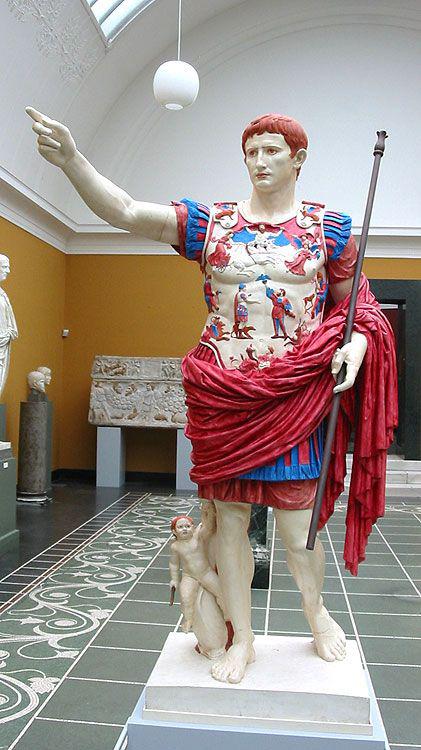
Review of Roman and Greek Statues – yes, they were painted
By: Michael A. Arnold

Imagine this: you are transported back to ancient Athens or Rome for one day – what would you see and do? In Athens, you might go down to the harbor and drink wine, watch the sun setting over the Mediterranean sea. In Rome, you might want to relax in the forum, watching life move all around you.
With the war in Ukraine, and everything else going on, this is probably useful to do. Just to keep yourself sane. In our fantasies we tend to imagine places like that as being quite serine. Unless you are into the wars and the really big events, you might have imagined pearly-white marble streets filled with happy people, surrounded by grandeur and opulence.
It was not like that. With Rome, there are a lot of actual Romans writing at that time about how noisy, dirty, and dangerous the city actually was. Some people might have heard the quote from Emperor Augustus saying 'I found it a city of bricks, left it a city of marble' but that is far from being actually true.
But the center of the city must have been nice, right? Look at all those statues! Here again is a bit of a misconception, one thing you would not see (strange as this might sound) are those famously purely white and marble statues. It must be said, like with the statue of the emperor Augustus at the top of this article, the image of the white marble statues does capture something powerful, and it is very striking visually, but it would not have looked like that in ancient times.
We get the idea of white marble statues from Renaissance sculptures, who were copying Greek and Roman models as they had them. But we know now that originally the classical statues looked something like this: It is easy to see where the white marble misconception comes from. Over the years the old paint slowly flaked off, leaving just the marble underneath. Then when the legacy of Ancient Greece and Rome began to be appreciated again during the renaissance, all they saw was the white marble – and so the renaissance artists like Michelangelo copied that, not knowing, or suspecting they were painted. Evidence of paint was only recently discovered, and if you were not looking for the paint that had once been there, how would you ever know?
That classical statues were painted was first discovered in 1980, in Munich, called by a then masters student Vinzenz Brinkmann. He was studying the statues, using a special kind of ultraviolet lamp, apparently looking marks left by workman's tools, but instead he noticed signs of 'polychromy', or different colors of paint being used in the same place. However, which is the surprising thing, even when he took the lamp away he could still see flakes of old paint on the statues with his own eyes. The evidence had actually been there the entire time; it had simply never been noticed before, somehow, even though they had been looked at for over a thousand years.
In another part of the world, in 1962, archaeologists started to dig in Anatolia in Turkey, at the site of a lost city known as Aphrodisias, and eventually wound find a cache of ancient Greek and Roman artefacts. When Mark Abbe, an assistant professor of Ancient Art at the University of Georgia, visited Aphrodisias in the year 2000 (archaeology takes a long time to uncover a site, and there are some excavations are still going on there now) he also found that many of the statues that had been uncovered also had flakes of colored paint on them. There were tiny flakes of red on the lips, black on the hair, and even the remains of gold paint. Based on research around this, archaeologists have painted a copy of the famous statue of Augustus you can see above.
Many might find this, strange because we are so used to thinking of these statues as being clean, with just the marble showing. Knowing that they were painted might be even more jarring. It does not look right at first; the paint used looks too vibrant, and too amateurly applied. Some might think that the statue above even looks a bit gaudy. However, it is what research has suggested they actually looked like in the classical era.
Instead of being pearly white, the statues like the city around them were full with color, and the seemingly primitive use of colors suggests that accuracy was not the most important thing, but visibility was. Statues, especially when they are things like emperors or important figures, are often political objects. Only important things and people had statues made of them after all.
This comes to what has been called a 'myth of whiteness' about the classical world. Both in terms of art and also the other kind of whiteness. Rome itself was not multicultural, but it was multiethnic, and so long as you were a citizen the color of your skin did not seem to matter much. There were soldiers from Syria and North Africa posted on the most northern frontiers, like Hadrian's Wall, and there were emperors from Africa. With ancient Greece, Homer speaks of the people of Ethiopia with nothing but praise, and it is thought the famous writer Aesop was an Ethiopian. This might also unsettle traditional ideas of the Roman empire and the culture of Ancient Greece, but they point to the ancient world being like another planet, one far removed from what we might expect of it, and that we should try to understand it more.
As we learn more about the ancient world the more strange and also somehow familiar it seems to us. Painted statues are just one example, there will be more. What we cannot do is judge the ancient world by the standards and the morals of the present, doing that is both ahistorical and unfair on the people who lived at that time. It has been 2000 years since the glory of Rome, and even longer since the glory of ancient Athens, and attitudes can change generation to generation – often in quite big ways. What is true of civic issues is true of artistic tastes. People today might even prefer the white, clean statues in the imagination of Renaissance artists – but the Ancient Greeks and Romans would not have. While history itself cannot change, our understanding of it does all the time – and in a way, this is true of our understanding of art more generally too.