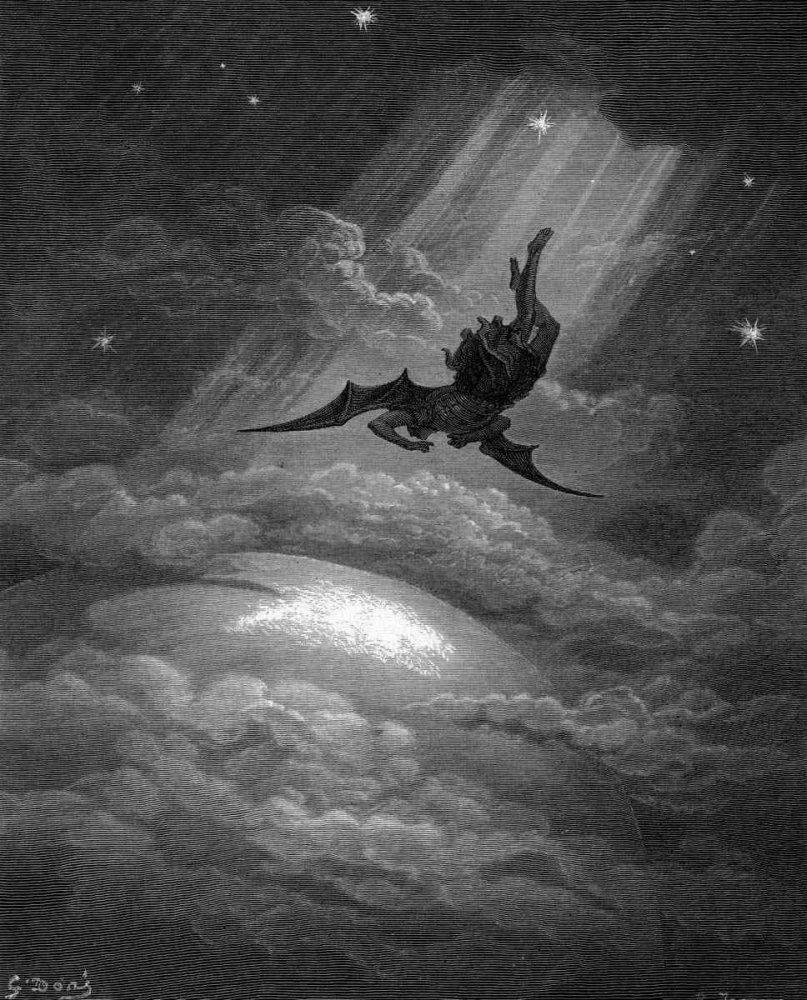
Review of Gustave Dore's Satan Descends Upon Earth
By: Michael A. Arnold

Every time I see this, and I can hear screaming. I can feel the anger.
For all the theory, history, and symbolism that you can refer to when talking about a work of art, it is important to remember that (most of the time) art is a visual experience. Something that can hit your emotions, even if there's no deep meaning behind it, can still be powerful. A picture is worth a thousand words as the saying goes.
I find that is true of a lot of Gustave Dore's works. Often they are depictions of scenes from famous works of literature. He has illustrated scenes from works by Dante, Shakespeare, Cervantes, and from the poem The Raven by Edgar Allan Poe (I don't know why). Here what we are seeing is a scene from John Milton's great poem Paradise Lost. At this point in the story, Satan and the rebel angels have been roundly defeated by God and his forces during the War in Heaven. He has fallen to Hell – a strange and dark place that in Milton's poem is beyond space and time, very far removed from the universe. However, when Satan regains himself in the lakes of fire, he makes a very interesting comment to the effect that if God was really all powerful he could have simply unmade Satan and his rebel angels like the flick of a light switch, or instantly changed their nature. The fact they were defeated and cast out means that, even in some small way, Satan's rebellion has 'made God sweat' so to speak. So, trying to find another advantage over God, Satan has decided to corrupt the new creation on the cosmic scene: humanity. Sneaking back into the universe, Satan finds earth and moves in.
This is quite an oversimplification of Milton's opening, and the poem has a lot more interesting and actually really strange details. Things like the possibility of life on other planets (this poem was written in the seventeenth century), that the angels are both genders, and also, the rebel angels set up a huge parliament called Pandemonium that seemed to mirror the rebels who overthrew the Charles II and tried to establish a republic in England, Milton was one of those rebels himself. There is more than just that too, Paradise Lost should really be read more.
But that was to give the context of this piece, an engraving done in 1866 – mostly for illustrated editions of books. Dore's engravings for works of literature have become recognized as serious works of art since, and when looking at them it is easy to see why. They are masterful, and really tend to capture the feel and tone of the scene they are illustrating amazingly well. Here the contrast between darkness and light, a big theme in the poem – with stars dotting the darkness of the clouds to give it some sort of thematic balance, makes it difficult to not imagine something like the engravings when reading the scene.
As the bright light of the sun beams down, in long shafts of light through the clouds, on the small world below, Satan himself is flying but looking like he is still in some way falling, with has his target in sight. There is a sadness to this image, but still a majesty in the not-quite illuminated Satan. In the poem Satan is the hero, and he's a fantastically charismatic protagonist, and you can see something of that here. Satan looks small against the background of creation, but he is also obviously huge since the earth itself is what we are seeing. He flies, but it looks like he is falling, almost like he is not in control of his own actions. There is a lot going on, reflecting the complexity of the poem.
And honestly, sometimes it is fine to look at something and appreciate the skill that went into making it, and the striking beauty of it too.