
Review of Snow Country by Yasunari Kawabata
By: Michael A. Arnold

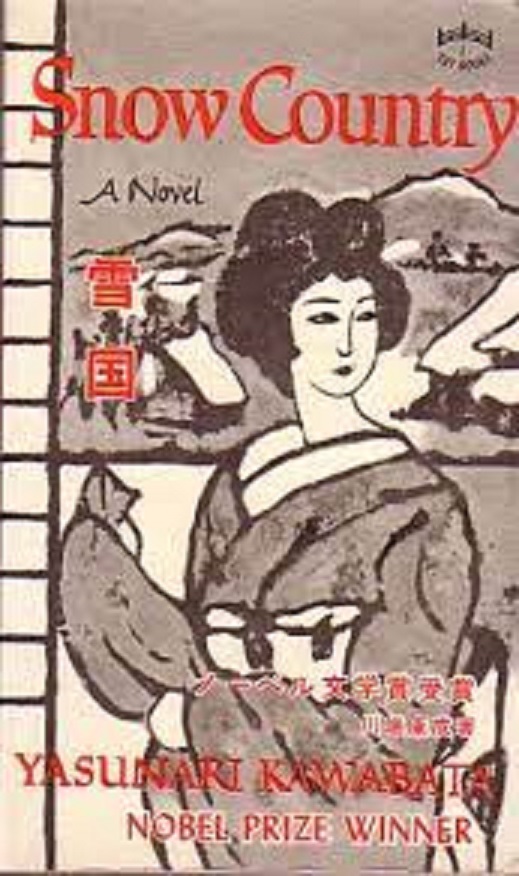
Yasunari Kawabata's novel Snow Country, written in 1948, was first translated into English in 1956. It won Kawabata the Nobel prize for literature in 1968 and has recently been given the imprimatur of Penguin's Modern Classics series, cementing the novel's status as a classic, and meaning it can continually be in print for people to easily buy and read it.
Good! It is an amazing novel, and is easily a serious rival to some of the best books from the west. It is delicate, deliberate, and poetically hides a lot of depth, which makes it more than worth reading – it is worth rereading. The images and descriptions are sonorous and subtle, and there is something about so many of the scenes that makes them somehow memorable even when they are not on the surface very important. That is the first thing the reader notices about the novel, the sheer power and majesty of the language - which seems to radiate, like the winter coldness of the first two lines:
There is something stark and cold in the repeated use of the word 'the' in English here which perfectly captures the bleak hardness of the thick snow all around us in the Snow Country.
Of course, since it is a translation from Japanese, a language so unlike English, the translation is going to be a flawed delivery of the original – which is true of all translations in some way. Even though I do not speak Japanese, nor have even seen a copy of the original text, even I can see the translation by Edward Seidensticker has awkward phrasing in places. Given that the Seidensticker translation is now over 50 years old, I think this novel is owed a new translation just to tighten up the language a little and lend more power to it. A good translation can make all the difference, but the current translation is not insufficient. The words 'it could probably be much better' come to mind, just to smooth out some of the tiny bits of grit that might still linger here. Despite this, Snow Country is an exceptional novel, but it is a novel that will sadly be easily unappreciated. Snow Country is about small moments and a complex relationship between two deeply unhappy people.
The novel is very good at giving information, ironically since it is a novel, without words - in a sense; often it is done through described images, symbolism and the way the characters interact. Because of this, is hard to sum up the plot of the novel for people who have not read it. It is very easy and also wildly inaccurate to call Snow Country a love story, but this is how it is advertised. Shimamura and Komako are in a sexual and romantic relationship, but it is not really very romantic. Their 'love' is not idealized, it is troubled and distant. Shimamura is already married, and his wife is so distant from both him and the 'Snow Country' she is a feature in the background rather than a character. She is only mentioned once or twice. Shimamura is using the 'Snow Country' to get away from her, and because the Snow Country is so different from his home it is like he is stepping into another world entirely.
Shimamura is from Tokyo which by the time this novel was written and set it had become a large and modernised city, and he is an intellectual - and something of a dilettante or bohemian. He writes criticism of modern European drama, a niche market and interest in 1940s Japan, but one reflective of the westernisation that Japan was going through when this novel was first published. This westernisation is one theme running throughout the novel, and it has a major isolating effect on the relationship between Shimamura and Komako – the 'love interest'.
Komako is a country Geisha, in a very rural and traditional part of Japan. The 'Snow Country' is in the Niigata prefecture, on the north shore of Japan facing Korea, and is still a quite conservative part of the country. The village Shimamura goes to, and where Komako entertains is noticeably without many modern comforts, and so the modern and western-interested Shimamura is very much the outsider here. His 'world' is global, Komako's world is small and local, but she has learned to fit herself in to it well. She acts as if she is in her place, and will remain a Geisha until she can retire like other older women around her are doing. But is more a sad acceptance than anything else, her entire life is spent entertaining guests at the spa with playing music, partying and drinking, but she is clearly unhappy to be living this life. She is trapped and does not know why or how.
Toward the end of the novel Komako moves in with a family in the village, and while they sleep downstairs together in one room, she is given the master bedroom upstairs. While living in his house she is almost always getting drunk and bringing men home, and at times she comes across as quite selfish and ungrateful, but we can understand why she is like this. This is the thing that really sets this novel apart from, and above, so many others, it makes its characters painfully human, and in a way not many novels are willing to do.
It seems to only really be the sexual side of Komako's job that draws Shimamura to her, and this is made explicit in the first scene with them together. Shimamura feels Komako's breasts and bluntly says he wants to sleep with her. He is creepy, and there is a very noticeable imbalance between the beauty of the language and the sad nature of this relationship. This may even put readers off the novel if they are expecting something more innocent and sweetly passionate, but it is the first indication that Snow Country is a mature – adult novel. Not to suggest that the novel is sexual, all the sex in the novel happens between scenes, it is adult because it deals with sex and themes in a mature way. It is even, in a sense, objective (the writer never suggests his own opinions on the characters and their actions) in a way that might even be described as Homeric.
During the novel we do not leave the Snow Country. It is an Othered place (to borrow Edward Said's term) and the people who live there are 'of' the Snow Country in a way that visitors like Shimamura are not, even though it is in the same country. This makes Shimamura isolated in a place that is itself isolated. He is also isolated from the truth in a way. Because of this a blissful unconsciousness about the entire novel that feels rather dream-like. For all his pretensions, Shimamura seems so blissfully unaware of his own ordinariness, seeming to imagine himself as an intellectual ignored - like a Japanese Prufrock. Things also happen around Shimamura and Komako, without them being much noticed by this 'world'. With all this in mind, the last image of the novel is an image of the universe, and this could be interpreted in a few ways, depending on your own feelings towards, and interpretation of the novel.
The novel takes place over two years, and we see the Snow Country during different seasons. We start with winter and the unusually thick snow that symbolically freezes everything in place, like how the characters feel frozen in place themselves, but they are crucially not fully conscious of this face. Winter takes up the whole of part 1, but in part 2 the seasons progress and the landscape changes. Despite this, it is always referred to as the 'Snow Country', keeping its essential coldness forever in the background – in a way the characters cannot see. Similarly, the novel repeatedly stresses that the characters may not even really see each other, as it often shows them looking at each other through mirrors or reflections. In the very first scene of the novel Shimamura looks at the young Yoko (another female character) through the reflection in his train window, in a line cleared of cold mist by his hand – he is looking at her, but not really looking at her at the same time. This metaphor of seeing and not seeing is essential to the novel, but his line of clear glass in the middle of a misty window pane has a second metaphorical level. It is suggesting the clear reality between two misty, uncertain worlds – like the barrier between the two main characters, Shimamura and Komako. If Yoko is an image of Komako's younger self, there is the further implication that her problems started years before. Yoko's place in the novel is very interesting. In a way she acts as in an 'as you are, as I was', and a vision of Komako's past. The novel subtly shows Shimamura having a lustful attraction to Yoko too, but it is never acted on. She herself is not innocent, but she is unaware of the reality of the Snow Country like Komako is aware.
The two women together become a kind of representation of Shimamura's own failings as a person. He is always interested in that very Japanese theme, the melancholy over the transience of life, and while he is always meditating on it throughout the novel he cannot seem to talk about it. Shimamura is as a person not incapable of love, but he is incapable of expressing love and other emotions to another human being, and Komako similarly has great difficulty expressing those same feelings but in a slightly different way and for a different reason. This is where the subtle power and maturity of this novel solidifies itself.
For all the beautiful language, everything is cold, distant, and is in danger of disappearing in Snow Country. It is very strange, all things considered, that in a Japanese novel released in 1948 there isn't a single mention of WW2. However, the war is there somewhere in the background, subtly influencing the characters and setting in an unconscious way, just like everything else important in Snow Country. Because of this difficulty the novel is not very accommodating, and it doesn't have much of a story. It has a plot and do things happen, but they happen in a way that might to some feel incidental or without meaning unless you are really paying close attention to it. Everything in the novel is drenched in symbolism, and because of this it is obscure. It is also quite depressing. Komako is seemingly always drunk and Shimamura is very sleazy. For all the subtly of its themes and lyrical beauty of its language, the novel is readily depicting the less pleasant side of life. Old Geisha women end up bored in homes bought for them by old admirers, young men die of illnesses leaving loved ones and girlfriends behind, and people find themselves unhappily trapped in a place in society, unable to say why they are unhappy and unable to find an escape.
During this review I have stressed, over and over, three things about this novel that really do need to be stressed. That the characters are in a very real sense unlikeable on the surface - that this is a major part of the novel that readers are just going to have to accept and accommodate, and that the novel is very symbolic and subtle, and so should be read very slowly, and with the utmost care. But after saying all this, if you can find yourself accommodating the difficulty, Snow Country is without a doubt one of the finest novels of the 20th century. It reaches the darker parts of the human condition with lyrical and beautiful writing, and with very grounded, and expertly characterised real people living within it. It is able to talk about the parts of life we do not find very pleasant to even think about, and it is a statement on our own isolation in the vast, blind cosmos. We humans are all alone and essentially unhappy on this small planet together. It is, in short, a serious book for adults.
The train came out of the long tunnel and into the Snow Country. The earth lay white under the night sky.