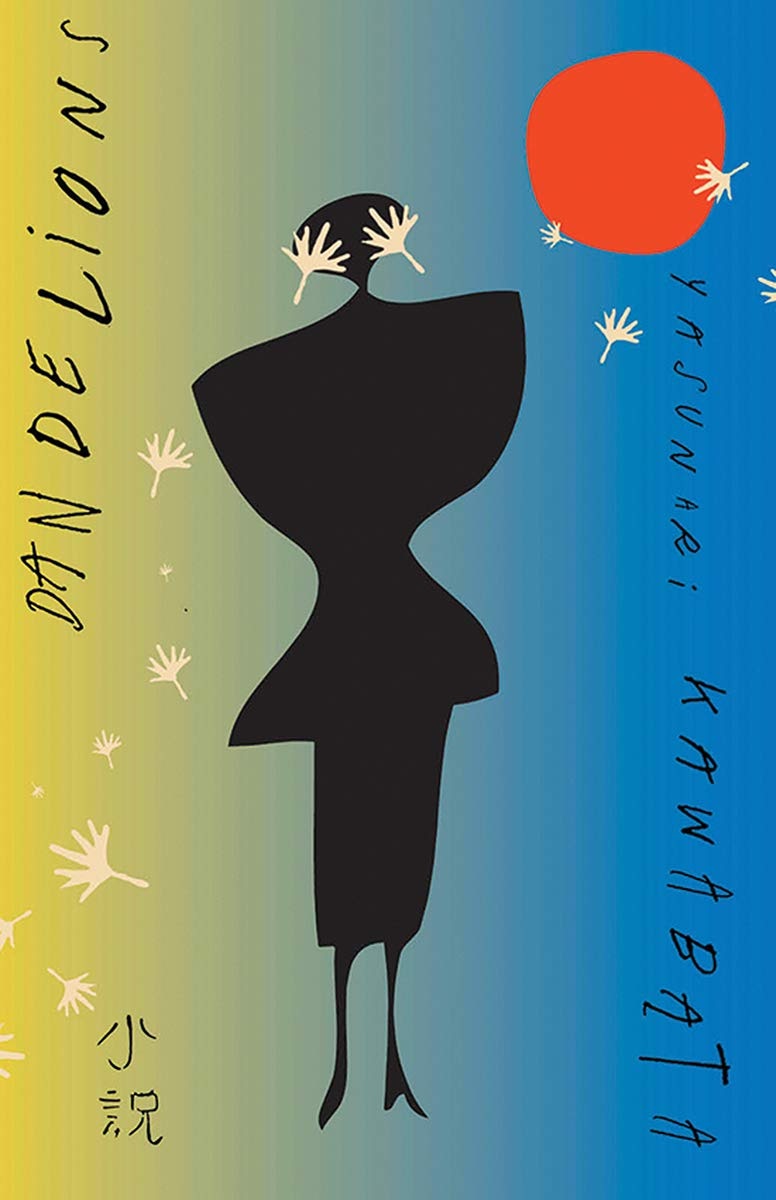
Review of Dandelions by Yasunari Kawabata
By: Michael A. Arnold

It is difficult to even find much information about this novel's manuscript. It may have been found with the author following his mysterious death, a death that seems to have been intentional. The subject this month is Yasunari Kawabata's last novel, Dandelions, originally published in Japanese 1972 has recently been released by Penguin Publishing - in the summer of 2019. This is probably the first wide release of this novel in English –it was first published in English in 2017, but it is difficult to find a copy of this edition. Considering Kawabata won the Nobel Prize for literature in 1968 for the staggering beauty and complexity of his novels, especially Snow Country (one of my personal favorite novels), this seeming reluctance to even look at his final novel is a bit mysterious.
If the tone of this novel is anything to go by, however, Kawabata's last days were spent in the middle of a deep sadness that he never came out of. The whole novel has a feel of the world being somehow wrong, and that the characters are isolated from each other in a way that is very hard to define. This is not just the difficulty of communication that characterizes Kawabata's work, it is almost like the characters are on different planets, sending occasional messages to each other through the dead void of space.
Kawabata was a complex writer, but a great one - and his greatest work is undoubtedly Snow Country. That is a book that relies on the reader to interpret it - like a sort of written painting, or a long prose poem, and the events of the story are not exactly its focus. It is not a novel where a lot happens, but instead there are a lot of symbols that have to be combined before it is understood. Dandelions is the same.
The entire novel is just a conversation between two characters over the course of an afternoon and a night. These two characters, identified as Kuno and Ineko's mother, have just put Kuno's girlfriend Ineko in a mental hospital because she has developed a strange, and fictional, condition called somagnosia where she cannot see certain objects in front of her for no logical reason. There is a scene in the novel, a memory, of Ineko holding a tennis ball but is unable to actually see it, but sees her own hand behind it instead, even though she can feel herself holding the object. This is a major sign that sight, and people being blind to things, is a major theme here.
However, when reading this novel, it is hard to not feel like something is somehow missing here, and this novel may even be unfinished. Also included in this edition, the Penguin Modern Classics edition, is Kawabata's Nobel Prize speech. His speech is quite opaque, even to a fan like me, with a long section about calligraphy and Buddhism. Calligraphy also appears in this novel, with another inmate at the asylum writing the phrase ‘To enter the world of the Buddha is easy, to enter the world of demons is hard' over and over. Something about this was clearly on Kawabata's mind in the last years of his life, and the two characters talk about this phrase, contemplating what it could mean, during the course of the novel. What it actually means, however, is left very much open, and the reader is left as uncomfortably confused as the characters in it. They are, like us, blind to things.
This is a strange novel to read, because you both want to take it as you would other Kawabata novels – really getting into the symbols and thinking about what it means for the characters, and how to apply that to your own life. But there is also the sense of deep melancholy and emptiness with knowing it is either unfinished or dealing with issues that the writer was personally struggling with – and never resolved himself. There's a deep sadness here, one that is always present.
You finish this book haunted by it. Yes, it reflects the author's own troubled state of mind, and some things are frankly lost in translation, in one form or another. While it is still a fine last novel, but it is easy to feel like he never got a chance to finish it properly. Or gave himself the chance. As such, it is a difficult novel in more ways than just one.