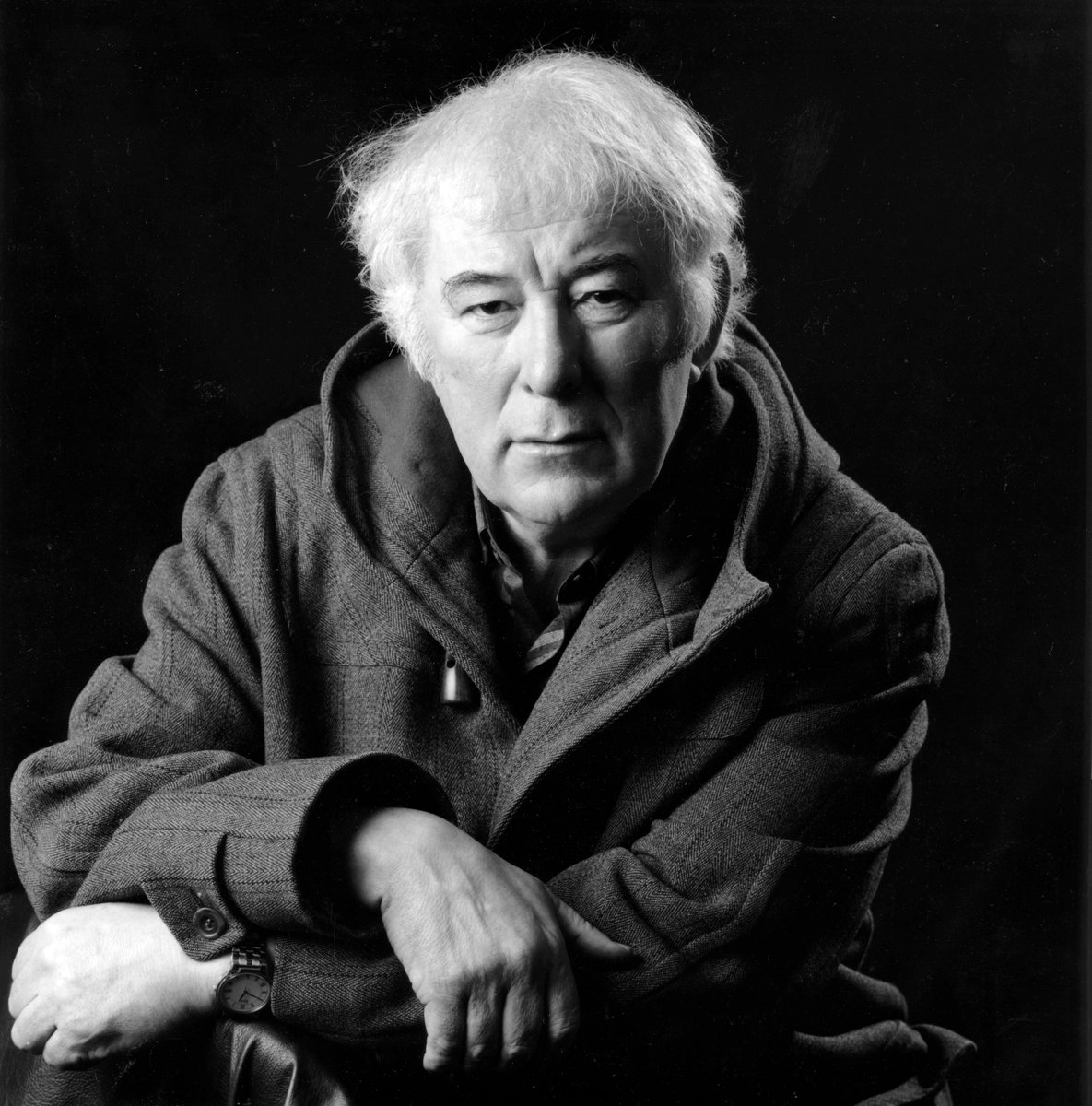
Seamus Heaney the Romantic?
By: Michael A. Arnold

Ever buy a book randomly, and it turns into the best decision you could make?
Recently, when I was taking a little break, I have been reading a lot of Romantic poetry (that is Romantic with a capital R, Wordsworth, Shelley, Coleridge and people like that), and found Keats the Poet by Stuart M. Sperry in a secondhand bookshop. It is well respected in Keats scholarship, at least it was back in 1994 when my copy of this book was reissued in paperback for the general reader.
In it, Sperry discusses Keats' understanding of the word 'sensation' as a central key to understanding his poetry. Sperry defines 'sensation' in this context as something very close to consciousness, or the way in which the internal 'world' experiences and interprets the external, especially in relation to things like the aesthetic beauty of nature. Sensation is the process that begins with perception, in short – and this is very similar to the general poetic process throughout the Romantic era. This was, Sperry argues, a central conduit for the creation of poetry for the Romantic poets.
This might be why so many of Wordsworth poems are things like 'Address to a Butterfly' (there are at least two poems with that title in Wordsworth's oeuvre) where he writes poems about very similar images and objects in the natural, or the 'real', world. Wordsworth, like Keats, is always rediscovering and reinterpreting the world through this 'sensation'. They are like memories that are always being reinterpreted, and each new interpretation is the basis of a new poem. When I was reading this I thought that this could easily be applied to the work of Seamus Heaney too.
From his very first collection, Death of a Naturalist, to his very last Human Chain, Heaney was similarly writing about reinterpretations while reliving events and memories in this Keatsian 'sensation' sort of way - very often involving images and memories from his childhood. Take the poem that names the first collection, 'Death of a Naturalist' as an example, the event described in that poem is something Heaney the child could not have understood to the depth that Heaney the poet does when he writes about it. In a sense, Heaney's work is often like The Divine Comedy, a work he greatly admired given all the references to it throughout his life. Heaney, like Dante, is always writing with a sense of duality: there is always Heaney the experiencer of the event and Heaney the poet and interpreter of the event.
In poems like 'Death of a Naturalist', or the much later 'Anaharish', the sensation (the experience) is relived as a way to properly understand the experience through a lens of more mature experience. In this way Heaney, like a Keats or a Wordsworth, is always reinterpreting the earlier sensations of his life and then exploring and learning from them as a way of creating poetry. It is rare for the same event to inspire different poems in Heaney, but the same sensations are touched upon in different ways, and in this we can see a kind of development of understanding throughout Heaney's body of work. Take for example 'Midterm Break' from Death of a Naturalist and 'Funeral Rites' from his fifth collection North. They are both about basically the same theme, death of a close relative, but while 'Midterm Break' is very melancholy and embarrassed, the first line of 'Funeral Rites' is 'I shouldered a kind of manhood'.
Perhaps it is because Heaney is older, both from the Heaney narrating the poem and the Heaney writing the poem years later, but the reaction to the death of the family member are starkly different. Between the two poems, experience has been gained, and something has been learned about the world. This relearning, or reinterpretation of the 'sensation' has 'allowed' the creation of a new poem.
It is worth wondering what the relation between more modern poetry and older poetry is. Obviously, Heaney is not really a Romantic, but what can this similarity in method tell us about the act, and the art, of writing poetry itself?